
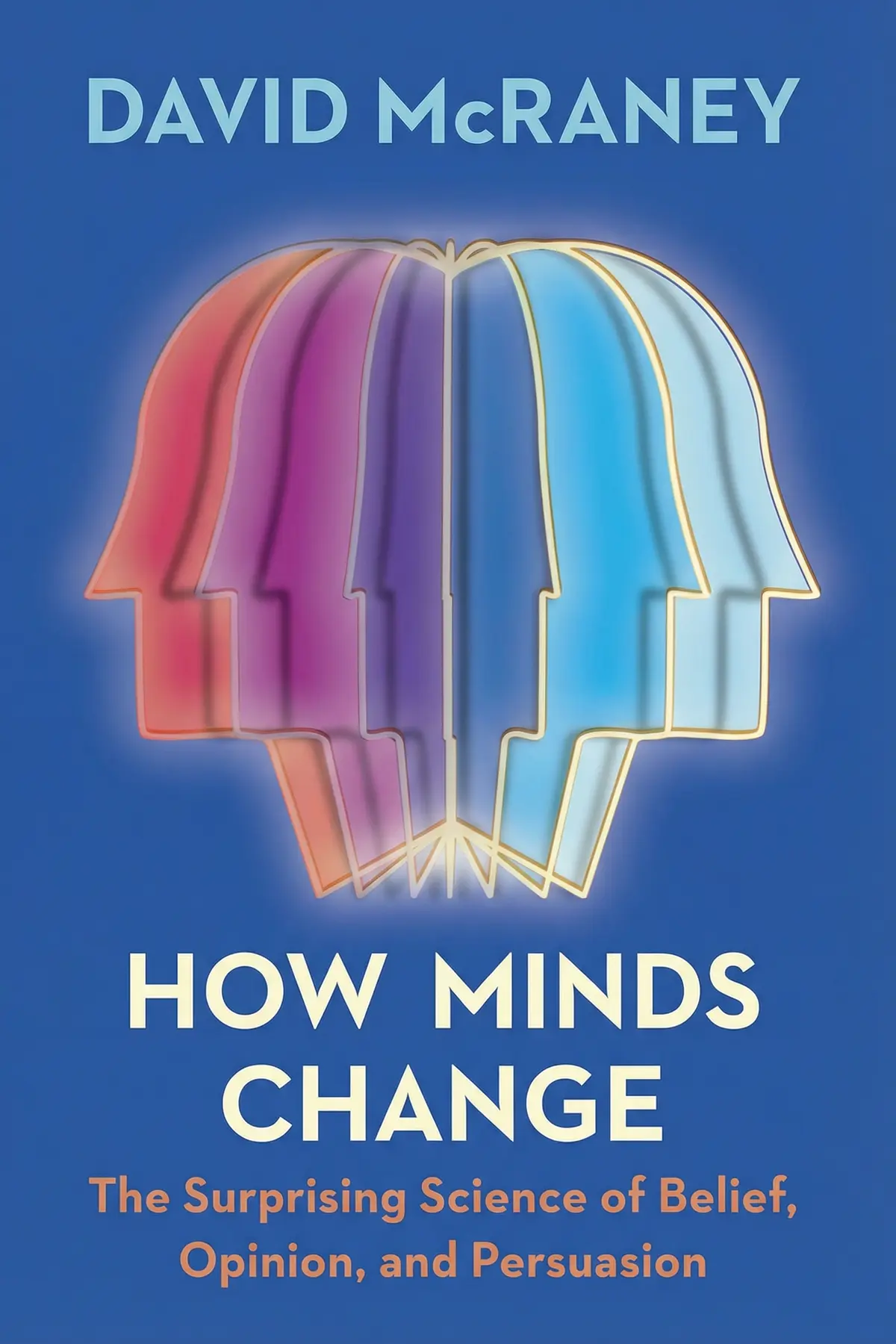
22 min 58 sec
You are Now Less Dumb: How to Conquer Mob Mentality, How to Buy Happiness, and All the Other Ways to Outsmart Yourself
Uncover the psychological traps and cognitive biases that lead us astray. David McRaney reveals how to recognize self-deception, navigate social pressures, and cultivate a more rational, self-aware approach to daily decision-making.
Table of Content
1. Introduction
1 min 35 sec
You probably think you’re a fairly rational person. You believe that your opinions are based on logic, your feelings are triggered by clear causes, and your actions are the result of conscious choices. But what if most of that is an elaborate story your brain tells you after the fact? In You are Now Less Dumb, we explore the humbling truth that our minds are constantly working behind the scenes to deceive us, often without us ever noticing the slight of hand.
This isn’t just about being wrong occasionally; it’s about the fundamental way our brains are wired to interpret the world. From the way we perceive sports games to the reasons we find certain people attractive, our internal reality is often a distorted version of what’s actually happening. We rely on mental shortcuts and biases that served our ancestors well but can lead us into modern traps of mob mentality and poor financial decisions.
Throughout this summary, we will peel back the layers of these psychological illusions. We’ll look at why we see what we want to see, how our physical environment dictates our moods, and why even our own memories can’t always be trusted. By the end, you’ll have a clearer understanding of the mechanisms of self-deception. The goal isn’t to achieve perfect logic—that’s impossible—but to become just a little less naive about the ways your own mind tries to outsmart you. If you’ve ever felt like you didn’t quite understand your own reactions, or wondered why a group of people could look at the same event and see two completely different things, then you’re in the right place. Let’s dive into the fascinating, sometimes messy reality of the human psyche.
2. The Subjective Nature of Reality
1 min 57 sec
Discover how two groups can watch the exact same event yet walk away with completely opposing versions of the truth, revealing that our eyes see what our hearts believe.
3. The Interaction Between Action and Attitude
2 min 02 sec
Learn why doing a favor for someone you dislike might actually turn them into a friend, and how simple physical movements can change your opinion of abstract symbols.
4. The Trap of False Causality
2 min 02 sec
Understand why the human brain is hardwired to see patterns and causes where none exist, leading us to trust ineffective remedies and fall for the placebo effect.
5. The Halo Effect and Generalizing Excellence
2 min 03 sec
Explore the mental shortcut that causes us to assume that if someone is good at one thing, or even just attractive, they must be talented in every other area of life.
6. The Misinterpretation of Emotional Arousal
1 min 54 sec
Find out why a frightening experience can be mistaken for romantic attraction, and how our brains often invent the ‘why’ behind our physical feelings.
7. The Backfire Effect and Belief Defense
1 min 52 sec
Discover why presenting someone with facts that contradict their beliefs often makes them hold those beliefs even tighter, and how we protect our sense of self.
8. The Illusion of the Majority
1 min 51 sec
Uncover the social phenomenon where everyone in a group follows a rule they secretly dislike because they mistakenly believe everyone else supports it.
9. The Psychology of Group Membership
2 min 02 sec
Learn how we divide the world into ‘us’ and ‘them,’ and why we are so quick to exclude members of our own group the moment they stop fitting our ideal.
10. The Impact of Enclothed Cognition
1 min 50 sec
Explore how your choice of clothing doesn’t just change how others see you, but actually alters your own mental performance and behavior.
11. The Limits of Money and Motivation
2 min 06 sec
Find out the exact income level where more money stops making you happier, and why getting paid for your favorite hobby might actually make you hate it.
12. Conclusion
1 min 44 sec
As we’ve journeyed through the various ways our brains deceive us, from the Halo Effect to the backfire effect, the recurring theme is clear: we are not the objective, rational beings we imagine ourselves to be. We are storytellers who use every bit of information—and every lack of it—to construct a narrative that keeps us feeling safe, consistent, and superior. Our minds are constantly taking shortcuts to save energy and protect our identities, often at the expense of the truth. But by becoming aware of these patterns, we can start to catch ourselves in the act of self-deception.
To be ‘less dumb’ is to accept that your first impulse might be wrong, that your memory is fallible, and that your opinions are often more about group loyalty than logic. This awareness is your best defense against the pitfalls of mob mentality and irrational decision-making. In your daily life, try to practice a little bit of ‘mental pausing.’ When you feel a strong emotion or a sudden certainty, ask yourself: ‘Is this real, or is this just a story my brain is telling me?’ Consider the environment you’re in, the clothes you’re wearing, and the group you’re trying to impress.
Ultimately, the goal of understanding our biases is not to become a perfect machine of logic, but to lead a more authentic and examined life. Use what you’ve learned to be more compassionate toward others, knowing that their brains are playing the same tricks on them. Choose your ‘uniforms’ wisely to boost your focus, protect the hobbies that give you intrinsic joy, and remember that more money isn’t a guaranteed path to a better life once your needs are met. By shedding these common illusions, you don’t just become smarter—you become more grounded in reality, and in the end, that is the most powerful way to outsmart yourself.
About this book
What is this book about?
Have you ever wondered why you stay convinced of an opinion even when faced with contradictory facts, or why you suddenly feel more competent just by changing your clothes? You are Now Less Dumb is an illuminating deep dive into the quirks of the human mind, focusing on the hidden biases and irrational tendencies that govern our lives. David McRaney explores a wide range of psychological phenomena, from how we misinterpret our own physical sensations to the way we align ourselves with group norms we don’t actually support. The book promises to strip away the illusions of logic we wrap ourselves in every day. By examining famous experiments and relatable social scenarios, it provides a mirror to our own mental shortcuts. The ultimate goal is not just to point out our flaws, but to offer a path toward greater self-awareness. By understanding how the brain naturally fools itself, we can begin to outsmart our own instincts, make better choices in our relationships and careers, and move through the world with a bit more clarity and a lot less self-delusion.
Book Information
About the Author
David McRaney
David McRaney is a journalist and the creator of the widely acclaimed blog You Are Not So Smart, which he successfully adapted into a best-selling book of the same name. His career spans various media roles, including working as a reporter, editor, and television host, as well as being an active public speaker. McRaney currently resides in Mississippi with his wife.
Ratings & Reviews
Ratings at a glance
What people think
Listeners find the work highly insightful, noting it is packed with information about psychological mechanisms and values its firm grounding in basic psychology. Furthermore, the book is accessible and well-crafted, incorporating a "guy-type" sense of humor that makes it quite entertaining. Listeners also describe the content as fascinating and simple to follow, while commending the author’s ingenious methods for clarifying complex subjects.
Top reviews
Eleni
David McRaney has a way of making you feel like a total idiot while simultaneously making you smarter. If you’ve ever wondered why you keep making the same irrational mistakes, this book lays it all out with a sharp, guy-type humor that keeps the dense psychology accessible. I specifically loved the breakdown of the 'Backfire Effect'—it explains so much about why arguing on the internet is a total waste of time. While some people claim it's just a repeat of his first book, I found the deep dive into narrative psychology and how we construct our own identities through storytelling to be fresh and genuinely eye-opening. The writing is snappy and the chapters are short enough to digest during a quick commute. Truth is, we are all just a collection of biases wrapped in a trench coat, and this book is a great mirror to hold up to your own brain. It’s a fun, quick read that actually challenges you to think about how you think.
Show moreUbolwan
Ever wonder why you're more likely to agree with a crowd even when you know they're wrong? This book explores the fascinating concept of deindividuation and how being part of a group can lead us to do things we’d never dream of doing alone. McRaney’s writing style is punchy and packed with personality, making even the more technical parts about 'Enclothed Cognition' feel like a fun conversation at a bar. I appreciated how he emphasized that being 'less dumb' is about awareness and practice rather than just gathering facts. It’s not just a list of ways we fail; it’s a guide to noticing those failures in real-time. Look, we all want to believe we are objective observers of reality, but this book proves we are mostly just making it up as we go. It’s a humbling, hilarious, and ultimately helpful look at the human condition that everyone should probably read twice.
Show moreCaleb
As someone who spends way too much time on social media, the section on the Backfire Effect was a massive reality check. It explains perfectly why showing someone hard evidence that they’re wrong usually just makes them double down on their original belief. McRaney reminds us that we are essentially animals with brains evolved for survival in primitive societies, not for processing the complex digital world we live in today. This book is insightful and filled with these 'aha' moments that make you rethink every argument you've ever had. I loved how it tackled the delusion that we have a firm grasp on reality when most of our perceptions are just defense mechanisms for our egos. The writing is incredibly engaging and managed to keep me hooked from start to finish. It’s the kind of book that makes you want to buy a copy for every single person you know just so you can finally have a rational conversation.
Show moreWitthaya
After hearing so much about the first book, I decided to jump straight into this one instead. It’s an incredibly easy read that breaks down complex neurological concepts into bite-sized, entertaining anecdotes. McRaney’s clever approach to explaining the 'Sunk Cost Fallacy' really hit home for me, especially regarding how much time I waste on bad movies just because I paid for the ticket. My only real gripe is that it feels a bit repetitive if you’re already familiar with basic behavioral economics or have read 'Thinking, Fast and Slow.' To be fair, the author isn't trying to write a PhD thesis here; it's popular science meant for a general audience. The tone is conversational and engaging, which makes the rather scary reality of our mental shortcomings much easier to swallow. It’s definitely worth a look if you want to understand the invisible forces driving your daily decisions and social interactions.
Show moreAnchalee
This book is a fantastic follow-up for anyone who enjoyed the first installment but wanted a deeper dive into social psychology. One of the most compelling sections discusses 'Narrative Psychology' and how our memories aren't exact recordings of the past. Instead, they are stories we tell ourselves to maintain a consistent sense of identity, which is honestly a bit terrifying to realize. McRaney has a talent for taking these heavy concepts and making them feel relevant to everyday life, like why we act differently when we're wearing certain clothes. The book is well-written and maintains a fast pace, though a few chapters felt like they were treading water on ideas that were already well-established. Even with those minor lulls, the insights into how we deceive ourselves are invaluable. It’s a great tool for anyone looking to build a bit more self-awareness and skepticism toward their own thought processes.
Show moreElena
Picked this up on a whim and ended up finishing it in two sittings because the pacing is so great. The author uses a clever approach to explain things like the Benjamin Franklin effect, showing how doing a favor for someone can actually make you like them more. It's filled with these little 'life hacks' of psychology that are as practical as they are interesting. Not gonna lie, some of the examples he uses to illustrate 'dumb' behavior felt a bit condescending toward the reader's intelligence, but the core information is solid. It’s a strong foundation in basic psychology for anyone who isn't already a student of the field. The humor is definitely on the 'guy' side, which might not be for everyone, but I found it added a lighthearted touch to some pretty bleak realizations about our brains. Overall, it’s a very accessible read that doesn't require a science degree to understand.
Show moreYanin
Finally got around to reading this sequel, and while it isn't as 'mind-blowing' as the first, it's still a solid read. It turns out we are just a big pile of predictability, and this book does a great job of showing us how to spot those patterns. The 'dumb' the title refers to isn't about lack of education, but rather the hard-wired cognitive errors we all make regardless of our IQ. I particularly enjoyed the discussion on how to use this information to change our own behaviors through conscious thought and practice. There were a few spots where the author seemed to repeat himself, and some of the studies felt a little cherry-picked to fit a specific narrative. However, the overall message is powerful and delivered with enough wit to keep it from feeling like a textbook. It’s a helpful reminder that our brains are often our own worst enemies, but awareness is the first step toward fixing that.
Show morePrasarn
The chapter on the 'Common Belief Fallacy' was probably the highlight of an otherwise hit-or-miss experience. While the book is definitely entertaining and filled with interesting trivia about our collective irrationality, it feels a bit like a collection of blog posts rather than a cohesive narrative. Personally, I was disappointed by the reliance on secondary sources and some of the loose interpretations of scientific studies. It felt like the author was reaching for a 'gotcha' moment even when the data was a bit more nuanced than he presented. If you haven’t read 'You Are Not So Smart,' you will likely find this fascinating and mind-blowing. However, for those of us who have already explored this genre, it feels a lot like a rehash of familiar ground. It’s a decent introductory text for basic psychology, but don't expect it to provide a rigorous scientific framework for overcoming your brain's natural tendencies.
Show moreLincoln
Wow, I have very mixed feelings about this one after finishing the last chapter. On one hand, it’s packed with details from interesting studies in neuroscience and psychology that I had never heard of before. On the other hand, the tone is sometimes a bit too 'shock-value' oriented for my taste. The author frequently takes a small experimental result and treats it as a universal law of human nature, which feels a bit intellectually dishonest. Gotta say, I’d recommend reading this with a grain of salt and drawing your own conclusions rather than taking every 'gotcha' moment at face value. It’s not a terrible book by any means—it’s actually quite entertaining—but it lacks the scientific rigor I was hoping for. It’s great as a conversation starter or a light introduction to the topic, but it doesn't quite live up to the promise of making you 'less dumb' in any meaningful way.
Show moreBrahim
Not what I expected from a book that claims to help you overcome human irrationality. Frankly, the author seems to fall into the very traps of oversimplification and lazy thinking that he warns readers about. I found several instances where the science was pushed beyond its actual conclusions just to create a more sensationalist 'wow' factor. For instance, the way he applies small-scale experiments to every possible human relationship felt incredibly reductive and ignored the complexity of actual social dynamics. There were also a few basic factual errors regarding historical figures and common organizations that made me question the rigor of the rest of the research. While the 'guy-type' humor is okay, it often feels like it's trying to mask a lack of depth in the actual analysis. If you want a serious look at cognitive biases, there are much better options out there that don't trade accuracy for shock value.
Show moreReaders also enjoyed
Age of Propaganda: The Everyday Use and Abuse of Persuasion
Anthony Pratkanis
59 Seconds: Change Your Life in Under a Minute
Richard Wiseman
A Liberated Mind: How to Pivot Toward What Matters
Steven C. Hayes
AUDIO SUMMARY AVAILABLE
Listen to You are Now Less Dumb in 15 minutes
Get the key ideas from You are Now Less Dumb by David McRaney, plus 5,000+ more titles in English and Thai.
- 5,000+ titles
- Listen as much as you want
- 7-day free trial
- Cancel anytime







