
19 min 39 sec
You Are Not So Smart: Why Your Memory Is Mostly Fiction, Why You Have Too Many Friends on Facebook, and 46 Other Ways You’re Deluding Yourself
A deep dive into the various ways the human brain deceives itself. This summary reveals the hidden biases, delusions, and illogical shortcuts that influence every decision we make in daily life.
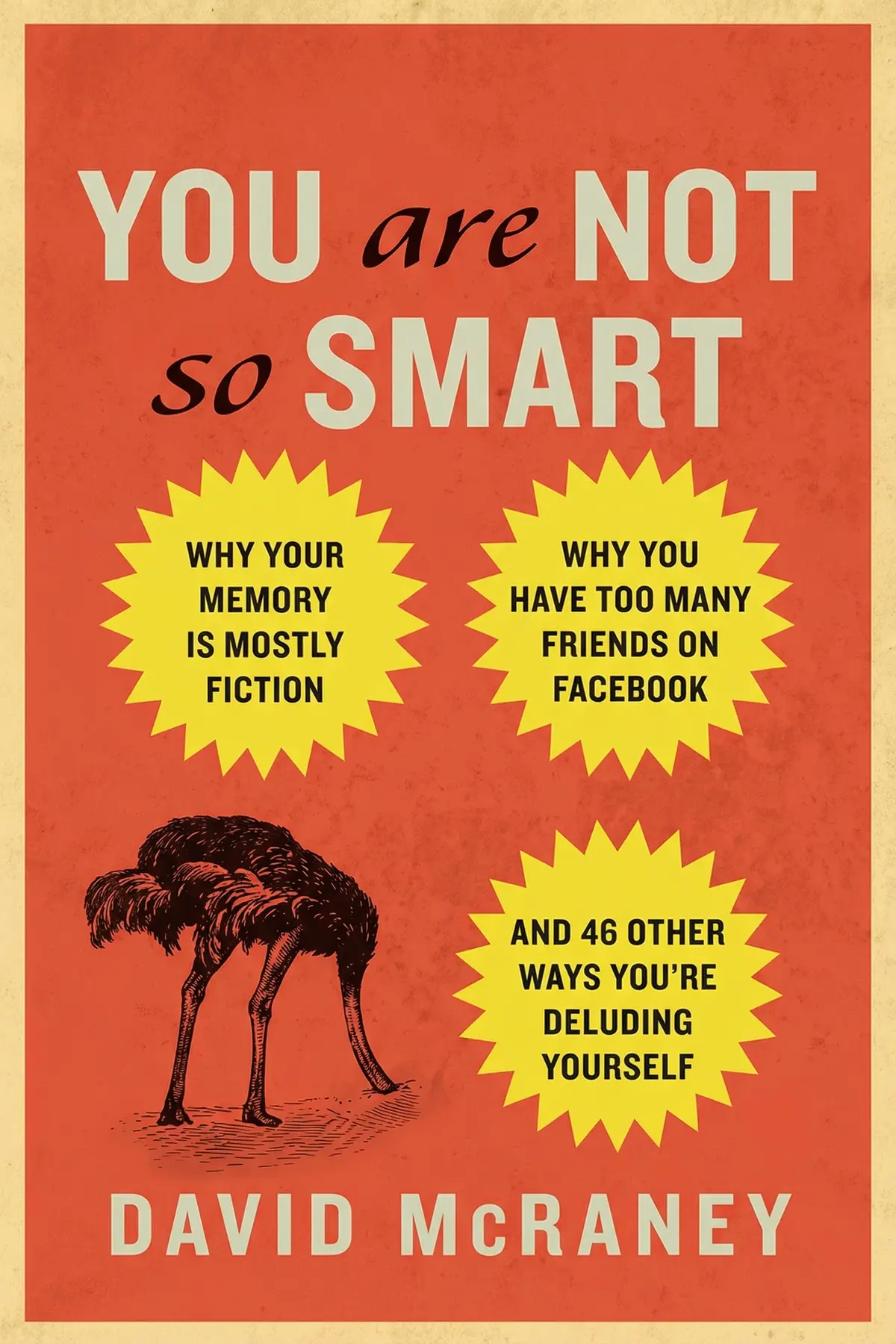
Table of Content
1. Introduction
1 min 51 sec
We like to imagine that we are the captains of our own souls, navigating the world with a steady hand and a clear eye. We believe that our decisions are the result of careful, logical deliberation and that our memories are faithful recordings of the past. It is a comforting thought, isn’t it? It gives us a sense of agency and a feeling of superiority over the chaotic world around us. But what if that feeling of control is just a very convincing illusion? What if, instead of being rational actors, we are actually characters in a story written by an unreliable narrator—our own brain?
This journey explores the many ways in which we are not quite as smart as we think we are. It is a deep dive into the psychology of self-delusion, revealing how our minds constantly trick us into feeling more competent, more ethical, and more logical than we truly are. The reality is that our brains are not designed to find the absolute truth; they are designed to help us survive and make sense of a complex environment. Sometimes, that means cutting corners, ignoring inconvenient facts, or fabricating entire explanations for things we don’t actually understand.
Throughout this exploration, we will look at why we see patterns in the clouds, why we struggle to change our minds even when presented with hard evidence, and why we often follow the crowd even when it’s heading toward a cliff. We will uncover the hidden biases that color our first impressions and the strange ways our unconscious minds influence our behavior without us ever realizing it. By the end, you may find that your perspective on yourself and the people around you has fundamentally changed. You might not feel quite as “smart” as you did before, but you will certainly be much better informed about the fascinating, irrational, and deeply human machinery working inside your head.
2. Finding Order in Chaos
1 min 59 sec
Explore why the human brain is hardwired to find meaning in random events and why we often feel we have more control over the world than we actually do.
3. The Invention of Reasons
2 min 05 sec
Learn about confabulation and the surprising way our brains fabricate stories to explain our actions and emotions when the real reasons are hidden from us.
4. The Echo Chamber of the Mind
2 min 14 sec
Discover how confirmation bias shapes our reality, leading us to seek out information that validates our views while ignoring anything that challenges them.
5. Protecting the Ego
1 min 58 sec
Uncover the defensive strategies our brains use to maintain self-esteem, including the strange habit of setting ourselves up for failure.
6. The Hidden Influence of the Unconscious
1 min 56 sec
Understand how environmental cues and unconscious associations can radically alter our behavior without us having any conscious awareness of the shift.
7. The Spotlight and the Pedestal
1 min 53 sec
Explore the egocentric biases that lead us to overestimate how much others notice us and how special we really are in the grand scheme of things.
8. The Complexity of Helping and Judging
1 min 57 sec
Learn about the bystander effect and the fundamental attribution error, revealing why we are often less helpful and more judgmental than we believe.
9. The Power of the Uniform
1 min 56 sec
Examine the chilling extent to which authority and social pressure can influence us to act against our own values and better judgment.
10. Conclusion
1 min 50 sec
We have traveled through the winding corridors of the human mind, uncovering the various ways we deceive ourselves every single day. From the patterns we see in the noise of randomness to the fictional stories we invent to explain our own behavior, it’s clear that the ‘self’ we present to the world is often a carefully constructed delusion. We’ve seen how we protect our egos with self-serving biases, how we are nudged by an unconscious mind we barely understand, and how easily we can be swayed by the pressure to conform or the command of an authority figure.
It can be unsettling to realize that our logic is flawed and our memories are unreliable. However, this knowledge isn’t meant to make us feel powerless. Instead, it serves as a vital tool for self-awareness. By understanding these mental shortcuts and biases, we can begin to spot them in action. We can learn to pause when we feel a surge of certainty, to question our first impressions of others, and to look for the evidence we might be accidentally ignoring. The goal isn’t to become perfectly rational—that’s an impossible standard for a human brain—but to become more humble and more curious about the way we think.
The throughline of all these delusions is a desire for comfort, consistency, and a sense of control. But true growth comes from stepping outside that comfort zone. It comes from the willingness to be wrong and the courage to admit that we don’t have all the answers. As you move forward, remember that you are not as smart as you think you are—but that’s okay. In fact, recognizing your own limitations is perhaps the smartest thing you can ever do. Use this awareness to be a little more patient with others, a little more skeptical of your own assumptions, and a lot more attentive to the fascinating reality that exists beyond your brain’s self-made illusions.
About this book
What is this book about?
Have you ever wondered why you feel so certain about a memory, only to find out later that the details were completely wrong? Or why you feel more confident in your opinions when you read articles that agree with you? This exploration of the human psyche dismantles the myth that we are rational, objective creatures. It delves into the fascinating world of cognitive biases, logical fallacies, and self-delusion. The promise of this summary is a complete perspective shift. By understanding the mechanics of how we trick ourselves—from finding meaning in random coincidences to blindly following authority figures—we can begin to see the world with more clarity. It’s not just about pointing out flaws; it’s about understanding the evolutionary shortcuts that once helped us survive but now lead us astray in the modern world. You will walk away with a better understanding of your own mind and a healthy skepticism of your most logical conclusions.
Book Information
About the Author
David McRaney
David McRaney is a journalist and self-described psychology nerd. He is the creator and author of the popular blog YouAreNotSoSmart.com, which provided the foundation for his work in this field. McRaney has written for several newspapers, including The Lamar Times and The Huffington Post. His talent was recognized early in his career when he was named one of the top ten college journalists in the nation in 2006.
Ratings & Reviews
Ratings at a glance
What people think
Listeners find this book highly engaging and skillfully written, featuring perceptive material that delivers broad outlines of psychological fundamentals. It is accessible to follow, containing lucid examples throughout every chapter, and listeners enjoy the sense of humor and cleverness. Scientific content receives varied feedback; while some commend the analysis, others find the research not the best.
Top reviews
Suvannee
David McRaney’s dive into the world of cognitive biases is an eye-opening journey into the messy, irrational reality of the human brain. Each chapter dismantles a specific misconception, like the Dunning-Kruger effect, using sharp wit and clear, relatable examples that make the concepts stick. While the recurring "you are not so smart" refrain might feel a bit cheeky to some, I found it incredibly refreshing to have my ego poked. It’s a fast-paced read that manages to make complex psychological principles feel like casual dinner conversation. My only minor gripe is that a few chapters feel a bit brief, leaving me wanting more depth on the academic studies. Overall, it’s a brilliant wake-up call for anyone who thinks they are a perfectly rational being.
Show moreKru
As someone who prides themselves on being a 'free thinker,' this book was a much-needed reality check for my own inflated ego. The chapter on Confirmation Bias was particularly convicting, showing how we all just curate information that makes us feel right. McRaney’s writing is accessible without being 'dumbed down,' providing a general overview that anyone can grasp regardless of their background. I loved the way he explained 'Learned Helplessness' through the lens of daily life and social structures. Even though the research is summarized for a general audience, the core insights are profound enough to change how you view your own decision-making process. It’s a book that invites you to be a little more humble about your own brain.
Show moreYindee
Imagine discovering that your entire sense of self is mostly a collection of convenient fictions created by your own brain to keep you sane. That is the core takeaway of this brilliant, bite-sized exploration of the glitches in our grey matter. McRaney takes complex ideas like 'Introspection' and 'The Availability Heuristic' and makes them feel urgent and fascinating for the modern reader. I actually found myself laughing out loud at some of the absurd ways our brains try to protect our self-esteem at all costs. While it might be 'pop-science,' it’s high-quality writing that respects the reader's time. It might make you feel a little less special, but you'll definitely leave the experience feeling much more informed.
Show moreMaja
Ever wonder why you keep buying things you don't need or why you're so sure your political opinions are objective facts? David McRaney breaks down these mental glitches in a way that is both entertaining and slightly disturbing for the average reader. The sections on brand loyalty and the 'Just-World Fallacy' really hit home for me. Truth is, if you’ve spent any time listening to shows like Radiolab, some of this material will feel like a retread. However, having all these cognitive biases compiled into one punchy, accessible volume makes for a great reference. It’s a solid introduction to pop-psychology, even if it occasionally sacrifices scientific complexity for the sake of a snappy, humorous punchline.
Show moreKan
Finally got around to reading this, and I must say the humor is what kept me turning the pages until the very end. McRaney has a talent for taking dry academic papers and turning them into vivid stories about why we act so weirdly in everyday places like Wal-mart. I especially appreciated the explanation of 'Apophenia' and how our brains are hard-wired to see patterns in total chaos. Look, the tone is definitely a bit 'tough love,' and I can see why some might find the constant reminders of their own stupidity to be a bit grating. Personally, I took it as a playful nudge rather than a serious insult. It’s an insightful look at the self-delusion we all practice every single day.
Show moreRatchada
Wow, this was a lot more engaging than your average science book, mostly because it doesn't take itself too seriously. It’s structured almost like a series of blog posts, which makes the information feel immediate and relevant to modern life. I found the 'Texas Sharpshooter Fallacy' explanation to be one of the best I've ever read, clearly illustrating how we find meaning in random data after the fact. To be fair, the author does tend to lean into some fairly sweeping conclusions that might not hold up under intense academic scrutiny. But for a casual reader looking to understand why they procrastinate or why they believe in lucky items, this is perfect. It’s witty, fast, and packed with interesting moments.
Show moreOrawan
It turns out that we are essentially strangers to our own motivations, according to McRaney’s fascinating analysis of human behavior. I was particularly interested by the section on 'Priming' and how subtle environmental cues, like the smell of a room, can shift our behavior without us noticing. The author uses a lot of humor to soften the blow of telling you that your memories are probably fake and your choices aren't actually yours. Not gonna lie, some of the specific examples, like the Katrina survival story, felt a bit out of place compared to the more clinical studies mentioned. Still, it’s a very well-written overview of why our brains take so many shortcuts. It is definitely worth a read for the cognitively curious.
Show moreCarlos
Picked this up on a whim after seeing it mentioned on a blog, and I have mixed feelings about the final product. On one hand, the writing is snappy and the 48 short chapters make it very easy to digest in small bursts during a commute. On the other hand, the lack of an index makes it frustrating to find specific experiments after you've finished. Many of the studies—like the classic wine tasting label experiment—are staples in the field, but they are repeated in almost every other pop-psych book on the market. It’s a fun, light read, but don’t expect any groundbreaking new research if you already know the basics of cognitive bias. It serves its purpose as an entry-level text for the curious.
Show moreJack
Despite the hype, this collection of psychological quirks felt a bit more shallow than I had hoped for a full-length book. While the 'Truth vs. Misconception' format is clever, it often feels a bit too 'black and white' for such a complex subject as the human mind. The book is essentially a long list of ways we fail at being rational, but it doesn’t offer much in the way of how to actually overcome these biases. Frankly, it can get a bit repetitive after the twentieth chapter of being told you’re delusional. It’s a great 'bathroom reader' or something to pick up for ten minutes at a time, but it lacks a strong narrative thread to tie everything together into a cohesive argument.
Show moreGun
Absolutely not what I expected from a book that claims to provide scientific 'truth' about human behavior. The author presents these concepts as absolute dogmas, completely ignoring the nuance that defines real social psychology. His chapter on the 'Bystander Effect' is particularly egregious, painting humanity as a monolith of apathy without acknowledging the countless cases of altruistic intervention that occur daily. To make matters worse, the anecdote about Hurricane Katrina felt incredibly smug and hypocritical given the book’s supposed stance on hindsight bias. It’s a collection of cherry-picked studies designed to make the author look clever while insulting the reader’s intelligence. Save your time and listen to a podcast with actual experts instead of this one-sided argument.
Show moreReaders also enjoyed
59 Seconds: Change Your Life in Under a Minute
Richard Wiseman
A Liberated Mind: How to Pivot Toward What Matters
Steven C. Hayes
Acting with Power: Why We Are More Powerful Than We Believe
Deborah Gruenfeld
Age of Propaganda: The Everyday Use and Abuse of Persuasion
Anthony Pratkanis
AUDIO SUMMARY AVAILABLE
Listen to You Are Not So Smart in 15 minutes
Get the key ideas from You Are Not So Smart by David McRaney, plus 5,000+ more titles in English and Thai.
- 5,000+ titles
- Listen as much as you want
- 7-day free trial
- Cancel anytime







