
23 min 14 sec
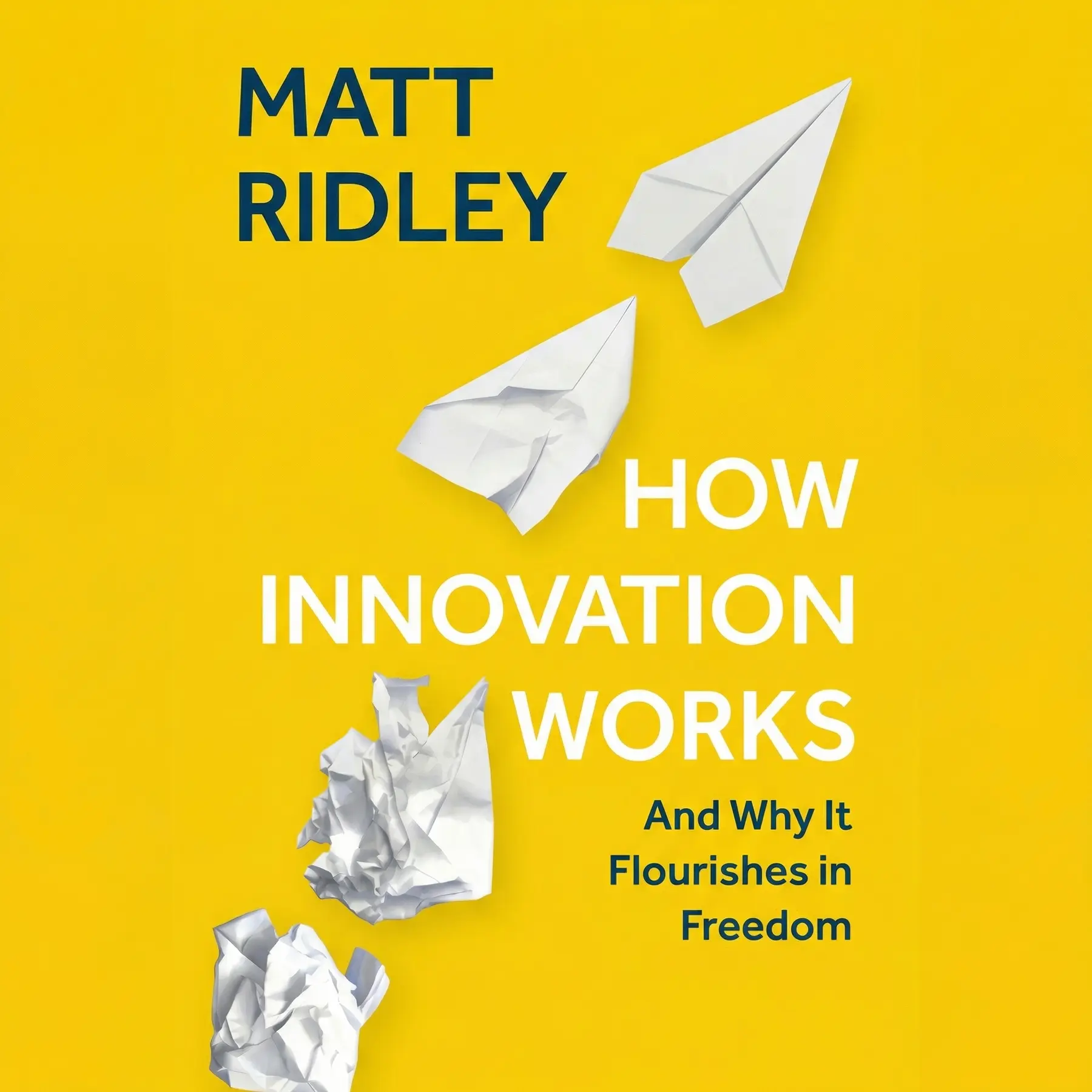
How Innovation Works: And Why It Flourishes in Freedom
By Matt Ridley
Discover why innovation is a bottom-up process of trial and error rather than a top-down flash of genius, and how freedom and collaboration remain the essential ingredients for human progress.
Table of Content
1. Introduction
1 min 48 sec
Every morning, we wake up in a world defined by ingenuity. We might check a weather app on a pocket-sized supercomputer, pour coffee brewed by a machine that would have looked like magic a century ago, or drive a vehicle that harnesses thousands of controlled explosions per minute to get us to work. We are surrounded by the fruits of innovation, yet we rarely stop to ask: where does this constant stream of improvement actually come from?
Most of us have been taught a version of history that emphasizes the ‘Eureka!’ moment. We picture a lone genius sitting in a quiet laboratory, suddenly struck by a bolt of inspiration that changes the world overnight. But as we will explore today, that narrative is largely a myth. Real innovation is much less like a lightning strike and much more like a coral reef—a slow, collective, and often messy process that builds upon itself over generations.
In this journey through the history of human creativity, we are going to look at the ‘how’ behind the ‘what.’ We will see that innovation is not just about making things; it is about finding practical solutions through a relentless process of trial and error. It is a bottom-up phenomenon that thrives when people are free to exchange ideas, share their failures, and tweak the work of those who came before them.
We will examine the evolution of the steam engine, the high-stakes world of medical breakthroughs, and the intangible ideas—like numbers and agricultural shifts—that changed our species’ trajectory just as much as any physical machine. Along the way, we will discover why some innovations are met with fierce resistance and why the centers of global progress seem to be shifting in the twenty-first century. By the time we finish, you will have a new understanding of the invisible forces that move our civilization forward and a clearer picture of what it takes to keep the engine of progress running in an uncertain future.
2. The Collaborative Nature of Invention
2 min 13 sec
Think innovation is the work of a single mastermind? The chaotic history of the steam engine suggests that progress is actually a team sport played across decades.
3. Risk and Reward in Medical Progress
2 min 23 sec
Medical breakthroughs often come from daring experiments that seem repulsive at first, showing that practical results often lead the way before science can even explain them.
4. The Slow Evolution of Travel
2 min 19 sec
From steam-powered horses to the modern automobile, the way we move has been transformed not by sudden leaps, but by a continuous chain of small, persistent tweaks.
5. Innovation Beyond the Physical
2 min 20 sec
Not all world-changing inventions are made of metal and wires. Sometimes, the most powerful shifts in human history come from new ways of thinking and organizing data.
6. The Need for Speed in Communication
2 min 13 sec
Our deep-seated desire to connect has pushed communication technology to evolve at a breakneck pace, transforming the world from a collection of isolated pockets into a global network.
7. Serendipity and the Power of Mixing
2 min 03 sec
Many of our most important discoveries happened by accident, proving that innovation thrives in environments where people—and ideas—can mingle freely.
8. The Limits of Top-Down Planning
2 min 03 sec
While it’s tempting to think that governments or giant corporations can plan innovation, the most successful breakthroughs often come from smaller, more agile outsiders.
9. Resistance to the New
2 min 01 sec
Innovation is rarely greeted with open arms. From margarine to genetic modification, new ideas often face a wall of fear and protectionism from the old guard.
10. The Global Shift of Innovation
2 min 05 sec
Is the West losing its creative edge? As some sectors in developed nations stagnate, the center of global ingenuity is moving toward rising nations like China.
11. Conclusion
1 min 46 sec
As we have seen, innovation is not a mysterious gift bestowed upon a lucky few. It is a fundamental human process that belongs to all of us. It is the result of millions of people making small, persistent improvements to the world around them. It is what happens when we are free to collaborate, free to fail, and free to share our ideas without fear.
The throughline of our exploration is clear: progress is a bottom-up phenomenon. It cannot be forced by a central planner or perfectly predicted by a CEO. It emerges from the ground up when we allow for the ‘recombination’ of ideas. Whether it is the evolution of the steam engine or the rapid rise of the internet, the recipe remains the same: take an existing idea, try to make it slightly better, watch what happens, and repeat.
The most important takeaway is that we cannot take innovation for granted. It requires a specific kind of environment to flourish—one that values openness over protectionism and experimentation over safety. As we face the challenges of the twenty-first century, from climate change to global health, our greatest resource is our collective ingenuity.
To keep the engine of progress turning, we must be willing to challenge the status quo and embrace the messiness of change. We must fight against the urge to over-regulate new ideas out of fear and instead foster a world where anyone, anywhere, can contribute to the next great leap forward. Innovation is our best hope for a more prosperous and sustainable future, but it only works if we give it the freedom to thrive. So, the next time you see a new technology or a radical idea, don’t just look for the genius behind it—look for the freedom that allowed it to exist.
About this book
What is this book about?
How Innovation Works explores the often-misunderstood mechanics of human progress. Instead of crediting lone geniuses with sudden breakthroughs, the book reveals that most advancements—from the steam engine to the smartphone—emerge through a messy, incremental process of trial, error, and collaborative refinement. By looking back at the history of technology, medicine, and social ideas, it identifies the specific conditions that allow creativity to flourish. The core promise of this exploration is a shift in perspective. You will see that innovation is not something that can be easily planned or mandated from the top down. Rather, it is an evolutionary phenomenon that requires a free exchange of ideas and the courage to experiment. Whether discussing the origins of the light bulb or the future of artificial intelligence, the narrative underscores that progress is a collective human endeavor that depends on our willingness to let ideas mingle and evolve in an open environment.
Book Information
About the Author
Matt Ridley
Matt Ridley is a highly regarded author whose work frequently centers on the intersections of science, technology, and economic history. He has written several influential books that explore how systems and ideas evolve over time, including The Evolution of Everything: How New Ideas Emerge, which examines the bottom-up nature of change. His other notable titles include The Rational Optimist: How Prosperity Evolves and Genome: The Autobiography of a Species in 23 Chapters. Ridley’s writing is known for challenging conventional wisdom and providing deep insights into the drivers of human advancement.

Ratings & Reviews
Ratings at a glance
What people think
Listeners describe the work as exceptionally accessible and skillfully crafted, utilizing a captivating narrative style to investigate every aspect of innovation. The content offers a crisp, evidence-led look at history through a thorough breakdown of various historical developments, and listeners value its practical, logical outlook. They consider it an enlightening and thoroughly researched guide, with one listener noting it covers the gamut of technology.
Top reviews
Oksana
Matt Ridley has a knack for making complex economic theories feel like dinner table conversation. His concept of 'ideas having sex' is more than just a catchy phrase; it is a fundamental shift in how we view progress. He systematically debunks the 'lone genius' myth by tracing the messy, collaborative history of the steam engine and modern vaccines. I loved the way he describes innovation as a bottom-up process driven by trade and exchange rather than top-down mandates from the elite. The writing is incredibly accessible, avoiding the dense jargon you usually find in tech history. It’s a refreshing, fact-based look at why some societies thrive while others stagnate under the weight of their own bureaucracy. Truly an eye-opener for anyone interested in why the world looks the way it does today.
Show moreHenry
Ever wonder why certain breakthroughs happen in clusters across different continents simultaneously without the inventors ever meeting? This book provides the most satisfying answer I’ve found yet by treating innovation as an evolutionary process rather than a series of 'Eureka' moments. Ridley’s prose is sharp and fast-moving, covering a massive technological gamut from ancient farming techniques to modern gene editing. I especially enjoyed the section on how regulation in Europe is stifling the next generation of digital giants. It’s a provocative read that challenges the way we fund science and protect ideas. Not every chapter hit the mark, but the overall message is powerful and incredibly relevant for our current age. I couldn't put it down once I started the section on computers.
Show morePlernpiriya
Innovation is often treated as a magical spark from a lone genius, but Ridley effectively dismantles that myth with surgical precision. He shows that progress is contagious and collective, thriving only when people are free to trade and exchange their 'recombinant' ideas. This book is a massive achievement in storytelling, covering everything from the telegraph to the sharing economy with equal enthusiasm. I found his arguments about the 'innovation famine' in certain sectors to be a necessary wake-up call for modern policymakers. The tone is optimistic and full of hope, which is exactly what we need right now. It’s easily one of the most thought-provoking books on my shelf. I highly recommend it to anyone who feels stuck in a pessimistic worldview.
Show moreMia
Finally, a book that acknowledges how most world-changing tech comes from tinkerers in garages rather than professors in ivory towers. I’ve been looking for a comprehensive history of innovation that doesn't just focus on the 'great men,' and Ridley delivered exactly that. From corrugated iron to the search engine, he demonstrates how innovation is a messy, unpredictable process of combination and recombination. The book is an eye-opener regarding how often we stand in our own way with restrictive rules and redundant licensing. It’s highly readable, well-documented, and provides a much-needed common sense perspective on human advancement. If you care about the future of technology, or just want to understand the past better, you need to read this.
Show moreJoshua
Picked this up expecting a dry history of the industrial revolution, but I was pleasantly surprised by the lively, storytelling pacing. Ridley walks through everything from the invention of the flush toilet to the complexities of nuclear power with a very common-sense lens. It’s fascinating to see how many 'simultaneous' inventions occur because the cultural atmosphere was just right for them. My only gripe is that the book occasionally feels like a series of loosely connected anecdotes rather than a cohesive argument. The chapter on coffeehouses felt particularly out of place, even if it was a fun read in isolation. Still, the breadth of the technology covered is impressive and kept me turning pages. It is a solid, informative read for any history buff.
Show moreVipawan
After hearing so much buzz about Ridley’s take on the 'bottom-up' nature of progress, I finally dove into this hefty volume. It’s a fascinating, information-rich journey that really highlights how much we owe to practical tinkerers rather than academic theorists. The way he compares technological evolution to biological evolution is masterful and makes a lot of sense when you look at how computers actually developed. I found his cautionary tale about nuclear power particularly sobering, especially regarding how safety-induced cost inflation can kill a promising industry. It’s a readable, well-written plea for more freedom to experiment and fail. Even if you don't agree with his politics, the historical data is hard to ignore. A great addition to any library.
Show moreAnawin
The chapter on the evolution of the flush toilet was unironically one of the most fascinating things I’ve read all year. Ridley has a gift for taking mundane objects and revealing the centuries of trial and error required to make them work. I appreciate the fact-based approach and the way he highlights the importance of 'perspiration' over 'inspiration.' It’s a bit long in some places, and he definitely has an axe to grind regarding government regulation, but the stories are top-notch. For anyone who likes knowing how things work, this is a solid choice. It’s informative without being pretentious, and it manages to cover a vast amount of ground without feeling like a textbook. Definitely worth the time for the stories alone.
Show moreNong
While I appreciate the exhaustive research into how the steam engine evolved, I found the author’s persistent crusade against intellectual property a bit exhausting. Ridley makes a compelling case for incrementalism, but his disdain for patents feels overly simplistic for such a globalized, complex economy. He writes with a clear bias toward deregulation that might alienate readers looking for a more balanced scientific perspective. To be fair, his descriptions of 'tinkering' as the precursor to formal science are brilliant and well-documented. If you can look past the libertarian undertones, there is a wealth of historical knowledge here that is genuinely worth your time. Just be prepared for a very specific political flavor that permeates the latter half of the text.
Show moreSuda
Frankly, I enjoyed the first half of the book much more than the second. The historical deep dives into steam engines and lightbulbs were excellent, but the later chapters devolved into a bit of a political manifesto. Ridley’s take on intellectual property rights felt a bit rushed and one-sided, failing to address the very real risks of a world without patent protection. I gotta say, he writes well, but the transition from historian to polemicist was a bit jarring for my taste. That said, the 'ideas having sex' framework is a genuinely useful tool for understanding cultural evolution. It’s a 3-star read for the uneven execution, despite the high-quality research. It is a good book that could have been great with a bit more balance.
Show moreArthit
To be fair, the historical anecdotes are charming, yet the book feels like it's stuck in a very conservative, old-school scientific echo chamber. I went into this hoping for groundbreaking insights into the future, but Ridley seems more interested in defending the 'old guard' of the scientific establishment. The ideas about incremental progress and 'floating ideas' aren't particularly new; I’ve seen much of this covered more effectively by people like Neil Shubin years ago. It’s a standard history of innovation that lacks the progressive spark I expected from a book with this title. If you’ve already read a lot of pop-science, you probably won't find much here that blows your mind. It’s a bit too safe and repetitive for my liking.
Show moreReaders also enjoyed

A Biography of Loneliness: The History of an Emotion
Fay Bound Alberti

Alexander Hamilton
Ron Chernow
Alexander the Great
Philip Freeman


A History of Iran: Empire of the Mind
Michael Axworthy

A History of the World in 6 Glasses
Tom Standage

21 Lessons for the 21st Century
Yuval Noah Harari

A Long Way Gone: Memoirs of a Boy Soldier
Ishmael Beah
AUDIO SUMMARY AVAILABLE
Listen to How Innovation Works in 15 minutes
Get the key ideas from How Innovation Works by Matt Ridley, plus 5,000+ more titles in English and Thai.
- 5,000+ titles
- Listen as much as you want
- 7-day free trial
- Cancel anytime







