
17 min 37 sec
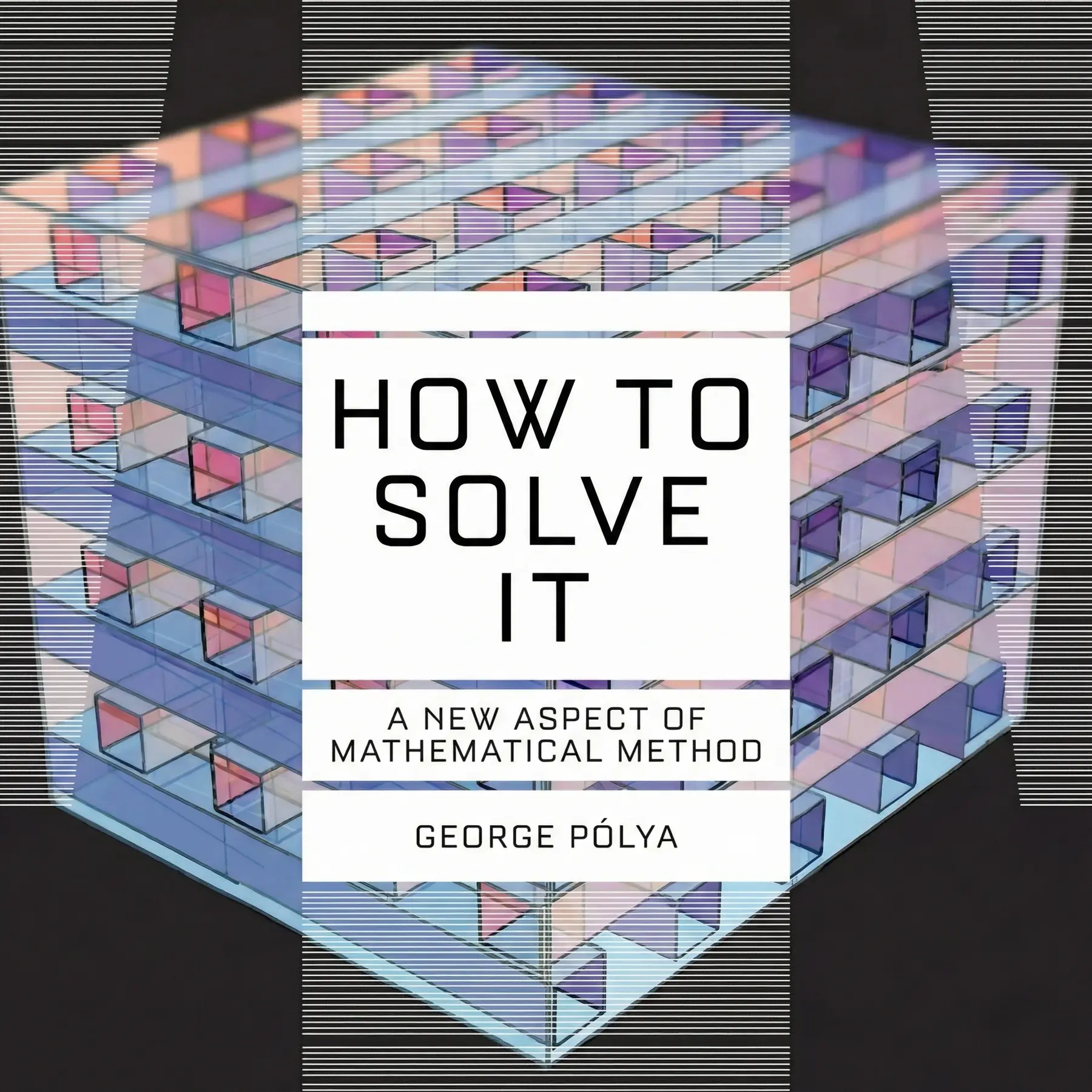
How to Solve It: A New Aspect of Mathematical Method
By George Pólya
Master the art of logical thinking with this exploration of mathematical heuristics. Learn a timeless four-step method to dismantle complex obstacles and find creative solutions in any field of life.
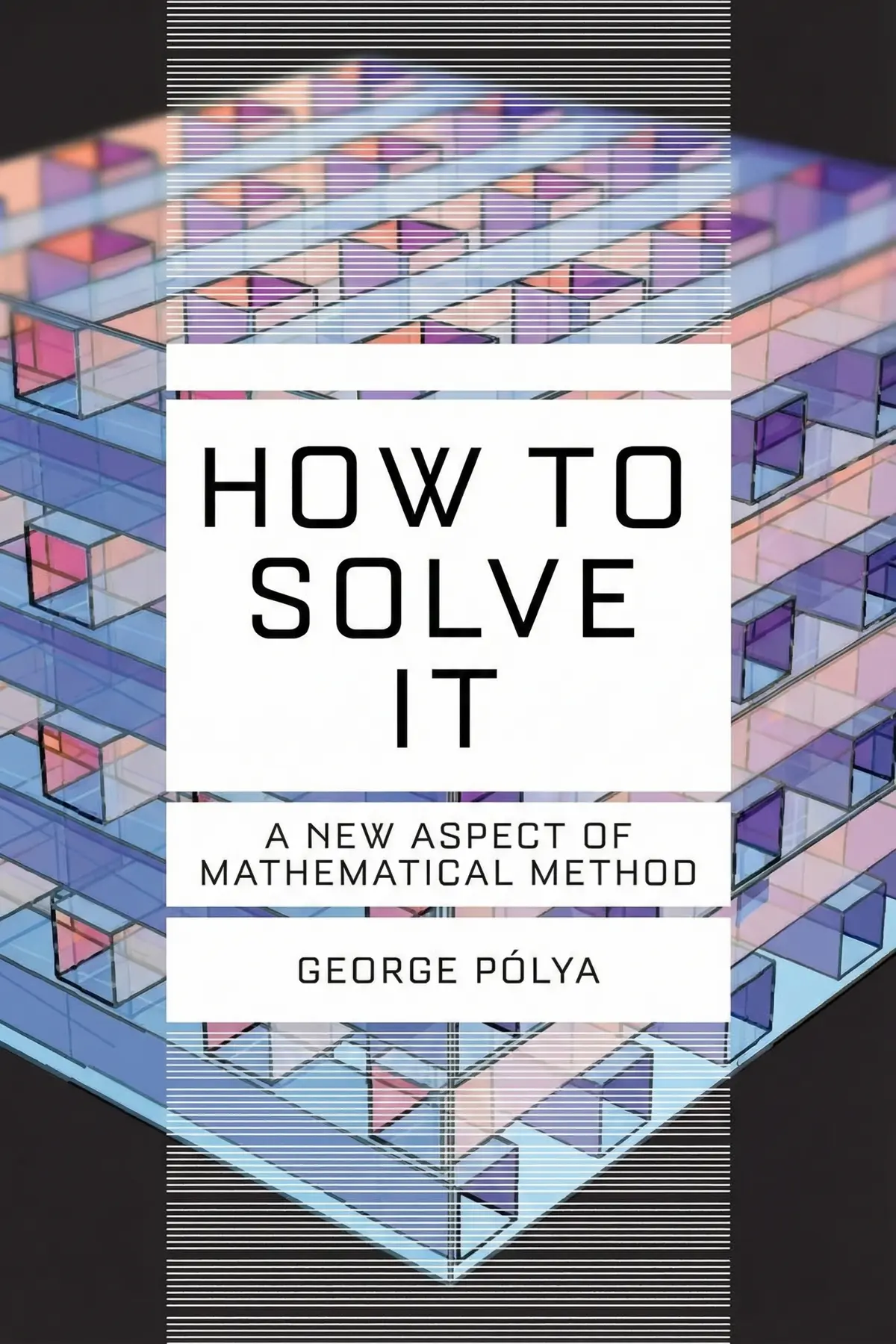
Table of Content
1. Introduction
1 min 55 sec
Every day, your mind is hard at work solving puzzles, even if you aren’t holding a pencil and paper. You’re calculating the best time to leave for an appointment, figuring out the most efficient way to organize a project, or deciding how to balance your budget. These are all mathematical problems at their core, and the same mental tools that help a scientist unlock the secrets of the cosmos are available to you in your daily life. The challenge is that most of us were never taught how to think about problems systematically. We often jump to conclusions, get frustrated when a solution isn’t immediate, or get lost in the details without seeing the big picture.
In this look at George Pólya’s seminal work, How to Solve It, we are going to explore a framework that has guided thinkers for generations. Written in 1945, this book remains a cornerstone of modern education and professional strategy because it doesn’t just give you answers—it gives you a method for finding them. Pólya introduces us to the world of heuristics, which is essentially the study of how we discover things. It’s about the mental moves we make when we are stuck and the questions we can ask to nudge our brains toward a breakthrough.
Over the next few minutes, we will walk through a four-step process: understanding, planning, acting, and reflecting. We’ll see how these steps apply not just to geometry or algebra, but to every complex situation you face. You’ll learn why the most important part of solving a problem often happens before you even start calculating, and why the final step—the one most people skip—is actually the secret to becoming smarter over time. By the end of this journey, you’ll have a structured way to approach the unknown, turning the chaos of a difficult challenge into a clear, manageable path forward. Let’s dive into the strategies that can transform you into a master problem-solver.
2. The Foundation of Understanding
2 min 25 sec
Discover why the first step to any solution is a deep, patient dive into the problem’s core requirements and constraints.
3. The Strategy of Devising a Plan
2 min 26 sec
Learn how to bridge the gap between what you know and what you seek by using patterns, analogies, and past victories.
4. Executing with Precision
2 min 20 sec
Explore the discipline required to turn a plan into a reality, ensuring every logical step is verified as you go.
5. The Power of the Backward Glance
2 min 05 sec
Understand why reviewing your solution is the most critical step for long-term intellectual growth and skill mastery.
6. Mental Tools for the Stuck Mind
2 min 29 sec
Explore specific heuristic techniques like generalization and decomposition that can break any mental deadlock.
7. The Psychology of Discovery
2 min 21 sec
Delve into the mental resilience and subconscious processes that fuel breakthroughs and manage the stress of the unknown.
8. Conclusion
1 min 36 sec
As we wrap up our journey through the strategies of George Pólya, it’s clear that ‘How to Solve It’ is more than just a book about math—it’s a manifesto for a more thoughtful life. We’ve seen that the path to solving any great challenge isn’t found in a magic formula or a sudden stroke of genius, but in the disciplined application of a few simple, powerful steps. By taking the time to truly understand what is being asked, by looking for patterns in our past experiences, by executing our plans with rigorous care, and by always looking back to learn from our victories, we transform our relationship with the unknown.
The next time you are faced with a daunting task at work, a complex decision in your personal life, or even a literal puzzle, remember to pause. Don’t let the urge for speed rob you of the clarity that comes from observation. Ask yourself: What is the unknown? Have I seen something like this before? Can I break this into smaller pieces? And most importantly, when you finally find the answer, don’t just walk away. Take a moment to appreciate the logic you’ve built and think about how you can use it again tomorrow.
Problem-solving is a skill that grows with use. Each challenge you face is an opportunity to refine your mental tools and expand your library of heuristics. By adopting this four-step method, you aren’t just finding answers—you are becoming the kind of person who can handle whatever comes next with confidence and creativity. You now have the framework. The only thing left to do is to step out and start solving.
About this book
What is this book about?
This summary explores George Pólya’s landmark approach to problem-solving, originally designed for mathematics but universally applicable to any challenge. It breaks down a four-stage process: deeply understanding the core problem, crafting a strategic plan, executing that plan with precision, and reflecting on the solution to gain lasting wisdom. You will discover how to use heuristics—mental shortcuts and patterns—to bridge the gap between confusion and clarity. By learning to ask the right questions and looking for analogies in previous experiences, you can rewire your brain to stop guessing and start solving with confidence. The promise is a more disciplined, creative, and resilient mind that sees every obstacle as an opportunity for growth.
Book Information
About the Author
George Pólya
George Pólya was a renowned Hungarian mathematician who served as a professor at Stanford University. He made foundational contributions to probability and complex analysis. Beyond his technical research, he was a giant in mathematical pedagogy, authoring an influential trilogy that includes Mathematics and Plausible Reasoning and Mathematical Discovery. His work earned him the Lester R. Ford Award and the American Mathematical Society’s award for Distinguished Service to Mathematics.
Ratings & Reviews
Ratings at a glance
What people think
Listeners find this work to be a superb manual for tackling problems, specifically in mathematics, and they value its useful directions. Furthermore, the text offers a methodical approach to deconstructing challenges, and one listener mentions it provides a solid foundation in problem-solving fundamentals. On the other hand, the prose is quite wordy, and though the book arrives in fine shape, some listeners find the content tedious to read.
Top reviews
Noi
Finally got around to reading this foundational text on mathematical heuristics, and I must say the logical progression is masterfully handled. While some might find the 1945 prose a bit stiff or dated, the core methodology for deconstructing complex problems remains incredibly relevant for anyone in STEM. Truth is, the famous four-step process mentioned at the beginning is worth the price of admission alone. I spent hours working through the sample problems in the back, finding the clues helpful without being overly revealing. Some sections feel slightly repetitive, yet this repetition serves to drill in the mindset required for genuine mathematical discovery. It’s not about magic tricks or shortcuts; instead, it provides a systematic way to think when you are stuck. This is an essential addition to any serious student’s library, even if you have to ignore some of the old-fashioned phrasing.
Show moreKofi
Ever wonder why some people seem to have a natural 'knack' for math while others struggle just to start a problem? Pólya demystifies this talent by showing that problem-solving is actually a systematic process that anyone can learn through practice and common sense. I love how he emphasizes that a student hasn't truly understood math until they can appreciate the idea of strict reasoning. The book doesn't offer quick fixes or esoteric knowledge; it offers a solid framework that demands active participation from the reader. My experience with the 'Short Dictionary' was mostly positive, as it allows you to dip in and out of specific strategies as needed. While the lack of female representation in the examples reflects its era, the actual logic remains universal. If you want to move beyond rote memorization and actually learn how to think, this is the gold standard.
Show moreCaleb
Unlike modern study guides that focus on rote memorization, this book asks you to slow down and truly understand the nature of the unknown. It offers no magic or tricks, only a systematic overview of how to approach a problem from multiple angles until it yields. I've found the advice about 'working backwards' and 'symmetry' to be applicable even in my non-mathematical daily work. Got to say, the author’s passion for 'strict reasoning' is infectious, even if the prose is a bit dense and wordy at times. He challenges the reader to not just solve the problem, but to look back at the solution and see if it can be improved. This reflective practice is what separates a student who just 'gets through' math from one who masters it. It’s a classic for a reason, providing a blueprint for the mind that remains remarkably sturdy.
Show morePloy
After years of hearing about the legendary 'List' from the first few pages, I finally decided to dive into the full text of Pólya’s masterpiece. What I discovered was an incredibly instructive guide that turns the 'art' of discovery into a teachable science. The author has a wonderful way of explaining complex heuristics so simply that they seem like common sense once you hear them. While the alphabetical layout of the dictionary section is a bit eccentric, the individual entries are packed with wit and historical anecdotes. It is a great example of lucid literature that transcends its specific subject matter to teach general logic. Some might find it a bit boring or 'pedestrian,' but there is beauty in the way he deconstructs the thought process. If you have ever felt defeated by a difficult problem, this book will give you the tools to fight back.
Show moreJeeranan
As a teacher who wants to inspire better reasoning skills in my classroom, I found Pólya's insights into the instructor's role to be particularly profound. The book argues that we often fail our students by focusing on facts rather than the beauty of a rigorous geometric proof. Not gonna lie, the middle section of the book is structured like a glossary, which makes a linear read quite difficult and occasionally tedious. However, the way he breaks down 'Reductio Ad Absurdum' and other strategies is remarkably lucid and accessible. You have to be patient with the verbose descriptions and the author's somewhat pedantic tone regarding terminology. If you can push past the formal language, you’ll find a treasure trove of advice on how to guide a student unobtrusively. It is a slow burn, but the fundamental concepts of looking at the unknown are timeless.
Show moreRatchanee
The 'Short Dictionary of Heuristic' section makes up the bulk of this book, and your enjoyment will depend entirely on how much you like alphabetical glossaries. Personally, I found the layout a bit frustrating because it prevents a natural flow of ideas, forcing you to jump around to connect related themes. That said, the actual content regarding the 'mental operations' of solving problems is top-notch and still feels fresh despite being decades old. Polya has a way of taking 'plain common sense' and turning it into a rigorous toolkit for the mind. Look, it’s definitely verbose, and you might find yourself skipping pages of examples that feel too basic or overly detailed. But if you are looking for a systematic introduction to the fundamentals of mathematical thought, you can't really ignore this one. It's a foundational text that has influenced almost every modern book on the subject for a reason.
Show moreMason
Pólya’s work feels more like a philosophy of education than a dry mathematics textbook, which was a pleasant surprise for me. He captures the essence of how a teacher should guide a student discreetly and unobtrusively toward their own 'aha' moment. The book is definitely a product of 1945, which means the language is formal and occasionally feels a bit full of itself. I found the examples focused on geometry to be excellent reminders of why proofs are the best examples of true evidence in our modern life. However, the organization of the 'Dictionary' section is quite strange and makes it feel more like a reference book than a cover-to-cover read. I’d recommend keeping it on your desk to consult when you’re stuck on a specific type of logic problem. It’s not a perfect read, but the core principles of decomposition and recombination are absolutely essential.
Show moreRapee
Picked this up during my undergrad because my professor mentioned it was the 'Bible' of mathematical methods, and it mostly lived up to the hype. The framework is simple yet intuitive, breaking down the act of solving into four clear phases that make even daunting problems feel manageable. I’ll admit the language is verbose and some chapters are a bit too focused on 'toy problems' that don't necessarily reflect the messiness of real research. To be fair, the book was written for a different era, so the lack of modern context is to be expected. I really appreciated the clues at the back, which provide just enough of a nudge to keep you moving forward without spoiling the answer. Even if you only read the first twenty pages and skim the dictionary, you’ll walk away with a better understanding of how to approach any difficult task.
Show moreLeah
This classic is a bit of a double-edged sword because it contains brilliant flashes of insight buried under mountains of dry, alphabetical entries. Frankly, I expected a more cohesive narrative about problem-solving rather than a dictionary of heuristics that feels disjointed and hard to navigate. While the first few pages summarize the entire method beautifully, the remaining two hundred pages often feel like they are over-explaining simple concepts. It deals primarily with well-posed toy problems, which might frustrate those looking for advice on open-ended research or real-world complexity. To be fair, the section on 'Irony' and its relation to absurdity was a clever highlight I didn't expect to find. If you are a math enthusiast, you might appreciate the historical weight of the text. For others, it might just serve as a very effective cure for insomnia due to its dense and repetitive nature.
Show moreRay
Not what I expected at all, especially considering how many people recommended this as a 'must-read' for general problem-solving skills. The truth is that the entire useful methodology could have been a five-page blog post or a simple infographic. I found the level of pedantism regarding terminology to be boringly intolerable and struggled to stay awake through the repetitive explanations. It is written in a very awkward style that targets a vague audience, hovering somewhere between high school students and professional researchers. Most of the book is just an alphabetical list of math terms and anecdotes that don't seem to lead anywhere specific. While I appreciate the 'List' at the front, the remaining 250 pages felt like a chore to get through. If you want insight into the mathematician's mind, you’d be better off reading Ian Stewart or G.H. Hardy instead.
Show moreReaders also enjoyed
AUDIO SUMMARY AVAILABLE
Listen to How to Solve It in 15 minutes
Get the key ideas from How to Solve It by George Pólya, plus 5,000+ more titles in English and Thai.
- 5,000+ titles
- Listen as much as you want
- 7-day free trial
- Cancel anytime







