Change Anything: The New Science of Personal Success
Kerry Patterson
Discover a systematic approach to driving meaningful change by mastering six sources of influence. This guide explores psychological and social strategies to transform behaviors and achieve significant results in any field.
1 min 28 sec
Have you ever wondered why some people seem to have a magnetic ability to shift perspectives and drive change, while others struggle just to get a simple project off the ground? We often see influence as a mysterious gift—something you’re either born with or you aren’t. But what if the ability to lead change wasn’t about charisma at all, but rather a systematic science that anyone can learn?
In our look at this transformative work, we are going to explore the mechanics of how people actually change. Most of us try to influence others through logic, or perhaps through pressure and nagging. Yet, as we’ve all likely experienced, these methods rarely stick. Real change requires more than just a good argument; it requires a deep understanding of the diverse forces that shape our choices every single day.
Over the course of this summary, we will break down the strategies used by world-class influencers—people who have tackled everything from global health crises to deep-seated corporate inertia. We’ll see how influence isn’t a single lever you pull, but a combination of personal motivation, social support, and even the physical environment around us. By the end of this journey, you’ll have a new framework for looking at challenges. Instead of feeling frustrated by people’s resistance to change, you’ll start to see the specific sources of influence you can adjust to make new behaviors not only possible but inevitable. Let’s dive into the science of leading change and discover how you can apply these principles to the goals that matter most to you.
2 min 13 sec
Success in leading change starts with moving away from vague intentions. Learn why the most effective influencers focus on a few specific behaviors and set incredibly precise, time-bound targets.
2 min 24 sec
Persuasion is more effective than force, but words alone often fail. Discover how immersive experiences and powerful narratives can reshape how people view their own choices and possibilities.
2 min 05 sec
The myth of the lone hero is a barrier to real change. Learn how to leverage social groups and create environments where admitting mistakes is the first step toward progress.
2 min 09 sec
Rewards can be a powerful tool for change, but they are also a double-edged sword. Explore how to use incentives to reinforce positive habits without accidentally encouraging the wrong ones.
2 min 02 sec
Our surroundings exert a silent, constant pressure on our choices. Discover how the layout of an office or the cleanliness of a street can subtly dictate how we interact and behave.
2 min 23 sec
Small design choices can lead to big changes. See how everything from popcorn bag sizes to container markings can automate the ‘right’ decision and eliminate the ‘wrong’ one.
1 min 38 sec
As we wrap up our exploration of the science of influence, it’s clear that leading change is far more complex—and far more achievable—than simply having a ‘strong personality.’ We’ve seen that becoming an influencer requires a multi-faceted approach. You must start with crystal-clear, measurable goals and identify the specific vital behaviors that will lead you there. From there, it’s about engaging people on three distinct levels.
First, there’s the personal level: using storytelling and direct experience to build internal motivation and the belief that change is possible. Second, there’s the social level: tapping into the power of groups and fostering a culture of collective accountability and honesty. And finally, there’s the structural level: utilizing rewards, physical environments, and everyday objects to nudge behavior in the right direction or even automate the desired results.
The most important takeaway is that if you are failing to influence change, it’s rarely because people are just ‘stubborn.’ More often, it’s because you are only pulling one lever when you need to be adjusting several. True influencers don’t rely on willpower; they build a system where success becomes the natural outcome.
Your next step is to take a look at a challenge you’re currently facing. Don’t just try harder to persuade. Instead, look at the six sources we’ve discussed. Is the environment working against you? Are the social pressures pushing in the wrong direction? Are there silent objects that could be redesigned? By applying these scientific principles of influence, you can stop struggling against resistance and start leading the way toward meaningful, lasting transformation.
Leading change is often viewed as an elusive art, but this summary reveals that it is actually a precise science. Based on the insights of leadership experts, the text explores why most attempts at persuasion fail and how a structured approach can succeed where willpower and nagging do not. By examining behavioral triggers across personal, social, and structural levels, the summary provides a roadmap for anyone looking to solve persistent problems. Whether you are trying to improve public health, revitalize a company culture, or help an individual overcome a personal hurdle, the strategies presented here—from the power of storytelling to the subtle impact of physical environments—offer a comprehensive toolkit for becoming a master influencer and achieving measurable success.
The authors are a distinguished group of leadership and business specialists who have dedicated their careers to studying human behavior and organizational dynamics. In addition to this work, they are recognized for writing the New York Times bestseller Crucial Conversations.
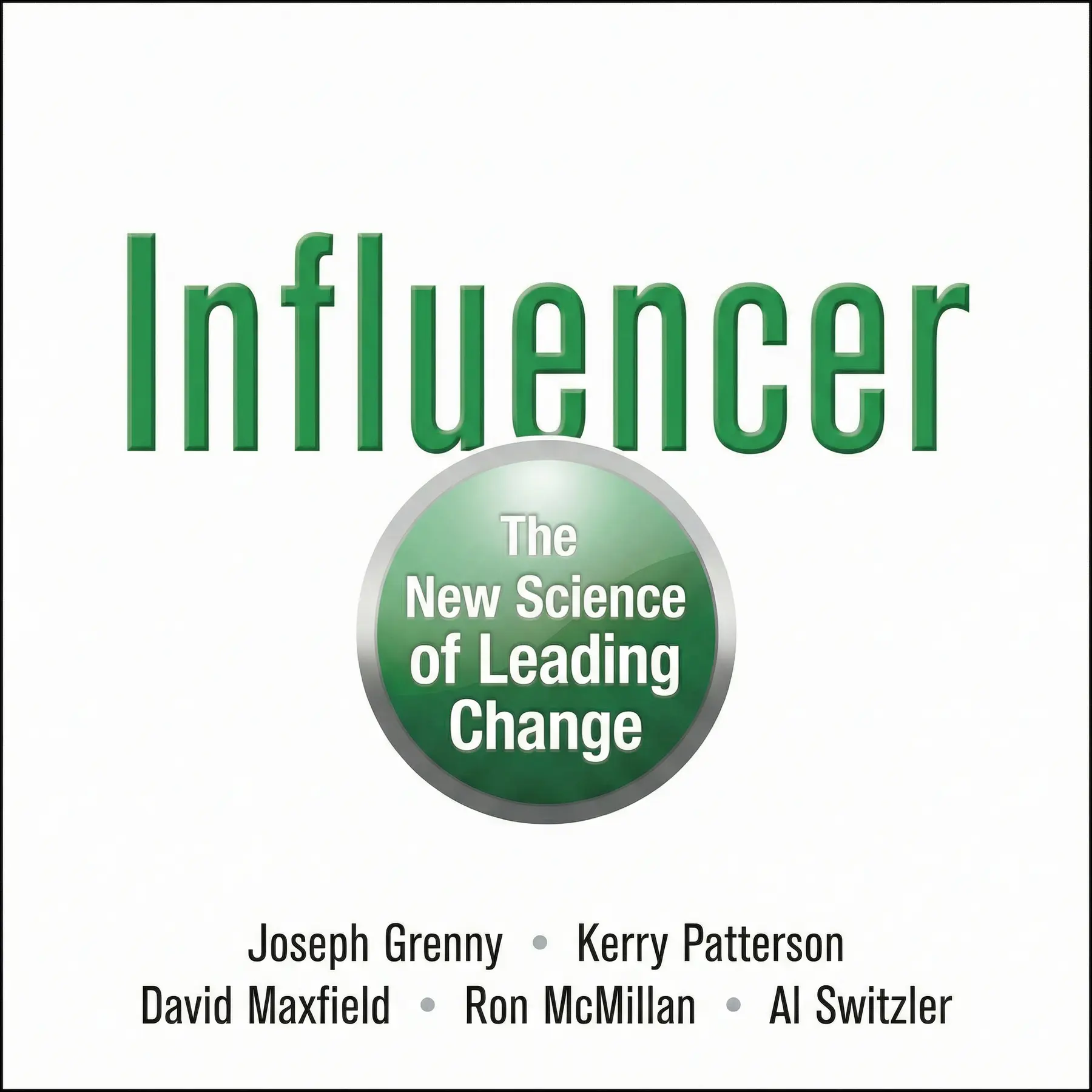
Listeners find this work exceptionally accessible and absorbing, featuring powerful anecdotes that are smoothly woven into the content. Many value the rigorous research and actionable advice, describing it as a beneficial resource for both individual growth and professional development. The book functions as a thorough manual for driving transformation, and one listener pointed out its profound examination of essential interpersonal abilities. Although the prose itself is well-regarded, listeners hold varying views on the overall speed of the delivery.
After hearing a lecture on self-mastery, I decided to tackle this book to understand why my personal goals always seemed to stall. The 2x3 matrix, which breaks influence into personal, social, and structural motivations and abilities, was a massive epiphany for me. I realized I was only focusing on my own willpower, which is just one of the six horses pulling the cart. Grenny and his co-authors provide a roadmap that makes changing even the most stubborn habits feel achievable through systematic strategies rather than just grit. While some of the stories about public health initiatives in Africa felt a bit removed from my daily office life, the underlying logic is bulletproof. It is easily one of the most practical guides on human behavior I have encountered in years. I now find myself drawing out the matrix whenever a project at work hits a snag. Highly recommended for anyone tired of failing at change.
Show moreThis book is a total game changer for any leader who feels like they are constantly shouting into a void. Instead of focusing on why people are inherently difficult, the authors show how to diagnose the hidden environmental and social pressures that keep individuals stuck. The concept of identifying vital behaviors is a revelation. I found the stories about the Delancey Street project and the eradication of disease to be incredibly moving examples of what is possible. Some might find the academic tone a bit dry, but the depth of the research makes the conclusions feel much more reliable than your average business book. It requires some intellectual heavy lifting, but the payoff is a complete shift in how you view human interaction. I will be keeping this on my desk for a long time for frequent reference during team meetings.
Show moreFinally got around to reading this after seeing it on several must-read lists, and it lived up to the hype for me. The truth is, most of us are terrible at influencing change because we try to talk people into things. This book flips that on its head by showing how to change the environment and the social stakes instead. I used the 6-source matrix to help my kids with their study habits, and the results were almost immediate once I addressed the structural hurdles. It is rare to find a book that works just as well for parenting as it does for corporate culture. Yes, the authors can be a bit repetitive, and they definitely like the sound of their own collective voice. But if you can look past that, the tools provided here are incredibly empowering. It is about more than just tricks; it is about understanding fundamental drivers.
Show moreWhat I appreciated most about this work was the deep, analytical look at what it takes to move the needle on complex social problems. I was impressed by the level of research involved and how the authors integrated psychological concepts like dehumanization and moral justification. It explains why so many change initiatives fail—we usually only address one or two sources of influence when we need at least four to succeed. The story of the order wheel at restaurants was a fun, unexpected detail that perfectly illustrated a structural solution to a social conflict. While some might find the academic writing style tedious, I appreciated that it was not just another superficial business book filled with empty buzzwords. It is a comprehensive guide for anyone who wants to be an intentional agent of change in their community or workplace. If you want real results, this is it.
Show moreIs it really possible to influence anyone? This book argues yes, provided you stop relying on verbal persuasion and start looking at the structural forces at play. I loved the deep dive into vicarious experiences and how stories can change minds where data fails miserably. The research is robust, and you can tell the authors have spent decades in the field of sociology. My only gripe is the writing style; the frequent use of 'we (the authors)' felt a bit pretentious and interrupted the flow of the more interesting case studies. Still, the breakdown of how social networks can either sabotage or support a new initiative is brilliant. It is more of an academic study than a quick self-help read, so be prepared for a slower pace. If you liked The Tipping Point, you will find this to be a much more actionable version of those same concepts.
Show moreAs someone who works in municipal government, I am constantly looking for ways to implement process changes without causing a mutiny. This book provided a fantastic framework, especially the distinction between opinion leaders and innovators within an organization. I found the six-source model to be a very helpful checklist to ensure I was not missing any roadblocks in my current project. However, I have to agree with other reviewers that the examples can feel a bit disconnected from a modern office setting. While the micro-loan stories from India are fascinating, they do not always translate easily to a bureaucratic US environment. I would have appreciated more white collar case studies to bridge that gap. Still, the core message is persuasive and the strategies for moral justification are eerily accurate. It is a solid four stars for the methodology alone, even if the pacing is a bit uneven.
Show moreThe core framework of this book is undeniably powerful, even if the delivery is a little clunky in places. I have read Gladwell and Carnegie, and while they are better storytellers, Grenny and his team offer a more systematic approach to actually doing the work of change. They break down influence into manageable pieces, making it clear that behavior is rarely just a matter of willpower. I particularly appreciated the section on how to make the invisible visible, using data to show people the consequences of their actions. The book does repeat itself, and the first 50 pages are definitely a test of endurance, but stick with it. Once you get into the structural ability and social motivation sections, the value becomes clear. It is a dense read, but if you are serious about making a real impact, it is worth the time. Just do not expect a fast-paced thriller.
Show morePicked this up because my manager would not stop raving about vital behaviors, but I found the actual reading experience to be a bit of a slog. To be fair, the methodology is sound, but the authors spend way too much time patting themselves on the back. That story about the African village straining water is inspiring, sure, but do we really need to hear it ten different times? I was hoping for more concrete corporate examples that apply to a high-tech environment rather than these broad sociological studies. The middle section drags significantly, and I felt like the same information could have been condensed into a long-form article. It is not a bad book, and the framework for identifying opinion leaders is actually quite useful for organizational change. However, you will need some serious patience to weed through the fluff to get to the meat.
Show moreTo be fair, the authors have a lot of great data to share, but the execution left me wanting more. I struggled with how the stories were broken up throughout the book; I would have preferred one chapter per case study rather than bits and pieces scattered everywhere. It made it hard to follow the narrative arc of the successes they were describing, like the Japanese assembly line example. The vital behaviors concept is great, but the book feels like it is trying to be both a social science textbook and a business guide. This results in a weird mix of academic jargon and motivational speak that does not always mesh well. I think the entire book could have been about 100 pages shorter without losing any of the actual meat. It is a useful reference for my library, but I do not think I will be re-reading it cover to cover.
Show moreI wanted to love this, especially since my therapist recommended it for better interpersonal skills, but the tone was just too annoying. Every few pages, I would hit that cursed phrase 'we (the authors)' and I would just have to set the book down and sigh. It felt like the book was written by a committee that could not decide on a single voice, leading to a disjointed mess of chapters. Some sections are dense with psychological theory, while others are just vague anecdotes that may or may not have actually happened. The example of the American auto workers visiting Japan was particularly weak and felt like a dated stereotype rather than a useful business case. I did get a few notes on how to reward behaviors rather than punish them, but it was not worth the 300-page journey. Frankly, there are better books on influence that do not sound quite so arrogant.
Show more
Joseph A. Maciariello



Deborah Gruenfeld
Mike Michalowicz
Hamilton Helmer

Margaret Heffernan
AUDIO SUMMARY AVAILABLE
Get the key ideas from Influencer by Joseph Grenny, plus 5,000+ more titles in English and Thai.