
Exodus: How Migration is Changing Our World
Paul Collier
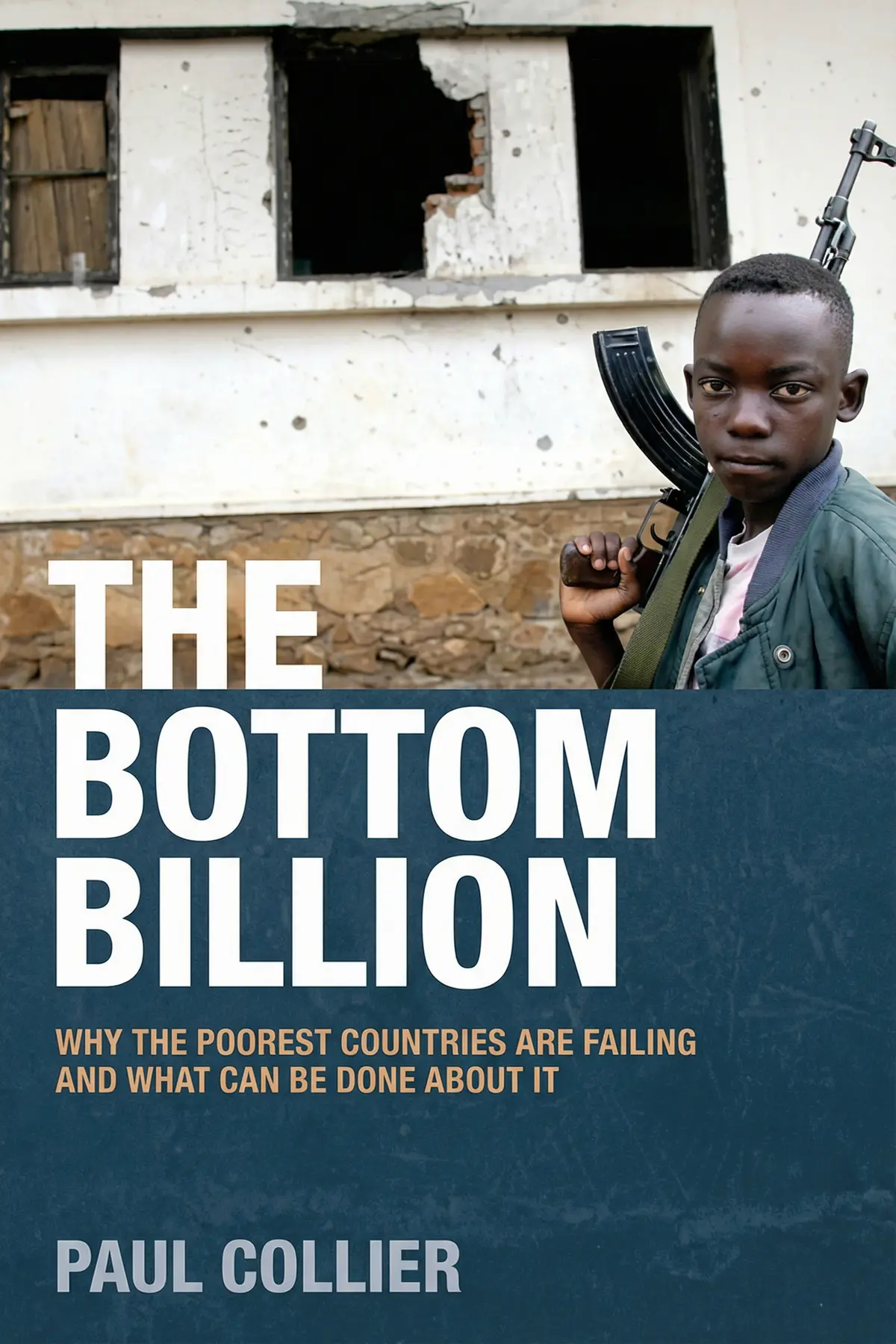
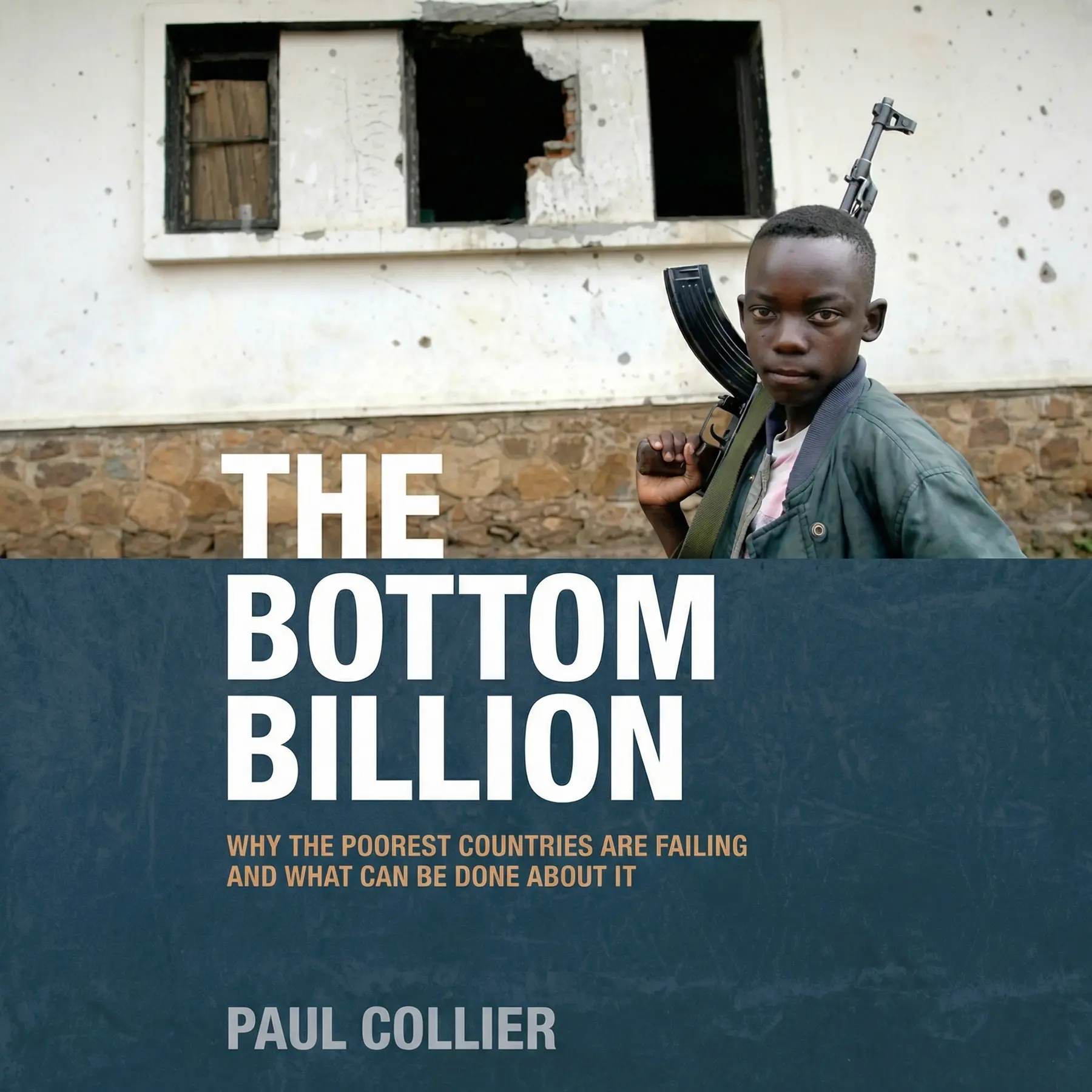
The Bottom Billion examines why fifty failing nations stay trapped in poverty while the rest of the world prospers, offering a bold four-part plan to bridge the widening global economic divide.
2 min 03 sec
When we think about the global economy, we often imagine a world divided into two groups: the rich West and the developing nations of the East and South. We see the rapid rise of countries like China and India and assume that, given enough time, the rest of the world will naturally follow suit. But there is a silent, tragic reality that this optimistic view misses. There is a third group of people—the bottom billion—who live in roughly fifty countries that are not just falling behind the West, but are falling behind the rest of the developing world as well. These countries are caught in a downward spiral where poverty isn’t just a temporary state; it is a structural trap.
Paul Collier, a leading expert on development economics, argues that our current approach to global poverty is fundamentally flawed because it fails to recognize that these nations face unique obstacles. They aren’t simply on a slower track toward prosperity; they are stuck in a hole. While the middle four billion people on the planet are experiencing the benefits of globalization and rapid industrialization, the bottom billion are facing stagnation or even decline. Their incomes are lower today than they were in the 1970s, and the gap is widening every year.
In this summary, we are going to explore why these fifty nations are failing to thrive. We will break down the four specific traps Collier identifies: the conflict trap, the natural resource trap, the trap of being landlocked with bad neighbors, and the trap of bad governance in a small country. We will also look at why traditional globalization hasn’t helped these countries and what the international community needs to do differently. This isn’t just about giving more money through aid; it’s about a radical shift in how we use trade, law, and even military power to provide these nations with a fighting chance to join the modern world. Let’s dive into the mechanics of poverty and the hard truths of global development.
2 min 12 sec
Discover why civil wars are not just political tragedies but economic dead ends that reinforce a self-perpetuating loop of instability and poverty.
2 min 19 sec
Learn why the discovery of oil or minerals can be a curse rather than a blessing for a developing nation’s economy and democracy.
2 min 03 sec
Explore the unique challenges faced by landlocked nations that are forced to rely on the infrastructure and stability of their struggling neighbors.
2 min 11 sec
Understand why failing policies and weak institutions are particularly difficult to overcome in small, marginalized nations.
2 min 20 sec
Investigate how the very forces that boosted China and India are now making it harder for the world’s poorest countries to compete.
2 min 13 sec
Delve into the complexities of foreign aid and discover why it needs to be viewed as a targeted tool rather than a universal cure-all.
2 min 02 sec
Discover the controversial but necessary role of external security and global standards in stabilizing failing states.
2 min 09 sec
Learn how changing the rules of global trade could give the world’s poorest nations a competitive edge in a crowded market.
2 min 12 sec
The plight of the bottom billion is one of the greatest moral and security challenges of our time. As Paul Collier has demonstrated, these fifty nations are not just experiencing a temporary dip in their fortunes; they are caught in a series of interlocking traps that the modern world has largely ignored or misunderstood. The gap between these failing states and the rest of the world is not just a tragedy for the people living there—it is a threat to global stability. Poverty, as we have seen, breeds conflict, and in an interconnected world, that conflict can easily spill over borders in the form of extremism, pandemics, and mass migration.
Breaking these traps requires a move away from ‘development as usual.’ We cannot rely on aid alone, nor can we expect the market to fix itself. Collier’s vision is one of ‘intelligent intervention.’ It requires a coordinated effort using all the tools at our disposal: targeted aid for reform-minded governments, trade preferences to jumpstart industry, international charters to set standards for governance, and, when necessary, military force to ensure basic security. This approach is not without risk, and it demands a level of political courage and international cooperation that is often in short supply.
Ultimately, the message of The Bottom Billion is one of both urgency and hope. While the challenges are immense, they are not insurmountable. We now understand the mechanics of these traps better than ever before. We know that growth is possible even in the most difficult environments if the right conditions are met. The task for the rest of the world is to stop looking the other way and to begin treating the bottom billion not as a lost cause, but as a priority. By providing the tools and the stability these nations need, we can help them join the rest of humanity on the path toward prosperity. The cost of action is high, but as Collier makes clear, the cost of continued neglect is far higher.
For decades, the global community has viewed poverty through a lens of 'developing' versus 'developed' worlds. However, Paul Collier reveals a more complex and troubling reality: while most of the world is seeing historic growth, a group of about fifty countries—home to one billion people—is actually falling behind or stagnating. These nations are not just poor; they are stuck in specific traps that traditional aid alone cannot solve. This book provides a deep dive into the four specific traps: conflict, natural resources, being landlocked with bad neighbors, and poor governance. Collier argues that to save the bottom billion, the international community must move beyond simple charity. He proposes a multi-pronged approach involving trade policy, international legal charters, and even military intervention to stabilize these fragile states. It is a call to action for a more sophisticated and courageous brand of global development.
Paul Collier is a distinguished Professor of Economics and the Director of the Centre for the Study of African Economies at Oxford University. He previously served as the Director of the Development Research Group at the World Bank. Collier is a leading expert on the economies of low-income countries and is also the author of Wars, Guns, and Votes: Democracy in Dangerous Places.
Paul Collier
Listeners find this work deeply insightful and engaging, especially for those with an interest in global inequality and international development. It is grounded in extensive research and significant statistical studies, and listeners value the clear, succinct writing style that makes the data easy to grasp. Many view it as essential reading that provides good value, with one listener highlighting that interventions have a very large pay-off.
After hearing Paul Collier speak on a podcast, I decided to dive into his most famous work. The way he breaks down the four traps—conflict, natural resources, being landlocked, and bad governance—is both brilliant and terrifyingly simple. It’s a landmark statistical study that avoids the usual fluff of development literature. I was particularly struck by the data on how oil wealth can actually stifle a country's growth by inviting corruption and crowding out exports. While some might find his tone a bit clinical, the logic is hard to ignore. This book provides a clear roadmap for anyone trying to understand why a billion people are being left behind by the global economy. It’s essential reading for anyone who wants to move beyond mere charity toward real structural solutions. Highly recommended for its clarity and depth.
Show moreEver wonder why some countries stay trapped in poverty despite decades of international aid? Paul Collier provides a compelling, evidence-based answer that moves away from the usual political finger-pointing. He identifies the specific traps—like the resource curse and bad governance—that prevent the poorest nations from ever reaching the first rung of the economic ladder. The truth is, his call for international charters and more targeted security interventions is quite revolutionary. I found the statistical analysis of why democracies with large resource rents struggle particularly insightful. It's a dense book, yet the writing is never bogged down by jargon. This is a must-read for anyone who cares about global justice and wants to understand the actual mechanics of development. It’s landmark research that actually offers a way forward for the poorest billion.
Show moreAs someone who follows international development closely, I found this book to be a breath of fresh air. It moves past the 'aid is good' vs. 'aid is bad' debate to look at the structural realities of the poorest nations. Collier’s focus on the 'convergence' of the global economy—and why the bottom billion are missing out—is the best explanation of global inequality I’ve seen. The writing is concise, the statistics are easily understood, and the solutions offered are practical rather than utopian. I especially appreciated his take on how private capital needs a stable environment to flourish. While he could have included more diverse viewpoints, the empirical foundation of his work is impressive. It’s an incredibly well-written guide to the most pressing economic challenge of our time. Definitely a five-star contribution to the field that everyone should read.
Show moreThe chapter on the natural resource trap was a total eye-opener for me. Collier explains 'Dutch Disease' with such clarity that even a non-economist can grasp how resource wealth often becomes a curse rather than a blessing. To be fair, the book is a bit dated now, but the core theories regarding how landlocked countries are at the mercy of their neighbors' infrastructure still ring true. I appreciated the concise, punchy writing style that moves quickly through complex data sets. However, he does tend to brush off the legacy of colonialism a bit too easily for my liking. It's a solid 4-star read because it challenges the 'rock star' approach to aid. We need more than just money; we need laws and charters that actually mean something on the ground for real growth.
Show moreWow, this really puts the struggle of the 'bottom billion' into perspective. It’s a sobering reminder that while much of the world is converging, these fifty-some countries are actually diverging and falling further behind. Collier’s prose is accessible and fast-paced, making it easy to digest his arguments about why aid often fails to reach those who need it most. Not gonna lie, some of his suggestions for military intervention made me uncomfortable, but his empirical approach forces you to grapple with uncomfortable truths. He argues that we can't just leave these countries to their own devices when the 'villains' have all the guns and money. It’s a bold, provocative book that demands action. Even if you don’t agree with every solution, the diagnosis of the problem is incredibly well-researched and hard to dismiss in our modern age.
Show moreFinally got around to reading this classic on global inequality and it lived up to the hype. Collier is an excellent writer who knows how to make statistics feel urgent and relevant. His argument that we are using aid badly and trade, laws, and security scarcely at all is a powerful critique of current Western policy. The discussion on how ethnic diversity isn't necessarily a cause for conflict—unless one group dominates—was particularly fascinating to me. To be fair, some of the data feels a bit old now, but the fundamental logic of the 'traps' remains a great framework. It's a quick read that packs a huge punch. If you want to understand the modern world, you need to understand the bottom billion. Highly recommended for students and professionals alike who want to solve global poverty.
Show moreFrankly, the arguments here are as compelling as they are controversial. Collier isn't afraid to step on toes, whether he’s calling out 'useful idiots' who advocate for trade barriers or criticizing the World Bank for its obsession with the wrong metrics. He provides a roadmap for how the international community can intervene more effectively to stop the cycle of coups and corruption. I loved the focus on 'reformers'—the heroes within these countries who are trying to make a difference against impossible odds. My only real gripe is that he tends to simplify complex political situations into mathematical equations. Life in a failing state is more than just a regression analysis. Still, the book is incredibly insightful and provides a much-needed reality check for the development community. It is well worth the time for anyone interested in economics.
Show morePicked this up for a class on international relations and found it surprisingly readable. Collier focuses on why the 'bottom billion' missed the globalization boat while the rest of the developing world took off. The distinction he makes between the five billion who are seeing growth and the one billion stuck in stagnation is vital. Personally, I found the section on the 'conflict trap' most compelling, especially the idea that civil war is often a matter of opportunistic thugs rather than genuine grievances. It’s a bit repetitive in places, and the statistics can feel a little detached from the human reality on the ground. Still, it’s a thought-provoking look at global inequality that doesn't just offer platitudes. It's a decent introduction to the field if you can overlook the total lack of citations.
Show moreLook, Collier's work is definitely a landmark study, but it’s not without its flaws. He makes a strong case for why the poorest billion are stuck in a cycle of stagnation, particularly when they are landlocked with bad neighbors. However, I found his dismissal of political repression as a cause for civil war to be a bit hard to swallow. Can we really say that grievances don't matter just because the stats don't always show a correlation? Frankly, the book feels a bit like it was written from a high tower at Oxford without enough input from the people living in these societies. The research is broad, but sometimes it misses the nuance of local culture and history. It’s an important contribution to development economics, but take the 'one-size-fits-all' solutions with a grain of salt and keep your skepticism handy.
Show moreThis is an incredibly frustrating read despite Collier’s obvious expertise. While the concepts of the ‘conflict trap’ or ‘bad governance’ are intuitive, the book suffers from a total lack of academic accountability. Where are the footnotes? Where is the bibliography for the lay reader to verify these claims? He relies almost entirely on his own unpublished research, which feels arrogant and intellectually lazy. Furthermore, his unabashed support for Western military intervention feels like a dangerous throwback to neocolonialism that ignores recent failures in Iraq. I appreciate the focus on the world's poorest, but the free-market bias is so heavy it blinds him to alternative solutions. It’s an influential book, sure, but it’s one that should be approached with extreme skepticism and a critical eye.
Show more
Yanis Varoufakis

Andrew Ross Sorkin
Ha-Joon Chang
Niall Kishtainy
William J. Bernstein
AUDIO SUMMARY AVAILABLE
Get the key ideas from The Bottom Billion by Paul Collier, plus 5,000+ more titles in English and Thai.







