
21 min 33 sec
The Influential Mind: What the Brain Reveals About Our Power To Change Others
By Tali Sharot
The Influential Mind uses neuroscience to reveal why logic often fails to change people’s minds. It provides a research-backed framework for more effective communication by aligning with the brain’s natural instincts.
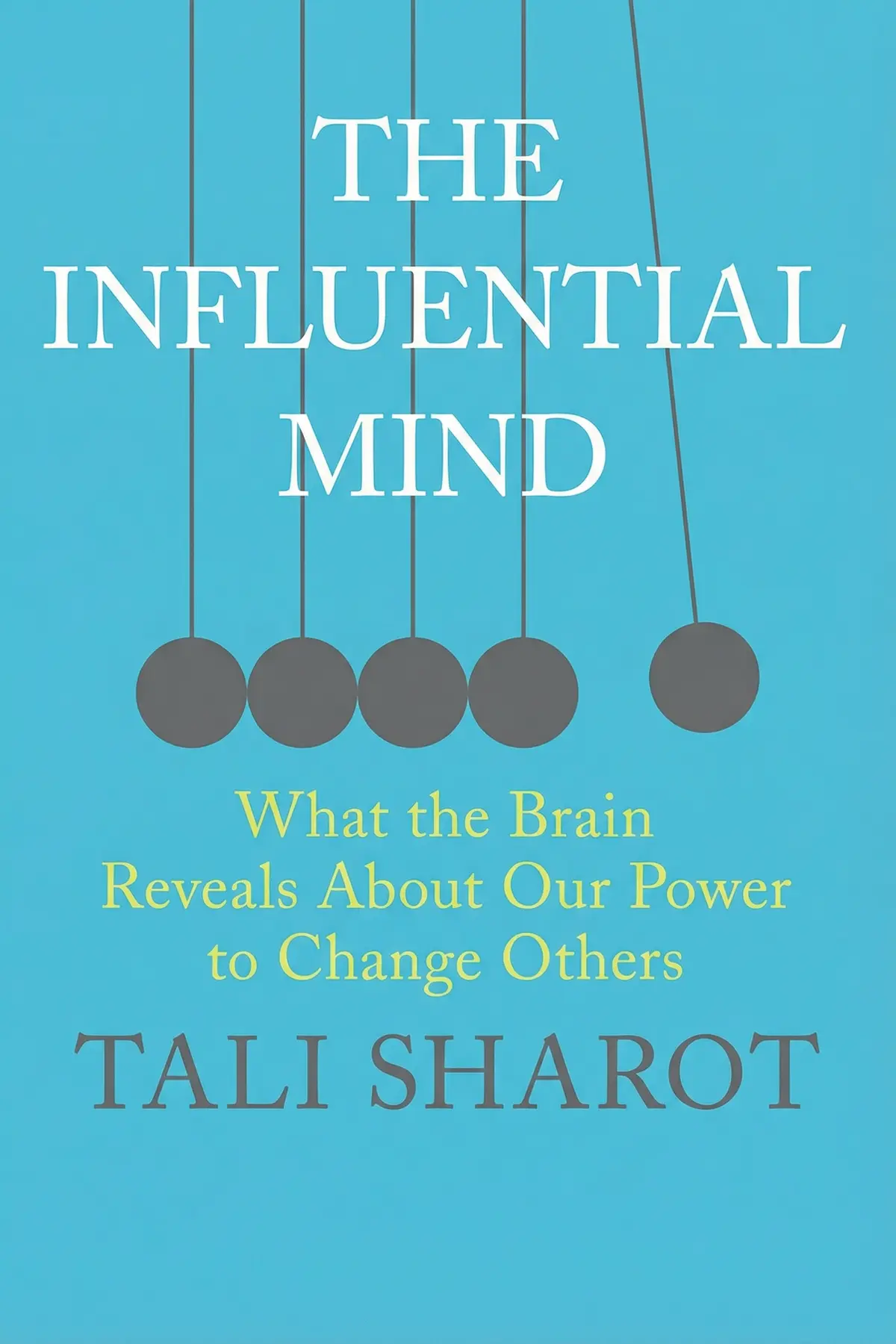
Table of Content
1. Introduction
1 min 41 sec
Have you ever found yourself in an argument where you had every single fact on your side, yet the other person refused to budge? It’s a common frustration, whether you’re trying to convince a colleague to change a workflow, persuading a friend to see a different political perspective, or even trying to get a child to eat their vegetables. We often assume that humans are logical creatures who simply need the right data to make the right decisions. But as neuroscientist Tali Sharot reveals in The Influential Mind, our brains aren’t actually built like modern computers that can be updated with a simple software patch of new information. Instead, we are navigating the world with an ancient biological operating system—one that is frequently more concerned with protecting our current beliefs than with finding objective truth.
In this summary, we are going to look at the fascinating ways the human brain processes influence. We’ll move past the gimmicky self-help mantras and look at what neuroscience actually tells us about how people make choices. We’ll explore why debunking a myth often makes people believe it more strongly, how a single person’s mood can ripple through an entire office, and why the feeling of being in control is one of the most powerful motivators we have.
The throughline of our exploration is this: to truly influence others, we must stop fighting against the brain’s natural hardwiring and start working with it. By understanding the instincts that drive us—such as the search for pleasure, the need for autonomy, and the power of emotion—we can become more effective communicators and leaders. Let’s dive into the inner workings of the mind to discover how we can reach people, even when they seem most resistant to change.
2. The Persistence of Prior Beliefs
2 min 49 sec
Discover why presenting people with contradictory evidence often fails to change their minds and actually reinforces their original, perhaps incorrect, viewpoints through a built-in neurological defense mechanism.
3. Framing Information for Positive Impact
2 min 24 sec
Learn why debunking myths can backfire and why focusing on positive benefits is a far more effective strategy for changing someone’s entrenched and potentially harmful opinions.
4. The Contagious Nature of Emotion
2 min 49 sec
Explore how our brains synchronize with those around us, making moods and emotional states highly infectious in both physical and digital environments.
5. Motivation Through Reward and Pleasure
2 min 36 sec
Discover how the brain’s instinctive drive toward rewards can be used to inspire action, and why fear-based motivation often leads to paralysis rather than progress.
6. The Biological Necessity of Control
2 min 40 sec
Learn how granting autonomy and a sense of agency to others can significantly improve their health, happiness, and willingness to comply with important guidelines.
7. The Ikea Effect and the Value of Effort
2 min 29 sec
Uncover the psychological secret behind why we value our own creations more than superior products made by others, and how to use this to build commitment.
8. Using Entertainment to Capture Attention
2 min 22 sec
Discover how the brain’s natural tendency to avoid boring or scary information can be bypassed by using humor and entertainment to deliver vital messages.
9. Conclusion
1 min 43 sec
As we have seen through these various neurological insights, influence is not about force, and it is rarely about pure logic. Our brains are complex biological organs with millions of years of evolution behind them, and they come with a specific set of rules. We’ve learned that once a mind is made up, it will physically shut down to ignore contradictory data. We’ve seen that emotions are contagious, moving from person to person like a virus, and that the promise of a reward is a much better motivator for action than the threat of a punishment.
We also discovered that the need for control is a biological imperative—that giving people agency over their own lives and work leads to better health and higher compliance. We saw how the ‘Ikea Effect’ makes us value what we help build, and how entertainment can be the key to unlocking attention for even the most serious topics.
The overarching lesson of The Influential Mind is that to change someone else’s behavior or opinion, you must first understand their internal state. You must look for common ground, frame your message positively, and provide a sense of control and participation. Instead of trying to argue your way through a locked door, neuroscience gives you the keys to understand how that door is built. By working with the brain’s natural inclinations rather than against them, you can build stronger connections, lead more effectively, and navigate the complex world of human interaction with much greater success. The next time you find yourself in a stalemate, remember that the person across from you isn’t just being difficult—they are simply human. Use these tools to meet them where they are, and you might just find that the path to influence is smoother than you ever imagined.
About this book
What is this book about?
The Influential Mind examines the underlying biological machinery that dictates how we form opinions and, more importantly, how we change them. While many people believe that logic and cold, hard facts are the best tools for persuasion, cognitive neuroscientist Tali Sharot reveals that our brains are often hardwired to resist information that contradicts our existing beliefs. By looking at the intersections of psychology and neuroscience, this summary explores the hidden forces—such as emotion, the need for control, and the search for reward—that truly drive human behavior. The promise of the book is to move beyond conventional, often ineffective advice about communication and leadership. Instead of banging our heads against the wall of human stubbornness, we learn to work with the brain’s natural inclinations. Readers will discover why a positive framing is more effective than a scare tactic, how our moods are literally contagious to those around us, and why giving someone a sense of agency is the fastest way to get their buy-in. It is a toolkit for anyone looking to bridge the gap between two minds in a way that is both scientific and profoundly human.
Book Information
About the Author
Tali Sharot
Tali Sharot is an esteemed professor of cognitive neuroscience at University College London, where she leads research into how the brain processes emotional responses and how these internal states shape our decision-making. Beyond her academic contributions, she is widely recognized for her book The Optimism Bias, which explores our brain's natural tendency to look on the bright side. Her research in this area was the core of her highly popular 2012 TED Talk, making her a leading voice in the study of human behavior and cognitive psychology.
Ratings & Reviews
Ratings at a glance
What people think
Listeners find the work an accessible title that improves awareness and offers great perspectives on human behavior. They also value the evidence-based perspective, as one listener notes the premises are supported by statistically significant research. The caliber of writing earns praise, with one listener describing it as well-written. However, the book’s duration draws varied feedback, with several listeners remarking that its short length makes for a quick read.
Top reviews
Goy
Tali Sharot has a gift for translating complex neuroscience into something actually useful for daily life. I was fascinated by the idea that we’re basically hardwired to seek immediate positive feedback rather than fear punishment. It explains so much about why my New Year’s resolutions always fail when I focus on the 'don't do this' aspect. The writing is incredibly smooth, and while the book is relatively short, every chapter feels packed with statistically significant insights that challenge your assumptions. I particularly enjoyed the section on curiosity and how we tend to avoid bad news until it's absolutely unavoidable. It’s a refreshing take on behavioral science that doesn't just recycle the same old tropes you see in every other pop-psychology book. If you want to understand how to actually move people, this is a must-read.
Show moreArt
This book is a masterclass in understanding the nuances of human interaction and persuasion. The most striking takeaway for me was the concept of the 'surprisingly popular' vote—the idea that the best answer isn't always the majority opinion, but the one that exceeds expectations. It’s a clever way to find hidden experts in a crowd and something I plan to implement in my own decision-making processes. Sharot’s prose is elegant and engaging, turning dry lab experiments into compelling stories about why we do what we do. The discussion on how stress makes us more conservative and risk-averse was also incredibly timely. I finished this in two sittings and immediately started recommending it to my colleagues. It’s rare to find a science book that is this practical.
Show moreSoontorn
Not gonna lie, I expected another dry science text, but I was pleasantly surprised by how much heart is in this book. Tali Sharot manages to make the 'embodied mind' concept feel personal and relevant to how we connect with one another. The idea that we are hardwired to respond to pleasure and freeze at danger is such a simple but effective lens for viewing human behavior. I also loved the section on curiosity and the 'burden of knowledge.' It’s a good reminder that just because we think something is important doesn't mean our audience will feel the same way. The book is well-researched, brilliantly paced, and offers a lot of 'aha!' moments. It’s easily one of my favorite reads of the year so far.
Show moreElla
Picked this up after seeing a recommendation, and I found the 'IKEA effect' explanation to be one of the most relatable parts of the whole text. Giving people a sense of agency, even if it's just an illusion of choice, is such a powerful tool for motivation. The book is well-written and moves at a brisk pace, which is great for busy readers who want the meat of the research without the fluff. I did feel like some of the anecdotes, like the one about the husband at the gym, were a bit simplistic compared to the deeper neurological data presented elsewhere. However, the overarching theme that we influence others by physically changing their brain states is profound. It’s a solid 4-star read for anyone looking to sharpen their communication skills.
Show moreVarinee
Ever wonder why providing more data to someone often makes them dig their heels in even deeper? Sharot explains this 'boomerang effect' brilliantly, showing how our priors are incredibly resistant to cold, hard facts. Truth is, we are emotional creatures, and this book does a fantastic job of highlighting why a powerful speech beats a spreadsheet every time. I loved the 'Amygdala of the Internet' label for Twitter; it perfectly captures the high-arousal environment that shapes so much of our public discourse today. The research is backed by solid experiments, making the conclusions feel earned rather than speculative. My only minor gripe is that the chapters felt a little disconnected at times, lacking a strong narrative thread to tie everything together.
Show moreSaovapa
As a manager, I’m constantly looking for better ways to lead my team, and the insights on agency here were incredibly valuable. People really do need to feel in control to stay motivated, and learning how to expand their sense of influence can lead to much better compliance and less frustration. The scientific approach taken by Sharot is impressive, as she relies on statistically significant research rather than just anecdotal evidence. I found the chapter on how our state of mind dictates our reaction to news particularly enlightening. We often forget that a stressed person processes a 'threat' very differently than someone who is relaxed. It’s a well-written, insightful guide that has already changed how I frame feedback during our weekly meetings.
Show moreWararat
After hearing so much about Tali Sharot’s previous work on the optimism bias, I was eager to dive into this one. The way she breaks down social learning—why we follow the crowd while simultaneously craving uniqueness—is a fascinating paradox. The book is an easy read that manages to increase your awareness of your own cognitive blind spots without being condescending. I was especially intrigued by the point that physical changes happen in the brain when we successfully influence someone. It makes the act of communication feel much more consequential. While it isn't the most comprehensive book on the subject, its brevity is actually a strength, allowing the core messages to really land. A great addition to any library on human behavior.
Show moreBun
To be fair, much of what is discussed here will feel like a retread if you’ve already spent time with Kahneman or Cialdini. Concepts like anchoring and confirmation bias are staples of the genre, and Sharot doesn't necessarily reinvent the wheel. That said, her conversational tone makes the heavy science feel much more digestible for a general audience. I appreciated the specific examples regarding vaccine debates and how focusing on benefits works better than debunking myths. It’s a quick read, maybe a bit too short for the price point, but it serves as a decent refresher. If you are new to mind and brain exploration, you’ll likely find it much more enlightening than a seasoned reader of behavioral science would.
Show moreAnucha
Look, it’s a solid introduction to the field, but it occasionally feels like a hodge-podge of observations rather than a cohesive theory. One minute we’re talking about baby iPhones, and the next we’re diving into the wisdom of crowds. While the individual tid-bits are certainly interesting, I was hoping for a more powerful, unified takeaway. The author’s involvement in many of the experiments adds a layer of authenticity that I appreciated, though. It’s a caruccio read, as the Italians say—pleasant enough but perhaps a bit light for those looking for a deep academic dive. It works best as a 'plane book' that you can finish in a few hours and walk away with three or four solid tips for your next presentation.
Show moreTaw
Frankly, I found myself getting distracted by the semantics right from the prologue. The author starts by talking about a 'role' we all share and then immediately pivots to calling it a 'duty' to affect others, which felt like a leap in logic. Beyond the word choice, the book felt quite repetitive of older titles like Influence. I was hoping for some groundbreaking new neuroscience, but instead, I got a lot of familiar stories about incentives and social learning. It’s very short, which some might like, but for me, it felt like it lacked the depth required to truly explore the 'influential mind.' It’s fine for a high school student, but if you’ve read more than two books on this topic, you can probably skip this one.
Show moreReaders also enjoyed


59 Seconds: Change Your Life in Under a Minute
Richard Wiseman

A Liberated Mind: How to Pivot Toward What Matters
Steven C. Hayes
Acting with Power: Why We Are More Powerful Than We Believe
Deborah Gruenfeld
AUDIO SUMMARY AVAILABLE
Listen to The Influential Mind in 15 minutes
Get the key ideas from The Influential Mind by Tali Sharot, plus 5,000+ more titles in English and Thai.
- 5,000+ titles
- Listen as much as you want
- 7-day free trial
- Cancel anytime







