

A Life Decoded: My Genome: My Life
J. Craig Venter
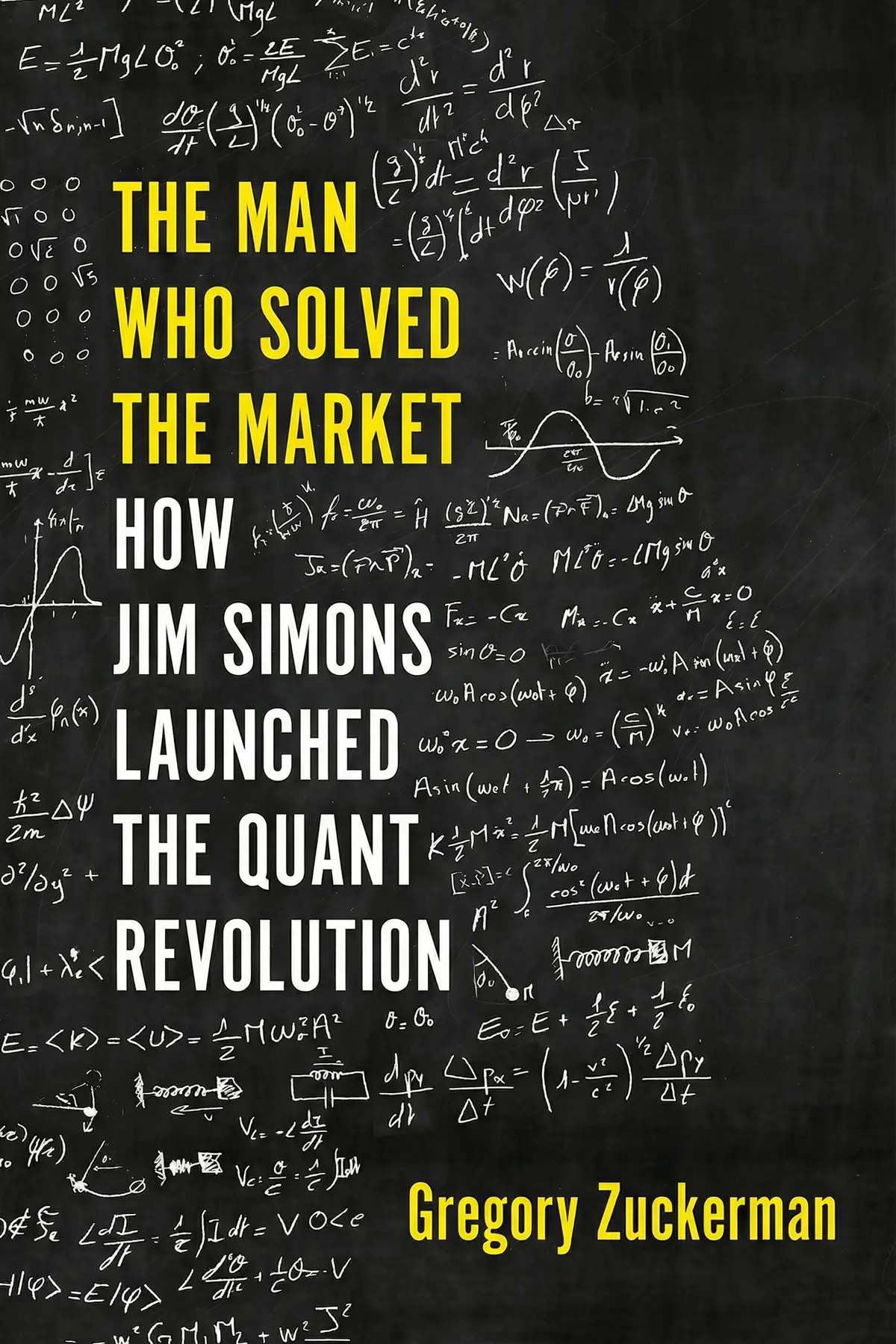
Explore the life of Jim Simons, the mathematician who revolutionized Wall Street. This summary details how he used complex algorithms and data to build Renaissance Technologies, the most successful hedge fund in history.
2 min 02 sec
Imagine looking at the world not through the lens of stories, emotions, or news headlines, but through the cold, elegant precision of mathematics. For most of us, the stock market looks like a chaotic sea of numbers, driven by the whims of human fear and greed. But for Jim Simons, the markets were just another set of patterns waiting to be decoded. He didn’t see companies or CEOs; he saw shoals of data moving in rhythmic, predictable cycles, much like the celestial bodies in the night sky. He believed that if you could find the right formula, you could predict the future movements of these patterns and, in doing so, unlock a fortune unlike anything the world had ever seen.
Jim Simons isn’t your typical Wall Street tycoon. He didn’t start in a boardroom or on a trading floor. He was a geometer, an award-winning academic, and a Cold War code-breaker. He is the man who launched the quantitative revolution, a shift that moved the levers of global finance from human intuition to machine-led algorithms. His firm, Renaissance Technologies, became a mythic entity in the financial world, producing returns that made legends like Warren Buffett and George Soros look like amateurs.
In this exploration of The Man Who Solved the Market, we are going to trace the arc of a life that redefined what it means to be an investor. We’ll see how a toddler’s fascination with Zeno’s paradox grew into a professional obsession with hidden patterns. We will explore how Simons transitioned from the ivory towers of academia to the high-stakes world of currency and commodity trading, and how he navigated the moral and psychological toll that came with such a radical shift. This isn’t just a story about money; it’s a story about the power of an idea and the relentless pursuit of a code that could explain the world’s most complex mysteries.
2 min 36 sec
From a very young age, Jim Simons displayed a unique ability to see the world through numerical relationships, even grappling with complex philosophical paradoxes before he started school.
2 min 15 sec
Simons quickly rose through the ranks of academia, but his restless mind soon pulled him toward the clandestine world of government code-breaking during the Cold War.
2 min 01 sec
Even as he achieved greatness in pure mathematics, Simons began to view the financial markets as an abstract system that could be modeled like a geometric surface.
2 min 01 sec
Leaving the security of university life behind, Simons founded Monemetrics to put his mathematical theories to the ultimate test: the pursuit of extreme wealth.
2 min 08 sec
As the money began to pour in, Simons found himself wrestling with his conscience, comparing his shift from academia to finance to a literary tale of lost honor.
2 min 01 sec
By shifting the focus from human intuition to massive historical data sets, Simons transformed his firm into a technological powerhouse capable of seeing what others could not.
1 min 55 sec
Through the collaboration of brilliant mathematicians like James Ax, Renaissance developed the Medallion fund, which became the most profitable portfolio in history.
2 min 01 sec
The firm’s expansion brought together brilliant but clashing personalities, eventually leading to a political and professional rift that shook the organization.
1 min 55 sec
Beyond his financial achievements, Jim Simons has used his fortune to become a modern-day Medici, funding scientific research and education on a global scale.
1 min 57 sec
The story of Jim Simons and Renaissance Technologies is more than just a tale of unprecedented financial success. It represents a fundamental shift in how humanity interacts with complex systems. Before Simons, the stock market was seen as a human drama—a place of stories, reputations, and emotional swings. By applying the rigor of pure mathematics and the power of computational data, Simons proved that beneath the noise of the trading floor lies a world of predictable patterns and statistical certainties.
Throughout this journey, we’ve seen how Simons’ childhood fascination with paradoxes led him to the forefront of Cold War intelligence and eventually to the pinnacle of global finance. We’ve seen the psychological weight he carried as he transitioned from the ‘pure’ world of academia to the ‘applied’ world of wealth, and how he navigated the inevitable human conflicts that arise even in the most data-driven environments.
The takeaway from Simons’ life is that no system is truly impenetrable if you have the patience to collect the data and the brilliance to see the patterns within it. His legacy is found not just in the billions of dollars he earned, but in the way his ‘quant’ revolution has permeated every industry, from medicine to sports. As you move forward, consider the ‘hidden Markov chains’ in your own life or industry. What signals are you missing because you’re focused on the story rather than the data? Jim Simons showed us that the code to ‘solving’ any market—or any challenge—is often hidden in plain sight, waiting for someone with the right tools to uncover it. Whether through his philanthropy or his mathematical breakthroughs, Simons remains a figure who reminds us that the world is a beautiful, structured puzzle, and that there is always a deeper logic waiting to be discovered.
The Man Who Solved the Market chronicles the extraordinary journey of Jim Simons, a world-class mathematician and former code-breaker who turned his attention to the financial markets. While traditional investors relied on intuition and economic indicators, Simons and his team at Renaissance Technologies sought to uncover hidden mathematical patterns in market data. This narrative explains the development of the quantitative revolution, showing how Simons applied pure mathematics and early computer science to achieve unprecedented financial success. It also explores the personal and professional challenges Simons faced, including the moral weight of leaving academia for wealth, the internal conflicts within his firm, and his eventual transition into large-scale philanthropy. It is a story of how one man’s obsession with patterns transformed the landscape of modern finance.
Gregory Zuckerman is a Special Writer at The Wall Street Journal. He’s a three-time winner of the Gerald Loeb award, which is the highest honor in business journalism. As well as The Man Who Solved The Market, he is the author of The Frackers and The Greatest Trade Ever.
Listeners find this work absorbing and expertly crafted, especially appreciating the intriguing chronological narrative and deeply investigated material regarding the premier financial geniuses of the modern era. Additionally, the character studies earn praise, with one listener specifically pointing out the valuable perspectives on algorithmic trading. On the other hand, opinions are divided regarding the book’s cost-effectiveness and political themes; some view it as a valuable purchase, whereas others feel it is a poor use of funds and too politically charged.
This book offers a masterclass in narrative non-fiction, chronicling the rise of Jim Simons and his band of eccentric geniuses. Zuckerman excels at spinning a complex timeline into a gripping story that feels more like a thriller than a financial history. While many writers would get bogged down in dry data, the author focuses on the human element, showing how a group of mathematicians and code-breakers essentially conquered Wall Street. I found the transition from academic theory to the high-stakes world of Renaissance Technologies to be particularly fascinating. It’s a well-researched piece of work that sheds light on the greatest financial minds of this century without requiring a PhD to understand. Though the "winning formula" remains a closely guarded secret, the insights into the shift toward computerized investing are invaluable. If you enjoy deep-dive biographies that focus on how individuals change an entire industry, this is an essential read.
Show moreEver wonder how a bunch of code-breakers and academics managed to humble the titans of Wall Street? Zuckerman provides the answer through a brilliantly researched timeline that explores the philosophy of empiricism over rationalism. The most striking part was learning how Simons and his team ignored the "why" of the market and focused purely on the "what." They found patterns in the noise that no human eye could ever detect. This book convinced me that the efficient market hypothesis is flawed because humans are simply too emotional to be rational. The writing is snappy and the pacing is excellent, making it one of the most engaging finance books I’ve read in years. It’s a testament to the power of data and the brilliance of those who know how to listen to it. Highly recommended for anyone curious about the birth of the quant era.
Show moreAs someone who has always been skeptical of the 'efficient market' theory, Zuckerman’s account was incredibly validating. He shows how Renaissance exploited the inherent irrationality of human traders through sheer computational power and relentless data-mining. The truth is, the machine is immune to the cognitive biases that plague even the most seasoned Wall Street veterans. I found the sections on how they sourced non-traditional data sets to be the most enlightening part of the book. It’s a well-written, fast-paced journey through the evolution of modern finance. Zuckerman is a superb spinner of complex stories, and he manages to make the world of high-frequency trading feel human and relatable. Whether you're an industry insider or a layman, there's a lot to gain from this. It’s a fascinating look at the personalities who turned the financial world into a giant math problem and actually solved it.
Show moreWow, Zuckerman really pulled back the curtain on one of the most secretive and successful firms in history. The timeline is fantastic, tracing the path from Simons’ work as a code-breaker to the creation of the Medallion Fund. It’s a relief to read that even the employees were skeptical of their own success at first, only to realize the numbers were 100% genuine. The book does a great job of explaining that removing human error from investing doesn't eliminate human conflict from the office. I was gripped by the rivalry between the mathematicians and the traditional traders. The insights into computerized investing and the use of massive data sets are eye-opening for anyone who thinks they can beat the market with a spreadsheet. This is easily one of the best finance books of the decade. It is a brilliant, well-researched, and highly engaging story about the power of the human mind—and the machines it creates.
Show morePicked this up expecting a technical manual on quantitative trading, but I found a compelling character study instead. Look, if you’re looking for actual mathematical formulas or a blueprint to build your own algo, you’ll be disappointed. Zuckerman focuses instead on the personalities, specifically the duo of Brown and Mercer and their background in natural language processing at IBM. It’s fascinating to see how they applied linguistic patterns to market fluctuations. To be fair, the book does get a bit bogged down in the middle with a revolving door of secondary characters who are hard to distinguish from one another. However, the overall story of how they maintained their edge while rivals like Long-Term Capital Management crashed is worth the price of admission. It’s a solid, engaging account of the quants' takeover of the financial world, even if it skips the nitty-gritty math.
Show moreFinally got around to reading this after hearing colleagues rave about it, and it mostly lived up to the hype. The book provides an excellent biography of Simons, but the real stars are the internal dynamics and the political factions that developed within Renaissance. It’s a fascinating look at how even the smartest people in the room can succumb to ego and rivalry. My only gripe is that the author is sometimes overly dramatic about minor trading losses, acting like the firm was on the brink of collapse when they were still up 20% for the year. It feels like a forced attempt to create tension where the data shows none existed. Still, the insight into how they used Markov chains and price ratios is fascinating. It’s a worthwhile investment for those interested in the intersection of math and money, provided you can ignore the occasionally sensationalist tone.
Show moreThe chapter on the 2007-2008 financial crisis really highlights the tension between mathematical models and human panic. I loved the anecdote about Simons wanting to override the algorithms during a market dip, only to be held back by his own team. It shows that even the man who "solved" the market still felt the primal urge to panic sell. Zuckerman does a great job illustrating the move from old-school chartism to modern artificial intelligence. While the book lacks a "cast of characters" page—which would have been helpful given the dozens of PhDs introduced—the central narrative remains clear. The writing style is accessible and the sentences flow well, making for a quick read. It’s a fascinating story of how intellectual arrogance was replaced by data-driven humility. Even with the slightly distracting political segments, the core story of Renaissance Technologies is well worth your time.
Show moreTo be fair, the title is a bit of a marketing gimmick because the book isn't just about Jim Simons. After the first few chapters, the focus shifts heavily toward Robert Mercer and Peter Brown, which might throw off readers looking for a pure biography. I was hoping for more industrial context on technical analysis and why Renaissance’s models succeeded where others failed so miserably. Instead, we get a lot of fluff about the brand of cigarettes Simons smoked and mundane details about office lunches. The detour into 2016 politics and Mercer’s donations felt like it belonged in a completely different book, making the final third a bit of a slog. It’s not a bad read, but it feels like the author was stretching thin material to fill pages. If you like year-by-year event logs, you'll enjoy it, but don't expect deep market secrets.
Show moreAfter hearing so much hype, I found the final product to be a bit of a mixed bag. On one hand, the early years of Simons’ career and his mathematical achievements are genuinely interesting. On the other hand, the book eventually devolves into a series of anecdotes about workplace grievances and political donations. I missed being presented with more industrial context regarding how Renaissance's short-term tactics differed from traditional value investing. The author focuses so much on the secrecy of the firm that he ends up filling the gaps with useless trivia. It’s a bit frustrating to read about "stolen code" without ever getting a clear explanation of what that code actually did or how the theft was resolved. If you enjoy character-driven biographies, you might like this, but if you want to understand the 'how' of the market, you might want to look elsewhere.
Show moreNot what I expected at all, and frankly, quite a disappointment for someone looking for actual substance. I've been interested in quantitative analysis for years, yet I learned almost nothing new about the actual mechanics of RenTech’s success. The author seems obsessed with trivialities like how tall the employees were or what they played in poker games. Why do I need to know about the personal lives of the employees' children? The whole narrative feels like listening to a grandpa's story where he skips every interesting technical fact to talk about his old friends. Then, in the end, we get a massive dump of political commentary that feels totally out of place. This book is dangerously close to being a waste of time for anyone who actually works in the industry. It’s mostly gossip and very little insight, which is a shame given the subject matter.
Show moreJ. Craig Venter

Ishmael Beah

James Herriot

Barack Obama


Masaji Ishikawa
Andrew Ross Sorkin
Ben Macintyre
AUDIO SUMMARY AVAILABLE
Get the key ideas from The Man Who Solved the Market by Gregory Zuckerman, plus 5,000+ more titles in English and Thai.







