
God Is Not Great: How Religion Poisons Everything
Christopher Hitchens
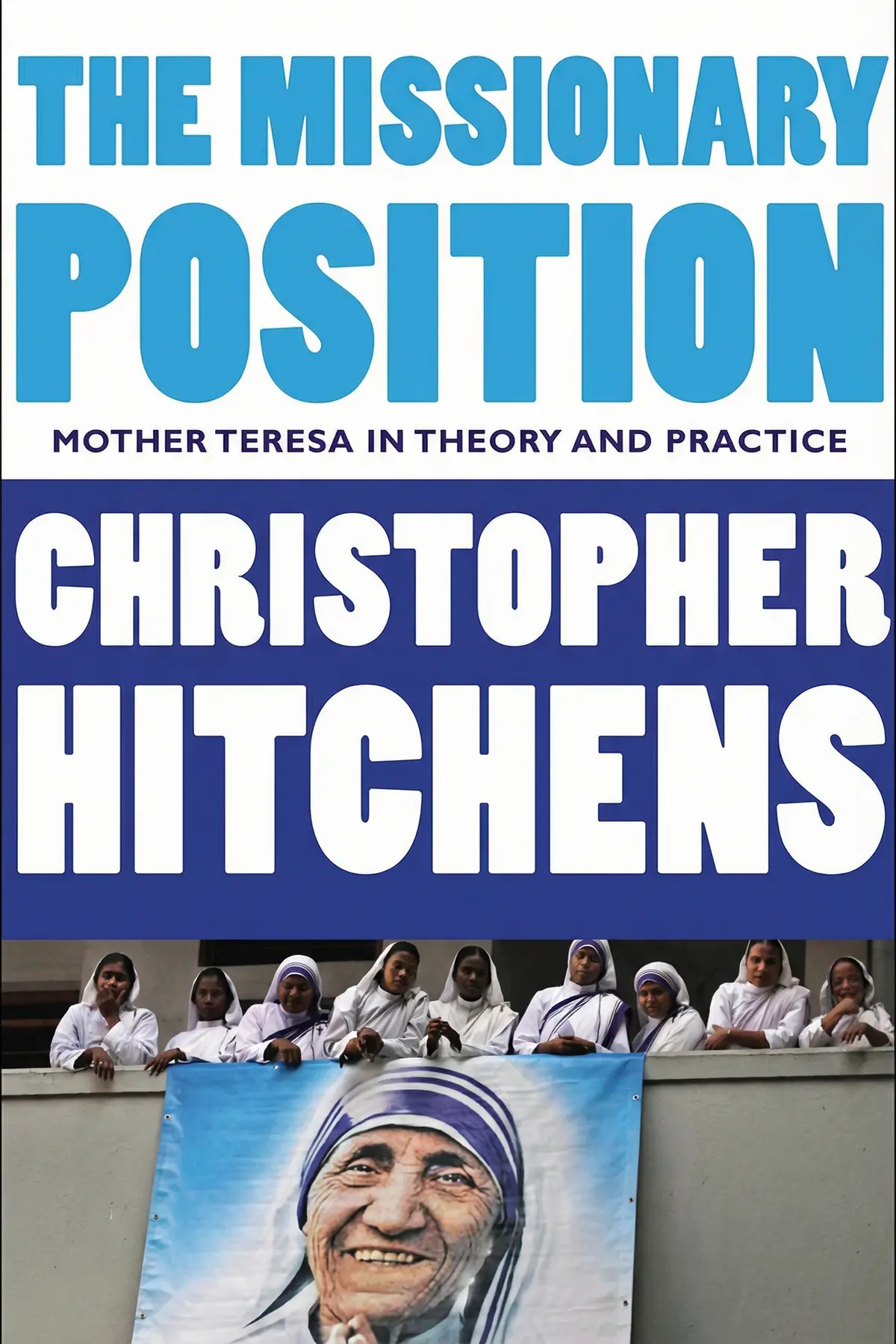
This critical investigation by Christopher Hitchens challenges the long-standing public perception of Mother Teresa. By examining her methods, motives, and radical beliefs, the author invites a deeper look at the reality behind the saintly image.
1 min 29 sec
When we think of the name Mother Teresa, the images that typically come to mind are those of selfless devotion, a tiny figure in a white and blue sari, and an almost superhuman commitment to the poor. For decades, she has been held up as the ultimate standard of human kindness—a living saint whose work was beyond reproach. But what happens when a seasoned journalist and dedicated skeptic decides to look beyond the carefully crafted image? In “The Missionary Position,” Christopher Hitchens does exactly that. He invites us to step away from the glowing, uncritical biographies we’ve all heard and instead engage in a rigorous analysis of a woman who became a global icon.
This isn’t just a list of grievances; it’s an exploration of the fundamental disconnect between a public reputation and a private reality. Hitchens, known for his sharp wit and socialist perspective, doesn’t just question the results of her work; he interrogates the very motives and radical beliefs that drove her. As we move through this analysis, we’ll see how Hitchens challenges the idea that suffering should be celebrated and the transparency of how charitable funds are used. It’s a journey that asks us to value truth over comfort and to realize that even our most cherished symbols of goodness deserve to be held to a standard of accountability. What follows is a look at the discrepancy between the saintly myth and the practical reality of her missions.
2 min 09 sec
How does a person become a global symbol of perfection, and what are we missing when we refuse to look behind the curtain? Explore the power of image and the necessity of critical inquiry.
1 min 56 sec
What if the goal of charity wasn’t to end pain, but to celebrate it? We examine the radical theological perspective that views suffering as a divine gift rather than a problem to solve.
2 min 00 sec
Where does the money go when a world-famous organization receives millions in donations? This section explores the discrepancy between massive financial support and the actual quality of care provided.
2 min 07 sec
Beyond the clinics, how do radical beliefs influence global social policy and political alliances? Discover the broader impact of dogmatic stances on issues like poverty and population control.
1 min 44 sec
As we wrap up our look at “The Missionary Position,” we are left with a much more complex and challenging portrait than the one we started with. Christopher Hitchens has taken us on a journey that deconstructs a global icon, asking us to look past the white sari to see the human being and the institution behind them. The throughline of this analysis is clear: holiness is not a shield against scrutiny. By questioning the motives, methods, and radical beliefs of Mother Teresa, Hitchens isn’t just attacking a person; he’s defending the principle of critical inquiry.
He reminds us that true compassion shouldn’t be separated from modern medicine, transparency, and social progress. If we truly care about those in need, we must demand that they receive the best possible care, not just a place to die in the name of a religious ideal. We must also be willing to ask where our donations are going and what kind of social policies we are supporting when we champion certain figures. The lesson here is one of intellectual courage. It’s easy to follow the crowd and celebrate a consensus hero. It’s much harder to look at the evidence, even when it contradicts a comforting story. Hitchens, with his sharp socialist and anti-religious perspective, challenges us to be more than just passive consumers of saintly narratives. He encourages us to be active, critical thinkers who value the physical well-being and rights of the individual over the glory of any institution. In the end, the book serves as a powerful reminder that the best way to honor humanity is to look at it clearly, without the distorting lens of myth, and to hold everyone to the same standard of truth and accountability.
The Missionary Position offers a provocative and rigorous critique of one of the twentieth century's most beloved figures: Mother Teresa. While the world largely viewed her as the ultimate symbol of selfless compassion, journalist Christopher Hitchens argues that this reputation was carefully constructed and often at odds with the truth of her work. Through a sharp lens, the book investigates the actual conditions within her missions and the radical religious ideology that governed her approach to suffering. Hitchens explores the tension between the massive financial donations received and the rudimentary medical care provided to the sick and dying. He questions whether the primary goal was the relief of human misery or the advancement of a specific theological agenda that viewed poverty as a spiritual gift. By scrutinizing her political associations and her uncompromising stances on social issues, the book promises to pull back the veil on a global icon. It serves as a call for critical thinking, suggesting that no figure, regardless of their perceived holiness, should be exempt from accountability or investigation.
Christopher Hitchens was an English author, debater, and journalist known for his sharp intellect and fearless prose. As a self-proclaimed socialist, Hitchens frequently took controversial positions, challenging famous public figures and established institutions. Throughout his career, he became a prominent voice in political and social commentary. In his later years, he gained widespread fame for his anti-religious writing and his strong support for the Iraq War. His work is characterized by a commitment to rigorous inquiry and a refusal to accept conventional wisdom, a legacy that continued until his passing in 2011.
Christopher Hitchens
Christopher Hitchens

Christopher Hitchens
Listeners find the work thoroughly researched and full of direct facts, with one review characterizing it as a "great scalpel of reason." Furthermore, the prose is highly regarded; one listener observes that it is written almost as a post-mortem, while others enjoy its scathingly funny tone. The pacing is also seen as impactful, with one review emphasizing Hitchens’ skill at skewering ideas. On the other hand, its credibility garners a variety of responses, as some applaud how it reveals the truth behind the myth while others find it unconvincing. The concise nature and skeptical viewpoint also lead to varied feedback; some value the brevity while others feel it is too short, and some label it as cynical.
Hitchens’ prose functions as a surgical instrument, meticulously dissecting the layers of myth surrounding a global icon. In this brief yet potent volume, he moves past the saintly veneer to reveal a woman whose primary concern was not the alleviation of suffering, but the promotion of a specific, dogmatic worldview. It is particularly jarring to read about the millions sitting in bank accounts while patients were denied basic medical care or proper analgesics beyond aspirin. Hitchens skewers the idea that poverty is somehow a beautiful gift from God, especially when Mother Teresa herself sought out the finest Western clinics for her own ailments. The account of her interactions with figures like Charles Keating and the Duvaliers in Haiti is deeply disturbing and well-documented. While the book is scathingly funny in parts, it remains a serious piece of investigative reporting. I found the pacing effective, even if the brevity leaves you wanting more data. Truly, this is a necessary 'scalpel of reason' for anyone who values truth over comfortable hagiography.
Show moreFinally, someone had the courage to look past the Nobel Prize and examine the actual outcomes of this mission. The chapter on her involvement with the Savings and Loan fraudster Charles Keating was a real eye-opener for me. Mother Teresa’s refusal to return stolen money to the victims, even when asked by the prosecutor, speaks volumes about her priorities. Hitchens uses a 'scalpel of reason' to show that she was an operative for a very political papacy rather than just a simple nun. The story of her telling a terminal cancer patient that Jesus was 'kissing' them through their pain—only for the patient to ask her to make him stop—is haunting. This is not a comfortable book, but it is an essential one. Hitchens' style is scathingly funny and his arguments are presented with a straightforward clarity that is hard to refute. A brilliant, necessary takedown of a manufactured myth.
Show moreThe Missionary Position is a devastating post-mortem of a manufactured icon. Hitchens is at his best here, using straightforward facts to dismantle the 'Saint of Calcutta' piece by piece. The evidence regarding her political alliances with right-wing dictators and her acceptance of stolen money from Charles Keating is simply undeniable. It’s a brave book because it attacks one of the few figures that everyone was 'supposed' to love. I found the pacing to be perfect; he doesn't waste a single word. The descriptions of the 'Home for the Dying'—where needles were reused and cancer was treated with nothing but aspirin—are enough to make anyone rethink her legacy. Hitchens shows that she wasn't a friend to the poor, but a friend to poverty itself. This is an essential read for anyone who prefers the harsh light of truth over the warm glow of a lie.
Show moreChristopher Hitchens doesn't just argue; he eviscerates. This book is a masterclass in how to dismantle a public myth using the subject's own words and actions. I was particularly struck by the contrast between the spartan, often miserable conditions of her clinics and the high-tech medical care she received herself. The fact that her order had tens of millions of dollars in the bank while patients were suffering on cots is a point that Hitchens hammers home with ruthless efficiency. His writing style is punchy and direct, making this a very quick but incredibly dense read. He manages to skewer the idea that she was a selfless servant of the poor, revealing instead a missionary focused on a very narrow, dogmatic agenda. It’s a brilliant, straightforward, and deeply necessary piece of reporting. If you think you know Mother Teresa, read this and think again.
Show moreAfter years of hearing nothing but praise for the 'Saint of the Gutters,' reading this was a massive reality check. The author presents a compelling case that Mother Teresa was more interested in the spiritual utility of pain than in actually curing anyone. I was horrified by the descriptions of unhygienic conditions and the practice of 'baptizing' the dying without their informed consent. Hitchens writes with a sharp, post-mortem style that is both informative and deeply cynical. To be fair, he doesn't hide his anti-religious bias, which might turn some readers off, but the facts regarding her finances are hard to ignore. Why was there $50 million in a Bronx bank account while children were being treated in such squalor? It’s a short read that packs a punch, though it feels a bit like a long-form essay rather than a comprehensive biography. It definitely makes you question how the media constructs these untouchable figures.
Show moreEver wonder why the world’s most famous charity seemed to lack basic medical supplies like sterile needles? This book answers that question by examining the actual theology behind the Missionaries of Charity. Hitchens argues that for Mother Teresa, suffering wasn't something to be fixed, but a way to get closer to God. This perspective explains why millions of dollars in donations didn't result in better hospitals. I found the section on her political support for the Duvalier regime in Haiti to be particularly damning. Hitchens’ writing is as sharp as ever, though he definitely has an axe to grind against the Catholic Church in general. Gotta say, the brevity of the book is both a strength and a weakness; it stays focused and fast-paced, but I would have liked to see even more forensic detail on the money trail. Regardless, it’s a powerful critique of how we canonize people based on reputation rather than results.
Show morePicked this up after seeing a documentary on Hitchens, and I wasn't disappointed by his signature brand of intellectual savagery. The book is short, but it hits like a freight train. He basically performs a post-mortem on Mother Teresa’s reputation, exposing the gap between her public image and her private actions. I was particularly struck by the hypocrisy of her preaching against birth control in overpopulated areas while ignoring the actual needs of the people living there. The prose is brilliant, though occasionally it feels like Hitchens is more interested in the 'scathingly funny' takedown than in providing a fully rounded portrait. Truth is, it’s a pamphlet-sized bomb aimed at the heart of a global consensus. It won't convince everyone, especially those with deep faith, but for a rationalist, it’s incredibly satisfying. A solid 4 stars for the sheer force of the argument and the quality of the investigative reporting.
Show moreLook, I’ve always been a bit skeptical of celebrity saints, so this book was right up my alley. Hitchens focuses on the 'business' of Mother Teresa, looking at where the money went and what it actually bought. The answer—not much in the way of healthcare—is pretty shocking. He writes with a 'scalpel of reason' that is both impressive and a bit terrifying in its precision. I appreciated the brevity of the work, though some might find it a bit too short for such a heavy topic. The way he links her to various political figures like the Duvaliers adds a much-needed layer of context to her 'apolitical' stance. It’s a bit of a grim read, especially the parts about the 'baptisms' of unsuspecting Hindus and Muslims on their deathbeds. Hitchens is scathingly funny at times, which helps cut through the heaviness of the subject matter. Very insightful.
Show moreIs it possible to be too cynical even when you're probably right? This book is a classic example of Hitchens’ ability to skewer ideas with wit and venom. He makes some excellent points about the lack of medical standards in the homes for the dying and the questionable associations with dictators. However, the tone is so relentlessly aggressive that it occasionally undermines the weight of the evidence. I wanted more cold, hard data on the finances and perhaps a bit more nuance regarding the cultural context of Calcutta at the time. It’s incredibly short—I finished it in about two hours—and it feels more like a polemic than a balanced investigation. Frankly, if you already dislike organized religion, this will be your bible. If you’re looking for a deep, objective dive, you might find the 'angry expose' vibe a bit exhausting. It’s a great piece of writing, but it feels incomplete in its brevity.
Show moreWhile I appreciate a good contrarian viewpoint, this felt less like an investigation and more like a mean-spirited hit job. I don't doubt that there were issues with medical care and finances, but Hitchens' tone is so mocking that it becomes distracting. He treats every action as a calculated piece of villainy, leaving no room for the possibility that she was simply a woman of her time and faith. The book is very short, which makes it feel like he’s just cherry-picking the worst moments to skewer her ideas. Not gonna lie, I expected something a bit more balanced and a lot more substantial. It feels more like a long, angry editorial than a well-researched book. If you already hate Mother Teresa, you'll love this, but if you're looking for an objective analysis of her life’s work, you should probably look elsewhere. Just too cynical for my taste.
Show more
Eckhart Tolle
Marianne Williamson
Deepak Chopra
Pico Iyer

Alcoholics Anonymous World Services


Daniel Goleman

Beth Moore
Paramahansa Yogananda
AUDIO SUMMARY AVAILABLE
Get the key ideas from The Missionary Position by Christopher Hitchens, plus 5,000+ more titles in English and Thai.







