
16 min 21 sec
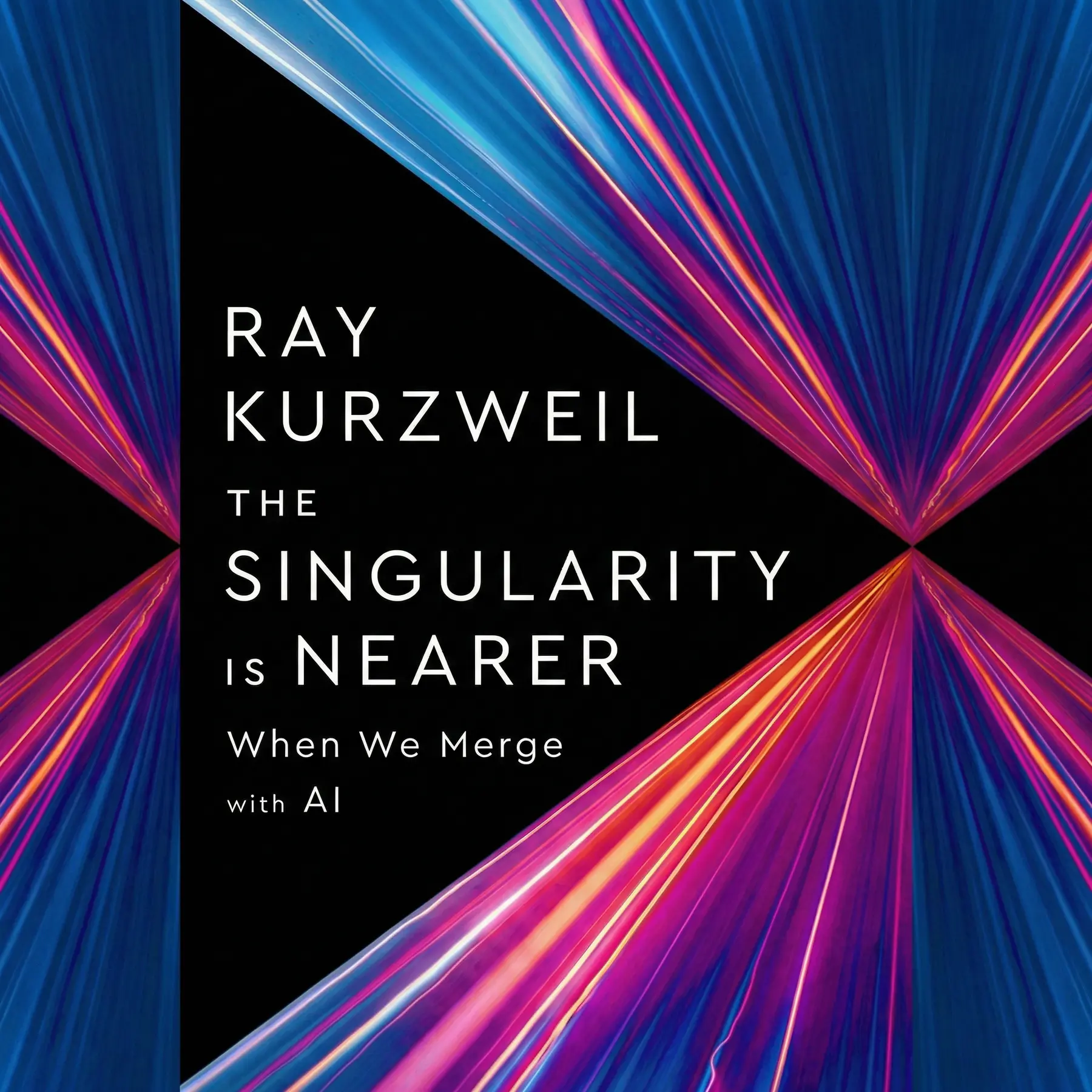
The Singularity Is Nearer: When We Merge with AI
By Ray Kurzweil
Discover a visionary roadmap for the next two decades as artificial intelligence and nanotechnology merge with human biology, promising an era of unprecedented intelligence and the end of physical scarcity.
Table of Content
1. Introduction
2 min 02 sec
Think back to the year 2005. At that time, the world was a very different place. Social media was a niche concept used by a handful of students, and the idea of a powerful computer living in your pocket was still largely the stuff of science fiction. It was in this environment that the visionary thinker Ray Kurzweil released his groundbreaking work, predicting a future where technology would eventually surpass human capability. Now, nearly two decades later, he returns to observe that his predictions weren’t just on track—they were actually conservative in many ways.
Since 2005, the landscape of what is possible has shifted under our feet. The cost of sequencing a human genome, once a multi-billion-dollar government project, has dropped by a staggering 99.997 percent. At the same time, the computational power we can purchase for a single dollar has increased by over eleven thousand times. These aren’t just interesting statistics; they are the evidence of a fundamental law governing our universe: the Law of Accelerating Returns. This law suggests that technological progress isn’t linear; it’s exponential. Each new invention provides the tools to build the next one even faster, creating a feedback loop that leads to explosive growth.
We are now entering the steepest part of this curve. In this journey, we will explore the coming ‘Singularity’—a moment in history where technological growth becomes so rapid and profound that human life as we know it is irreversibly transformed. We will look at how artificial intelligence is evolving from simple rules to creative partners, how nanotechnology will rewrite the rules of health and aging, and how our very definitions of work and purpose will be challenged. By the end, you’ll see why the merger between our biological brains and our digital creations is not just a possibility, but an impending reality that will redefine what it means to be human.
2. The Exponential Engine of Progress
2 min 03 sec
Discover why our brains struggle to comprehend the true pace of technological change and how the Law of Accelerating Returns drives our world.
3. The Evolution of Machine Intellect
2 min 11 sec
Trace the shift from rigid, rule-bound computers to the flexible, pattern-recognizing neural networks that are now beginning to mimic human thought.
4. Bridging the Gap to Human-Level Cognition
2 min 05 sec
Explore the remaining hurdles for AI, such as common sense and memory, and how overcoming them leads to an intelligence explosion.
5. Nanotechnology and the End of Disease
2 min 16 sec
Imagine a world where medicine is an information technology and tiny machines repair your body at the cellular level.
6. The Merger of Biological and Digital Minds
2 min 04 sec
Learn how brain-computer interfaces will allow us to expand our consciousness and connect directly to the global network of knowledge.
7. A Future of Abundance and New Purpose
2 min 08 sec
Consider how society will adapt to the automation of labor and the shift from a world of scarcity to a world of infinite possibility.
8. Conclusion
1 min 32 sec
The journey we’ve taken through these ideas brings us to a singular conclusion: the world is about to change more in the next twenty years than it has in the last several thousand. The Law of Accelerating Returns is an unstoppable force, and it is carrying us toward a future where the boundaries between biology and technology dissolve. We are standing at the threshold of a new era where disease is a memory, where our cognitive abilities are limited only by our imagination, and where the scarcity that has defined human history finally comes to an end.
But the Singularity isn’t just something that happens to us; it is something we are creating. It is the culmination of the human drive to overcome our limitations. As we move closer to 2045, our challenge will be to navigate the ethical and social hurdles with wisdom and foresight. We must ensure that the abundance created by these technologies is used to lift up all of humanity, not just a few.
Ultimately, the message is one of profound optimism. We are not approaching the end of the human story, but the beginning of its most exciting chapter. By merging with the tools we have built, we are expanding the reach of consciousness and ensuring that the light of intelligence continues to grow and explore the universe. The Singularity is near, and it offers us the chance to become something greater than we have ever been. It’s time to prepare for a future where the only limit is how far we are willing to dream.
About this book
What is this book about?
The Singularity Is Nearer serves as a detailed progress report and a future forecast for the technological evolution of humanity. Building on decades of accurate predictions, it explores how the exponential growth of computing power is leading us toward a pivotal moment: the Singularity. The book promises to explain not just when these changes will happen, but how they will redefine every aspect of our existence, from the way we treat disease to the way we define work and identity. It outlines a timeline where artificial general intelligence is achieved by 2029 and a full merger between human and machine occurs by 2045. Through the lens of the Law of Accelerating Returns, the text illustrates why the next twenty years will contain more progress than the previous century. It offers a glimpse into a world where nanotechnology repairs our bodies from the inside, where our brains are directly connected to the cloud, and where the costs of basic needs plummet. Ultimately, it provides a framework for understanding our transition into a post-biological era where the limits of the human mind and body are finally transcended.
Book Information
About the Author
Ray Kurzweil
Ray Kurzweil is a renowned inventor, futurist, and artificial intelligence pioneer with a history of accurate technological predictions. He has made contributions to various fields, including developing the first CCD flatbed scanner and creating speech recognition software, and has authored several best-selling books such as The Singularity Is Near and The Age Of Spiritual Machines.
Ratings & Reviews
Ratings at a glance
What people think
Listeners find the book stimulating and interesting, with one review mentioning how it clarifies various philosophical inquiries regarding the human mind. Additionally, the work presents a hopeful perspective on the times ahead, with one listener emphasizing its thorough examination of technological progress. Nevertheless, opinions on the prose are divided, as some consider it well-crafted while others feel differently.
Top reviews
Mason
Ray Kurzweil’s latest vision feels like a much-needed shot of adrenaline for anyone exhausted by the constant doom-scrolling of our current era. While most tech analysts are obsessed with the ways AI might dismantle society, Kurzweil remains a steadfast optimist, painting a comprehensive overview of how accelerating returns will eventually solve our most pressing biological limitations. His breakdown of the neocortex and its potential connection to cloud-based computation is truly mind-expanding. Truth is, it’s refreshing to read a book that doesn't just predict the future but actually provides a roadmap for how we might reach a state of post-biological existence. Some might find his confidence bordering on arrogance, but the depth of his research makes it hard to dismiss his claims. This isn't just about computers; it's a deep dive into the very definition of human identity. I walked away from this feeling genuinely excited about the 2030s.
Show moreYaowares
The chapter on identity and the future of the human mind is worth the price of admission alone. Kurzweil tackles some of the most profound philosophical questions regarding consciousness, specifically how we might maintain a sense of 'self' once we start merging our brains with synthetic interfaces. Personally, I found his arguments about the exponential growth of processing power to be airtight, even if the social implications are a bit glossed over. The book successfully explains complex biological concepts in a way that feels engaging and thought-provoking. We are moving toward a world where the line between human and machine is completely blurred. Not gonna lie, the idea that the first person to live a thousand years is already alive today is a lot to wrap your head around. If you want to understand the mindset of the people currently building our AI future, you absolutely have to read this.
Show moreLuke
Wow, it is so refreshing to read a futurist who isn't trying to sell me a bunker in New Zealand or tell me that the world is ending next Thursday. Kurzweil’s excitement is genuinely contagious, and he provides a much-needed break from the constant negativity that dominates our tech news. The way he connects the Big Bang to the eventual expansion of intelligence throughout the universe is nothing short of epic. Sure, some of the technical descriptions of the neocortex get a bit dense, but the overall message is clear and incredibly hopeful. It really helped me reframe how I look at the current pace of change. Rather than being scary, the Singularity feels like the natural next step in our evolution. If you need a little bit of optimism in your life right now, this is the perfect book to pick up. Five stars for the vision alone.
Show moreVilaiporn
After hearing so much buzz about the 'Singularity' for years, I finally dove into Kurzweil's newest work and was blown away by the clarity of his arguments. The book does an amazing job of explaining the philosophical questions of the mind, specifically how consciousness might arise from non-biological substrate. His perspective on the future of work is a bit controversial, but he makes a strong case for how technology creates new forms of value that we can't even imagine yet. I found the dialogue with 'Cassandra' at the end to be a clever way to address the common criticisms of his work, even if he still comes out on top in every argument. The writing is polished and the data visualizations really help drive home the idea of exponential growth. It’s a big, ambitious book that actually delivers on its promises. Truly a thought-provoking read for anyone interested in AI.
Show moreGor
As someone who treated the original 'The Singularity is Near' like a sacred text back in 2005, reading this felt like checking in with an old, albeit more eccentric, friend. The book offers a solid update on how Large Language Models have accelerated the timeline for the Turing test, though I wish he had spent more time on the potential for 'stochastic parrots' to stall out. His framework for longevity—the three bridges to immortality—remains the most compelling part of his philosophy. To be fair, some of the writing is a bit repetitive if you’ve followed his TED talks, but having all these data points in one place is invaluable. He predicts nanobots will be swimming in our bodies to stop aging by the 2030s, which sounds like sci-fi, but his track record for accuracy is actually decent. It’s a dense read, yet strangely accessible for such heavy subject matter.
Show morePetch
Ever wonder if you'll actually be around to see the year 2050? Kurzweil thinks so, and his evidence regarding the intersection of biotechnology and AI is pretty convincing. The sections on how we will eventually bypass DNA replication errors using nanobots were particularly fascinating to me. In my experience, most futurists are either way too dark or way too vague, but Ray gives you specific dates and metrics to watch out for. I do think he’s a bit too optimistic about how quickly humans will accept having chips in their brains. Most people are still skeptical of basic vaccines, so the idea of universal uptake for neural-cloud interfaces seems unlikely in the 2030s. Still, the book is an engaging look at what is technically possible if we don't blow ourselves up first. It’s a heavy book but moves fast.
Show moreMax
Finally got around to finishing this, and while I’m not 100% sold on the idea of injecting nanobots into my bloodstream by 2035, the data behind the 'Law of Accelerating Returns' is hard to ignore. The book is definitely an upgrade over his last one, providing much-needed context for the LLM explosion we've seen recently. My only real gripe is that he tends to talk up his buddies and their inventions a bit too much, which can feel a little like a tech-circle jerk at times. However, the core thesis is brilliant and the way he explains the evolution of information is very logical. It’s a bit over the top in parts—Kurzweil really does believe he’s going to live forever—but his intelligence is undeniable. It’s a fun, speculative journey that makes you look at your smartphone and realize we're already halfway to the merger he's predicting.
Show moreRapee
Frankly, this feels less like a groundbreaking new manifesto and more like a collection of extended blog posts updating his previous theories. While Kurzweil is clearly a genius, his writing style in this installment is a bit of a mixed bag; some sections are brilliant while others feel like a repetitive rehash of ideas he’s been talking about for decades. He leans heavily on his 'Law of Accelerating Returns' to hand-wave away very real concerns about AI-driven mass surveillance and the loss of human agency. I was also disappointed by the 'Perils' chapter, which felt incredibly rushed and shallow compared to the chapters on tech-utopianism. It's a decent overview of where we are in 2024, but it lacks the 'classic banger' feel of his earlier work. It’s a good addition for the collection, but maybe not a must-read if you already understand the basics of singularitarianism.
Show morePruet
Picked this up because I have a morbid fascination with the 'tescrealist' crowd, but Kurzweil has unfortunately leaned too hard into a specific tech-bro subculture this time. It is honestly cringe how he name-drops Bitcoin and Bojack Horseman as if they are fundamental pillars of the coming Singularity. He spends way too much time arguing that automation doesn't matter because people can just scroll on TikTok for free, which feels incredibly tone-deaf to anyone actually struggling with the current economy. The first two-thirds of the book is a basic high-school level review of history and biology that drags on forever. By the time he actually gets to the superhuman machine intelligence stuff, he’s just making wild leaps without enough factual support. He treats global risks like an afterthought, waving them away with a 'we’ll be fine' attitude that is not comforting at all.
Show morePat
Look, I’m all for scientific progress, but this book is essentially a 400-page exercise in ignoring the actual risks of total societal collapse in favor of an elitist fantasy. Kurzweil assumes everyone wants to be a tech-enhanced superhuman living in the cloud, and he treats anyone who disagrees as if they are simply failing to understand the math. His citations are a mess; some of them are just links to random YouTube videos, which makes his more 'scientific' claims feel a lot less credible. The way he talks about universal basic income as a simple fix for the total displacement of the global workforce is incredibly naive. It’s a very confident book, full of 'we WILL have this' statements that ignore political and environmental reality. Unless you’re already a true believer in the tech-utopia, you’ll likely find this spiritually draining. It's a dystopian vision masquerading as a hopeful one.
Show moreReaders also enjoyed
AUDIO SUMMARY AVAILABLE
Listen to The Singularity Is Nearer in 15 minutes
Get the key ideas from The Singularity Is Nearer by Ray Kurzweil, plus 5,000+ more titles in English and Thai.
- 5,000+ titles
- Listen as much as you want
- 7-day free trial
- Cancel anytime







