
15 min 32 sec
The Age of Spiritual Machines: When Computers Exceed Human Intelligence
By Ray Kurzweil
Explore the inevitable evolution of artificial intelligence as it mirrors and eventually surpasses human biological constraints, leading to a profound merger of man and machine in the near future.
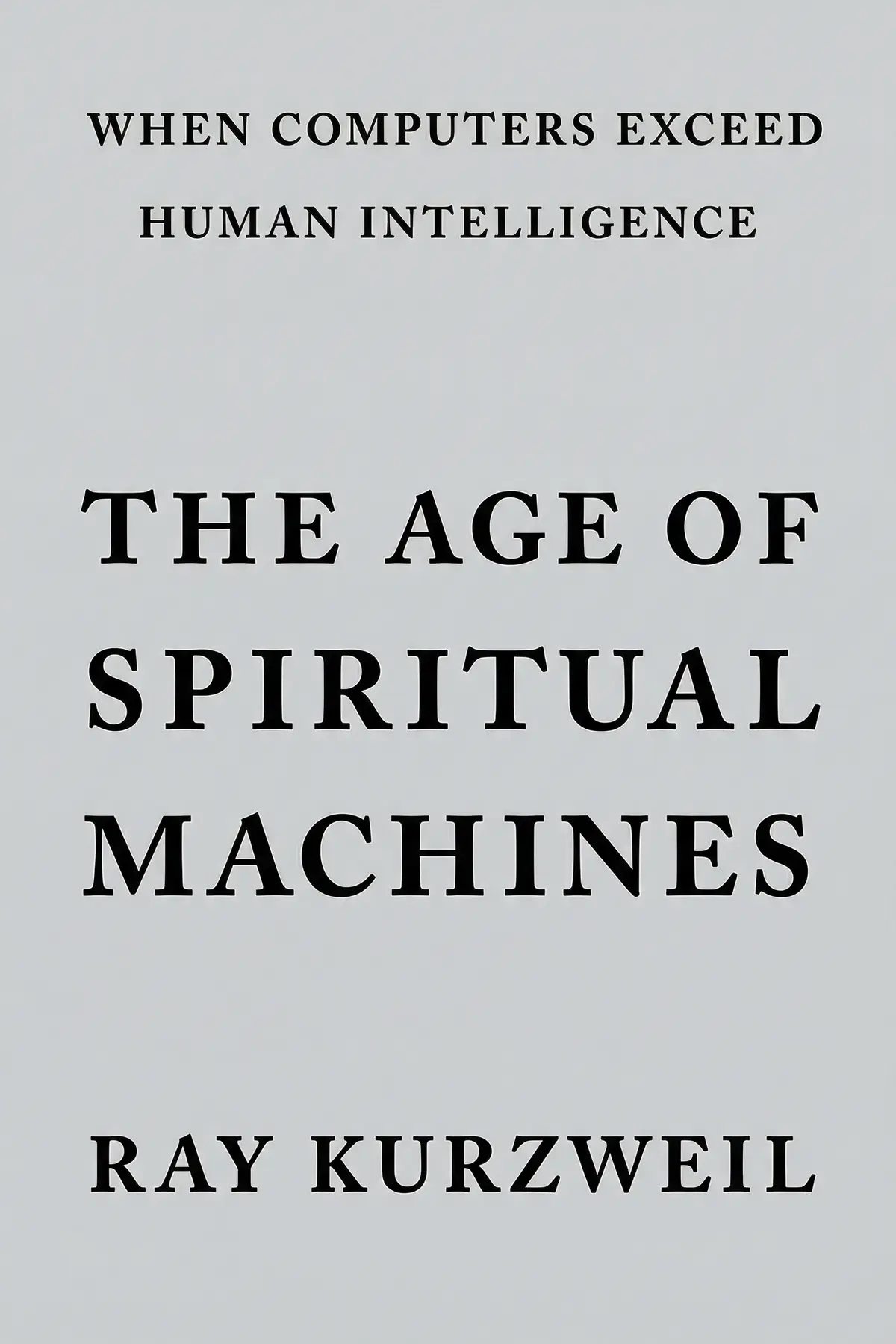
Table of Content
1. Introduction
1 min 17 sec
We often think of technology as something separate from ourselves—a collection of tools and gadgets that we happen to use. However, there is a much deeper story at play. If we look at the broad sweep of history, we see that the development of artificial intelligence is not an accident or a mere hobby. It is the next logical step in a journey that began at the very dawn of time.
In this exploration of our technological destiny, we are going to look at how the universe moved from a state of raw energy to complex life, and how that same process is now fueling the rise of intelligent machines. The pace of change is no longer measured in centuries; it is now happening in years and months. This throughline suggests that we are approaching a moment where our biological limits will no longer hold us back.
By examining the history of computation and the laws that govern progress, we can begin to see a future where the line between human and machine becomes blurred. We aren’t just building faster computers; we are building the next stage of evolution. As we dive into these concepts, we will see how the year 2029 and the year 2099 represent major milestones in this transformation. Get ready to rethink everything you know about what it means to be a conscious being in an age of silicon and software.
2. The Fluctuating Speed of Cosmic and Biological Time
2 min 19 sec
Journey back to the birth of the universe to understand why time seems to speed up and slow down as complexity emerges.
3. Computation as the Common Thread of Existence
2 min 20 sec
Discover how the ability to process and store information links biological life to the machines we build today.
4. The Mathematical Laws Governing Progress
2 min 00 sec
Unpack the two competing laws that dictate whether a system slows down or speeds up over time.
5. Transcending the Biological Bottleneck
2 min 04 sec
Learn why the limitations of our own DNA are pushing us to create a new kind of intelligence.
6. A Glimpse into the Year 2029
2 min 06 sec
Step into the near future where the power of $1,000 can buy the processing capacity of a thousand human brains.
7. The 2099 Merger of Man and Machine
2 min 05 sec
Explore the end of the twenty-first century, where the definition of humanity will be forever altered.
8. Conclusion
1 min 21 sec
The journey from the first sparks of the universe to the rise of intelligent machines is a single, continuous story of increasing complexity and order. We have seen how the slow pace of the early cosmos gave way to the faster rhythms of biological evolution, and how that process has now shifted into the high gear of technological progress. This isn’t just about building better tools; it’s about the next phase of life itself.
As we look toward the end of this century, the message is clear: the divide between ‘us’ and ‘our machines’ is temporary. We are heading toward a merger that will redefine intelligence and consciousness. While this may seem like science fiction, it is the mathematical result of the laws of computation and accelerating returns.
The takeaway is to prepare for a world where the limits of our biology are no longer the limits of our potential. We are entering an era where our thoughts and our technology will become one. By understanding these trends now, we can better navigate the transition into a future where the human spirit finds a new, more durable home in the machines we create. The age of spiritual machines is not just coming; it is already in motion, and it promises to expand the horizon of what it means to be alive.
About this book
What is this book about?
The Age of Spiritual Machines offers a sweeping look at the trajectory of intelligence, from the birth of the cosmos to the digital frontier. It suggests that technological progress isn't just happening alongside us; it is a direct continuation of biological evolution. By tracing the history of the universe and the development of life, this exploration reveals why technological change is accelerating and where it is headed. The book promises a vision of the future where the boundaries between human consciousness and silicon-based computation dissolve. You will discover how machines will eventually learn to think, feel, and even claim their own rights. It outlines a timeline for the next century, predicting when computers will match human brainpower and how we will use technology to upgrade our own minds. Ultimately, it provides a roadmap for understanding the coming singularity where our biological origins meet our technological destiny.
Book Information
About the Author
Ray Kurzweil
Ray Kurzweil is an acclaimed inventor, computer scientist, and futurist. His career is marked by groundbreaking innovations, including the development of reading machines for the blind, advanced speech-recognition systems, and sophisticated music synthesizers. He is the author of several influential books on artificial intelligence and the future of humanity, such as The Singularity is Near, How to Create a Mind, and The Age of Intelligent Machines.
Ratings & Reviews
Ratings at a glance
What people think
Listeners find the writing accessible and stimulating, with one listener praising the way it clarifies intricate technological topics. Furthermore, it earns high marks for being intellectually engaging, and one listener points out the thorough way it blends insights from multiple fields of study. Also, listeners value the text’s precise forecasts regarding what lies ahead, while one listener notes its immense computing power.
Top reviews
Anchalee
This book is a wild ride through the landscape of human and machine evolution. Ray Kurzweil manages to weave together history, physics, and philosophy into a narrative that feels like a roadmap for our species. I found the interdisciplinary approach refreshing; it’s rare to find a tech-heavy book that also dives into the nature of consciousness. Even if you don't buy into the concept of machines having 'souls,' the intellectual entertainment value here is immense. The prose is surprisingly accessible, making complex technical issues feel like casual conversation. It’s thought-provoking and stays with you long after the final chapter. I particularly enjoyed how he links biological evolution to the growth of technology. Truth is, it changed how I look at my smartphone.
Show moreSam
Picked this up on a recommendation and found myself surprisingly gripped by how Kurzweil breaks down high-level computational theories. He has this unique ability to explain the most dense concepts without losing the reader in jargon. The way he integrates knowledge from various fields—from biology to microchip manufacturing—is nothing short of masterly. To be fair, some of the specific timeline predictions haven't panned out, but the overarching trajectory he describes feels more relevant than ever. It’s an optimistic look at a future where our tools become an extension of our own minds. If you want a book that challenges your assumptions about what it means to be 'human,' this is the one. A truly comprehensive and visionary piece of writing.
Show moreKomsan
After hearing about the 'Singularity' for years, I finally decided to go to the source. This book is a masterpiece of synthesis. Kurzweil pulls together threads from computer science, evolutionary biology, and even art to create a unified theory of where we’re going. It’s incredibly thought-provoking, especially the sections on how we might eventually upload our consciousness into more durable substrates. Sure, the 2019 predictions are mostly wrong, but that's almost beside the point. The value is in the framework he provides for understanding the speed of change. It’s an intellectually stimulating journey that makes the future feel like something to be excited about rather than feared. If you're looking for a book that truly expands your horizons, this is it. Five stars for the sheer scope of vision.
Show moreViroj
As a software engineer, I found the bridge between biology and technology fascinating, even if the timeline feels like a fever-dream in retrospect. Kurzweil's core argument about exponential growth—the Law of Accelerating Returns—is incredibly sound. We might not have robot maids yet, but the sheer computing power we carry in our pockets proves he was right about the pace of change. The writing style is analytical yet engaging, which is a difficult balance to strike. I do think he underestimates the sheer complexity of the human brain's architecture, as PZ Meyers famously pointed out. However, the book serves as an excellent conceptual framework for thinking about the next century. It’s a bit dated, but the big-picture questions remain essential for anyone interested in AI.
Show moreSupachai
Ever wonder if your laptop will one day have a soul? Kurzweil isn't just asking that question; he's telling you exactly when it's going to happen. I loved the structure of the book, especially the dialogues with imaginary characters from the future which kept things light. It’s a great piece of intellectual entertainment that manages to be both scary and hopeful at the same time. While some parts feel like a sci-fi novel, the research backing his claims is clearly extensive. My only real gripe is that he ignores the potential for a digital dystopia, focusing instead on a glossy, high-tech heaven. Still, it’s a thought-provoking read that pushes the boundaries of how we define life. Definitely worth your time.
Show moreMaya
The chapter on the Law of Accelerating Returns provides a compelling framework for why we feel like technology is moving too fast. I’ve always been a bit of a tech-skeptic, but Kurzweil’s logical progression of ideas is hard to dismiss entirely. He makes a strong case for why the distinction between 'human' and 'machine' will eventually blur. Some of the sections are a bit dense with data, but the overall message is easy to understand. I appreciated the way he addressed the potential risks of self-replicating nanotechnology, even if he seems convinced we'll solve it. In my experience, books like this are better treated as thought experiments rather than literal crystal balls. It’s an engaging, high-level look at where we might be headed if things don't go off the rails.
Show moreMan
Gotta say, I didn't expect to enjoy a book about silicon chips this much. Kurzweil has a way of making the future feel inevitable. He looks at technological progress as a natural extension of biological evolution, which is a profound way to frame it. The book is definitely an intellectual workout, but it’s written for a general audience, so you don’t need a PhD to follow along. I liked the discussion on the Turing Test and what it really means for a machine to 'think.' To be fair, he’s way too optimistic about life expectancy and the 'spiritual' nature of code. But even when he’s wrong, he’s wrong in a way that makes you think more deeply about the world. It’s a very comprehensive, mind-expanding read.
Show moreRung
Finally got around to reading this 1999 classic and it’s a bizarre experience reading it through a 2024 lens. On one hand, his predictions about language translation and speech recognition were impressively close to the mark. On the other, his fixation on 'computerized glasses' and the end of physical documents feels like a missed swing. Look, the guy is clearly a genius, but the book suffers from a lack of skepticism. He presents his visions with a confident assurance that borders on the religious. The middle chapters on the history of the universe dragged a bit for me. It’s a solid 3-star read: historically important for the field of AI, but take his 'prophecies' with a massive grain of salt. It's half-brilliant, half-delusion.
Show moreEmma
Frankly, the biggest hurdle for me was the author's assumption that we can easily replicate the human brain through brute-force processing power. The brain isn't just a series of calculations; it's a messy, biological ecosystem. Kurzweil’s 'spiritual machines' feel more like very fast calculators than actual sentient beings. That being said, the book is still a fascinating artifact from the late 90s. It captures that pre-9/11 optimism about the digital age perfectly. While many of the specific predictions are a comedy of errors now, the underlying themes of connectivity and AI are more relevant than ever. It's worth reading as a historical document of futurism, but don't expect it to accurately predict your next decade. It’s a mix of genuine insight and wild speculation.
Show moreTippawan
Not what I expected given the hype that still surrounds Kurzweil in tech circles. While the first third of the book is an interesting history of computing, it quickly devolves into what I can only describe as utopian fantasy. Reading this today is actually a bit embarrassing because of how spectacularly he missed the mark on 2009 and 2019. Where are the pervasive computerized glasses and the death of paper? Instead of spiritual machines, we got social media algorithms and endless plastic waste. Frankly, his hubris regarding the human brain is the biggest issue; he treats our consciousness like a simple software update. It's a classic example of a smart person being blinded by their own optimism. I found it more frustrating than enlightening.
Show moreReaders also enjoyed
AUDIO SUMMARY AVAILABLE
Listen to The Age of Spiritual Machines in 15 minutes
Get the key ideas from The Age of Spiritual Machines by Ray Kurzweil, plus 5,000+ more titles in English and Thai.
- 5,000+ titles
- Listen as much as you want
- 7-day free trial
- Cancel anytime







