
27 min 13 sec
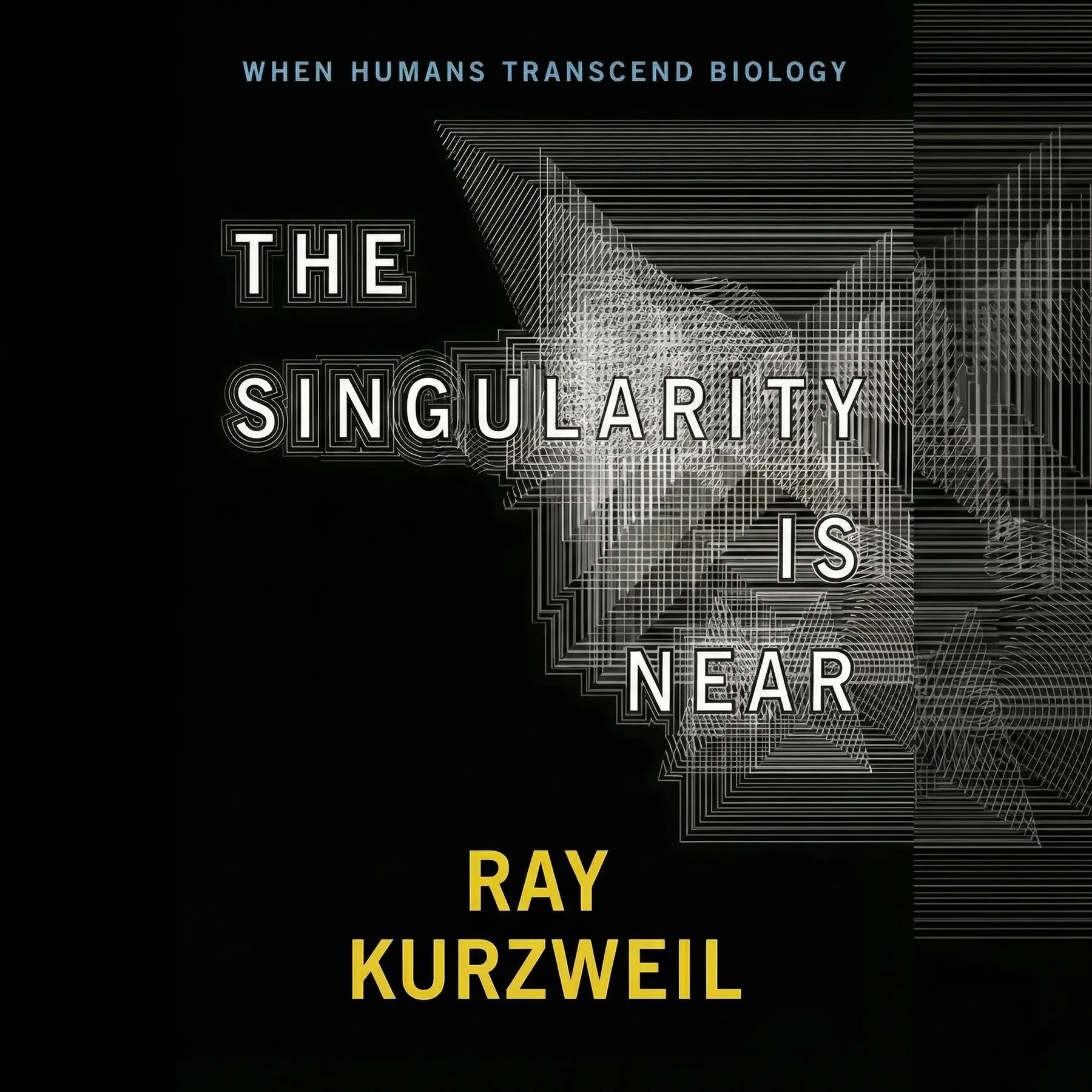
The Singularity Is Near: When Humans Transcend Biology
By Ray Kurzweil
This summary explores the inevitable merging of human biology and artificial intelligence. It details how exponential technological growth will lead to a 2045 singularity, granting us immortality and superintelligence.
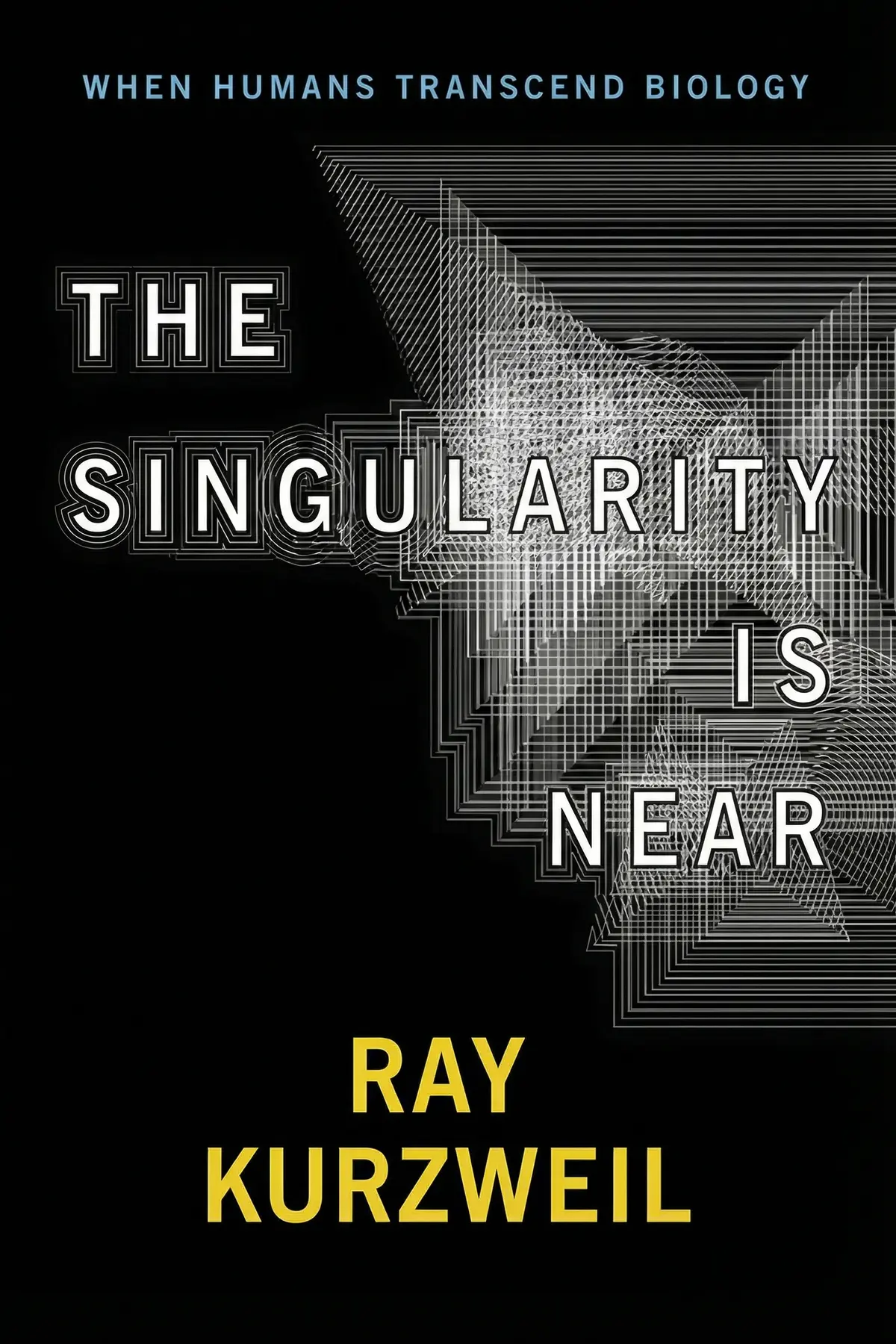
Table of Content
1. Introduction
2 min 28 sec
In the cult classic film The Matrix, there is a famous moment where the protagonist, Neo, has a complex training program instantly uploaded into his mind. In a matter of seconds, he opens his eyes and utters the iconic line: I know kung fu. For most of us, this seems like the pinnacle of science fiction—a dream of a distant, impossible future. But what if that level of mastery wasn’t just a movie trope? What if the ability to download skills, transcend the limitations of the human body, and live forever was actually much closer than we think?
We are currently standing at a pivotal moment in history. As we look around, we can see that the tools we use are changing more rapidly than ever before. However, most people view this progress as a steady, linear climb. We expect next year to be slightly more advanced than this year, much like how the last decade was slightly more advanced than the one before it. But according to the vision laid out in this summary, that linear perspective is a fundamental misunderstanding of how the world actually works. We are not on a steady climb; we are on an exponential curve that is about to go vertical.
This transformation is what we call the Singularity. It represents a point in the near future where technological growth becomes so fast and its impact so deep that human life will be irreversibly transformed. We aren’t just talking about better smartphones or faster internet. We are talking about the end of biological aging, the cure for every known disease, and a level of intelligence that is billions of times greater than all human minds combined. In this new era, the lines between our biological selves and our mechanical creations will blur until they disappear entirely.
Throughout this journey, we will explore the mechanisms behind this shift. We’ll look at how the very laws of evolution are picking up speed, why our current computing hardware is just the beginning, and how we will eventually reverse-engineer the human brain to unlock its full potential. We will also confront the staggering possibilities of nanotechnology and the ethical crossroads we will face as we redesign our own species. This isn’t a story about hundreds of years in the future—this is a story about the next few decades. The Singularity isn’t just a possibility; it is near. Let’s dive in and see what this means for the future of humanity.
2. The Exponential Nature of Evolution
2 min 31 sec
Discover why the world is changing faster than our brains can comprehend and how the history of life on Earth points toward an imminent technological explosion.
3. Hardware Beyond Silicon
2 min 31 sec
As traditional computer chips reach their physical limits, new materials like carbon nanotubes and DNA are poised to take computing into the third dimension.
4. Cracking the Code of the Human Mind
2 min 22 sec
Learn how scientists are reverse-engineering the human brain to create truly conscious artificial intelligence that can think, feel, and learn just like we do.
5. Medical Revolution Through Nanotechnology
2 min 14 sec
Imagine a world where tiny robots living in your bloodstream act as a secondary immune system, repairing cells and eradicating disease before you even feel a symptom.
6. Rewriting the Genetic Blueprint
2 min 18 sec
Genetic diseases and biological predispositions are about to become optional as we learn to use modified viruses to edit our DNA in real-time.
7. Organ Cloning and the End of Surgery
2 min 11 sec
The tragic shortage of donor organs is nearing its end as scientists develop ways to grow custom, compatible organs from a patient’s own cells.
8. The Evolution of the Physical Form
2 min 24 sec
From high-performance blood to shape-shifting bodies made of ‘foglets,’ explore how we will transcend our biological limitations to become something more.
9. The Merging of Minds and Machines
2 min 14 sec
Direct brain-to-computer interfaces will allow us to expand our memories, download skills instantly, and connect our thoughts to the vast web of global information.
10. The Singularity Event: 2045
2 min 17 sec
Step into the year 2045, the point of no return where intelligence explodes, mortality ends, and the very matter of the universe begins to awaken.
11. Navigating the Existential Risks
2 min 12 sec
While the future holds incredible promise, we must also address the ‘grey goo’ scenario and the potential for rogue technology to threaten our very existence.
12. Conclusion
1 min 31 sec
The journey toward the Singularity is not just a story about machines; it is the next chapter in the story of life. For billions of years, evolution has moved slowly, constrained by the random mutations of biology. But with the advent of technology, we have taken the reins of our own evolution. We are moving from a world of ‘or’—where we are either human or machine—to a world of ‘and,’ where we are both, and so much more.
As we have seen, the Law of Accelerating Returns ensures that this transformation is coming faster than most people realize. In the coming decades, we will witness the end of disease, the expansion of the mind, and the mastery of the physical world through nanotechnology. By 2045, we will reach a point where the very definition of humanity is transcended. We will become a species that is no longer bound by age, by the limits of memory, or by the constraints of a single planet.
The ultimate takeaway is one of profound optimism tempered by responsibility. We are the architects of the most significant shift in history. The Singularity offers us a chance to solve the oldest problems of the human condition and to bring intelligence to a silent universe. As you move forward, keep an eye on the pace of change around you. The future isn’t coming in a hundred years; it is unfolding right now, and the Singularity is near.
About this book
What is this book about?
The Singularity Is Near explores the staggering trajectory of human progress and the inevitable point where technological growth becomes so rapid that life as we know it is fundamentally transformed. It presents a future where the distinction between biological existence and artificial intelligence dissolves, leading to a new era of superhuman capabilities. By examining the exponential growth in computing, genetics, and nanotechnology, the book provides a roadmap for how we will eventually overcome the limitations of our own bodies and minds. The promise of this journey is nothing less than the conquest of disease, the reversal of aging, and the expansion of human intelligence across the cosmos. This transition, known as the Singularity, is projected to occur within our lifetimes, specifically around the year 2045. As we move closer to this horizon, our very definition of what it means to be human will be challenged. We are transitioning from a slow, biological evolution to a lightning-fast technological one. This summary dives into the mechanics of this shift, the scientific breakthroughs making it possible, and the profound ethical questions that arise when we hold the power to redesign ourselves and the universe around us.
Book Information
About the Author
Ray Kurzweil
Ray Kurzweil is a world-renowned inventor, entrepreneur, and author who currently serves as a director of engineering at Google. His career is marked by groundbreaking innovations, including the creation of the charge-coupled device (CCD) flatbed scanner. Beyond his work in hardware, Kurzweil has become a leading voice in futurism, authoring several books that explore the integration of humans and technology. His contributions have been recognized at the highest levels; he was awarded the US National Medal of Technology in 1999 and has received honors from three different US presidents. Additionally, Kurzweil holds 20 honorary doctorates, reflecting his deep impact on the fields of technology and artificial intelligence.
Ratings & Reviews
Ratings at a glance
What people think
Listeners find the book dense with information and concepts, featuring thorough explanations and a remarkable look at the future. They also value its thought-provoking nature, with one listener noting it offers context for decision making. The text earns praise for its intelligence, with one listener calling it an intellectual feast. However, interest levels vary; some find it absorbing while others find it tedious. There are also mixed reviews regarding prediction accuracy, as some find them credible while others point out that many remain unfulfilled.
Top reviews
Yuwadee
Ever wonder if your physical body is just an obsolete biological container? Kurzweil argues exactly that, presenting a fantastic view of our future where we transcend genetics, nanotechnology, and robotics. The depth of research is staggering, with over a hundred pages of notes that back up even his most audacious claims. Not gonna lie, the idea of uploading consciousness into a non-biological substrate is terrifying yet strangely hopeful. It’s a thought-provoking journey that functions as both a technical roadmap and a philosophical story of human destiny. I found the section on GNR (Genetics, Nanotech, Robotics) to be particularly gripping, even if the prose is occasionally dry. This is essential reading for anyone who wants to move beyond the background drone of daily life and contemplate the next stage of our evolution.
Show moreChokdee
Wow, the sheer scope of Kurzweil's imagination is breathtaking. I picked this up looking for a technical manual, but what I found was a profound meditation on metaphysics and the future of intelligence. The book is rich in information, detailing how we might eventually saturate the universe with our consciousness. It’s a polarizing read, but I found the discussion on how language has already allowed us to transcend our biology eons ago to be a brilliant touch. Truth is, even if only half of these predictions come true, our world will be unrecognizable within our lifetimes. Kurzweil provides the kind of high-level intelligence that makes for a truly rewarding intellectual feast. It’s the kind of book that makes you stop and stare at your smartphone, realizing it’s just the first step toward something much bigger.
Show moreFatou
Finally got around to reading this foundational text of modern futurism, and it is every bit as audacious as advertised! Kurzweil describes a future where technology advances so rapidly that human life is transformed into something unrecognizable. The book is incredibly thought-provoking, especially the sections on how we might merge with AI to expand our own 'source code.' Personally, I found his optimism about overcoming the speed of light to be a bit much, but the core thesis of exponential growth is hard to argue with. It’s a detailed, information-rich journey that challenges your perception of what is possible. If you’re tired of living in a world of linear thinking, this is the perfect antidote. It’s a story of destiny that actually makes you feel like you're living in the future today.
Show morePui
Ray Kurzweil’s vision for 2045 feels like a fever dream wrapped in a meticulously organized spreadsheet. This book is an incredible intellectual feast that pushes the boundaries of how we view our biological limitations. While his 'Law of Accelerating Returns' provides a solid framework, some of the specific hardware predictions for the 2010s clearly missed the mark. To be fair, seeing the current explosion of generative AI makes his 'strong AI' theories feel far less like science fiction than they did years ago. The technical density is high, making it a bit tedious for casual readers, but the detailed explanations provide vital context for anyone trying to understand the trajectory of human-machine integration. It’s a bold, polarizing masterpiece that demands your attention even when it feels laughably optimistic about biotech timelines.
Show moreSomboon
Picked this up nearly two decades late and was surprised by how much still feels relevant despite the missed deadlines. While we don't have nanobots in our bloodstreams yet, the rapid adoption of technology like ChatGPT proves that the rate of change is indeed accelerating. Kurzweil offers a detailed explanation of how biological evolution will eventually lose the race against human engineering. My only real gripe is the tone, which can be a bit 'kool-aid' heavy at times. He tends to gloss over the potential for catastrophic failure or the inequality that such technology would exacerbate. Still, it provides fantastic contextual information for making decisions about where our species is headed. It’s a long read, but the philosophical questions about the 'Chinese Room' and consciousness make the effort worthwhile.
Show moreBoy
Frankly, the existential dread this book induces is probably more valuable than the actual technical predictions it makes. Kurzweil paints a picture of a world where we shed our flesh and become immortal machine intelligences, which is both exhilarating and deeply disturbing. The truth is, the book is an intellectual feast that covers everything from quantum entanglement to the noösphere. While some find the technical details tedious, I appreciated the depth of the explanations. It provides a much-needed long-term perspective in an era of short-term thinking. My only criticism is his disregard for the ecosystem and the lot of the vast majority of the planet's inhabitants who won't have access to this tech. It’s a brilliant, if slightly myopic, look at what it means to be a human-machine civilization.
Show moreSiraporn
Not what I expected from a tech book; it's actually much more of a philosophical treatise on the nature of language and mind. Kurzweil’s central thesis—that we will escape the limitations of our bodies—is a daring bit of immanent metaphysics. I loved the way he deconstructs the 'Chinese Room' argument, though his writing style can be a bit repetitive after the first 300 pages. To be fair, his track record on timing isn't perfect, but the general direction of his forecasts seems more credible than ever. The book is rich in concepts that will keep you thinking for weeks. It’s an engaging, if somewhat grandiose, attempt to map out the next thousand years of history. Whether you view him as a prophet or a dreamer, the information here is undeniably valuable for anyone curious about our trajectory.
Show moreMontri
As someone who works in the biotech sector, I found the medical timelines in this book to be wildly over-confident. Kurzweil assumes that computational power can simply steamroll over the complex, messy realities of human physiology and clinical trials. He ignores the fact that drug delivery via nanobots requires solving ethical and biological hurdles that don't follow Moore's Law. Frankly, the writing is redundantly redundant in places, and the graphs where the future is 'filled in' according to his worldview feel more like cartoons than evidence. However, the book remains rich in concepts and provides a useful framework for thinking about exponential growth. It’s a mixed bag—intellectually stimulating but frequently blinded by its own monomaniacal gall. Read it for the big ideas, but take the specific dates with a massive grain of salt.
Show moreMatteo
The chapter on reverse-engineering the human brain is a heavy lift that requires some serious coffee and patience. Kurzweil’s intelligence is obvious, but he often falls into the trap of assuming that because something is mathematically possible, it is imminent. His claim that machines will soon emulate human intelligence by the end of this decade (relative to 2005) looks pretty shaky now. In my experience, the book is a bit of a house of mirrors meant to disguise the more outlandish aspects of his thesis. I enjoyed the 'intellectual feast' of ideas, yet I couldn't help but feel the absence of any real human emotion in his calculations. It’s a very dry, analytical look at a future that feels more like a cold simulation than a vibrant continuation of society. Interesting, but flawed.
Show moreLillian
Look, I wanted to engage with this 'Singularity' concept, but the 'Future Schlock' vibe is just too strong to ignore after the first few chapters. Kurzweil seems to inhabit a universe completely orthogonal to reality, where he assumes human fallibility won't just ruin all these shiny toys. He never deals with the fact that humans often suck; we’ll likely use virtual reality for base gratification rather than noble intellectual pursuits. The lack of appreciation for the human body as a holistic system is a glaring flaw. To be fair, his technical credentials are impressive, but his predictions for 2010 were mostly off-base. The whole thing feels like the delusion of a man who is simply terrified of death and is using bad statistics to justify his dream of living forever. It's a dense, tedious slog that fails to account for the social and moral vacuums it creates.
Show moreReaders also enjoyed
AUDIO SUMMARY AVAILABLE
Listen to The Singularity Is Near in 15 minutes
Get the key ideas from The Singularity Is Near by Ray Kurzweil, plus 5,000+ more titles in English and Thai.
- 5,000+ titles
- Listen as much as you want
- 7-day free trial
- Cancel anytime







