
24 min 52 sec
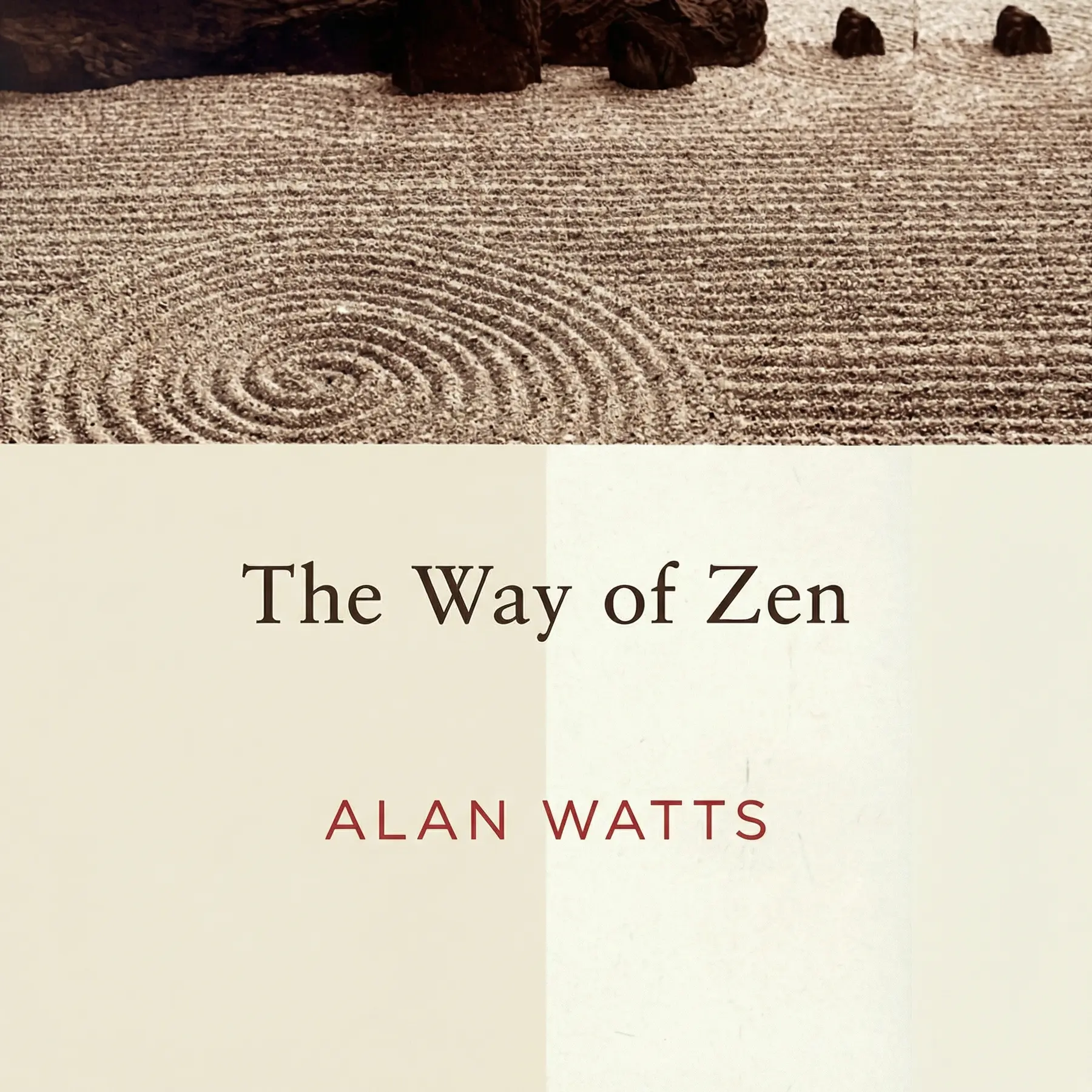
The Way of Zen
By Alan Watts
Explore the profound intersections of Chinese Taoism and Indian Buddhism that birthed Zen. This guide demystifies complex philosophical paradoxes, offering a path to spontaneity, naturalness, and a deep connection with the present moment.
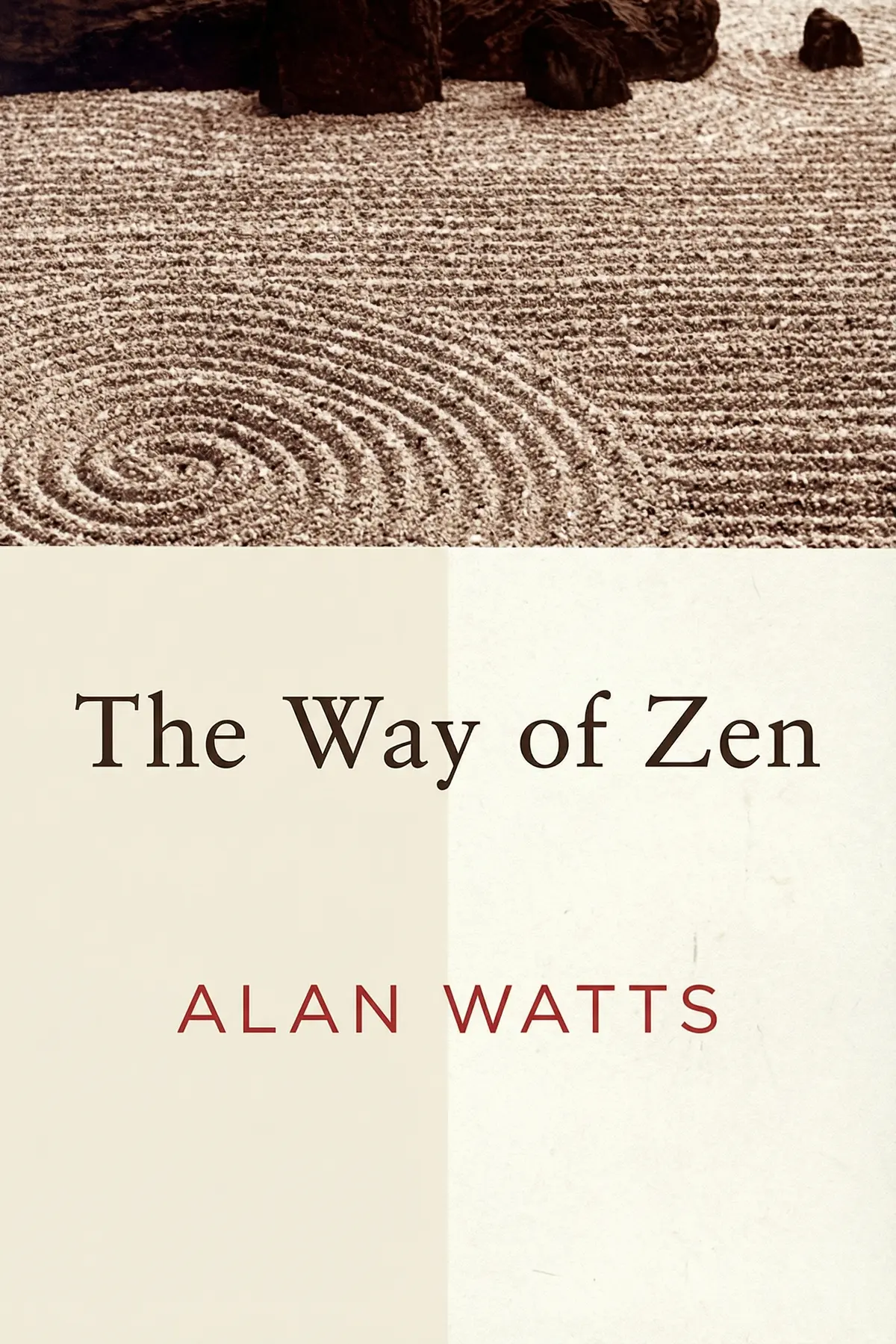
Table of Content
1. Introduction
2 min 17 sec
In our modern world, the word Zen is used so frequently that it has almost become a hollow catchphrase. We talk about a room having a Zen vibe, or we might say we need to find our Zen after a particularly stressful day at the office. For many in the West, the term is synonymous with a vague sense of tranquility, a minimalist aesthetic, or perhaps just a quiet moment of relaxation. But beneath these common associations lies a profound and ancient philosophical tradition that is far more complex—and far more rewarding—than most people realize.
What is Zen, really? Is it a religion, a philosophy, or a psychological technique? For the uninitiated, Zen can feel like a labyrinth of paradoxes. It tells us that to find something, we must stop looking; that to be wise, we must admit we know nothing; and that the self we spend so much time protecting is actually an illusion. This can be deeply frustrating for a mind trained in Western logic, where every problem has a concrete solution and every goal is reached through measurable effort.
This is where Alan Watts enters the picture. As one of the most celebrated interpreters of Eastern thought for Western audiences, Watts dedicated his work to demystifying these abstract concepts. He doesn’t just explain Zen; he invites us to experience the world through its lens. In this exploration, we will trace the lineage of Zen from its roots in Chinese Taoism and Indian Buddhism to its unique expression in art and daily life. We will look at how our conventional ways of knowing often get in the way of true understanding and how the pursuit of happiness can sometimes be the very thing that makes us miserable.
By the end of this journey, the goal isn’t just to have a better academic understanding of a historical movement. Instead, the throughline of this summary is about transformation—finding a way to see the world not as a collection of separate parts and stressful deadlines, but as a spontaneous, interconnected reality. You’ll discover how to trust your intuition, why the present moment is the only reality that truly exists, and how to stop being a victim of your own circumstances by realizing you are inseparable from them. Let’s begin by looking back at the ancient foundations that made this way of thinking possible.
2. The Taoist Foundation of Intuitive Knowledge
2 min 32 sec
Discover why true understanding often defies logical explanation and how the ancient Chinese philosophy of Taoism emphasizes intuition over rigid, fact-based decision-making.
3. Buddhism and the Deconstruction of Illusion
2 min 39 sec
Uncover the roots of Buddhist thought, where the pursuit of the ‘Self’ leads to the realization that our identities and labels are merely artificial constructs.
4. The Paradox of Striving for Enlightenment
2 min 41 sec
Explore the psychological ‘double-bind’ of Mahayana Buddhism, where seeking enlightenment is the very obstacle that prevents you from realizing you already possess it.
5. Zen's Emergence and the Eternal Present
2 min 33 sec
Delve into the historical origins of Zen in China and the revolutionary idea that the only reality is the one occurring in this exact moment.
6. Collapsing the Duality of Self and Circumstance
2 min 27 sec
Learn how Zen dismantles the barrier between your inner mind and the outer world, proving that we are not victims of our environment, but one with it.
7. The Power of Spontaneity and Aimlessness
2 min 25 sec
Embrace the Zen concept of ‘naturalness,’ where the most profound truths are found in actions that arise without effort, affectation, or goal-oriented striving.
8. Meditation as Observation, Not Achievement
2 min 20 sec
Redefine your meditation practice by shifting away from the desire to ‘clear the mind’ and moving toward a quiet, purpose-free awareness of the present.
9. The Aesthetic of Emptiness and the Aimless Life
2 min 33 sec
Witness how Zen principles come to life through art, poetry, and architecture, where empty space and simplicity reveal the beauty of a life without forced meaning.
10. Conclusion
2 min 25 sec
As we come to the end of our exploration into The Way of Zen, it’s worth looking back at the ground we’ve covered. We began by tracing the roots of this tradition back to the intuitive wisdom of Taoism and the deconstructive power of Buddhism. We’ve seen how Zen challenges our most basic assumptions about knowledge, time, and the self. It invites us to stop viewing ourselves as isolated individuals struggling against a separate universe and instead to see ourselves as part of a single, spontaneous flow of reality.
Throughout this journey, the recurring theme has been the danger of over-analysis and the beauty of naturalness. We’ve learned that the pursuit of happiness is often the very obstacle that keeps us from it, and that the search for enlightenment is like looking for a horse while you are already riding it. Zen isn’t about acquiring a new set of beliefs or becoming a ‘better’ person in the conventional sense. It’s about a fundamental shift in perception—a realization that the illusions of the ego and the labels we use to describe the world are not the world itself.
So, how can you take these abstract ideas and apply them to your daily life? The most direct path is through the simple act of presence. Zen encourages us to live an ‘aimless’ life—not in the sense of being lazy or irresponsible, but in the sense of doing what we do for its own sake, rather than as a means to an end. When you eat, just eat. When you walk, just walk. When you listen, be the listening.
A practical place to start is with your breath. Take a moment to sit quietly. Don’t try to master a complex breathing technique or achieve a spiritual state. Instead, just watch your breath come and go. Imagine your body is like a vessel being emptied of air as if a weight were sinking into your abdomen, and then let the next breath flow back in as a natural reflex. Don’t strive to do it perfectly; just allow it to happen.
By practicing this kind of naturalness, even for a few minutes a day, you begin to dismantle the mental blocks that keep you trapped in the past or the future. You start to realize that the tranquility and peace we often associate with Zen aren’t things you have to go out and find—they are what remains when you stop struggling. The extraordinary truth of Zen is that reality is always right here, in the present moment, waiting for us to finally notice it.
About this book
What is this book about?
The Way of Zen serves as a bridge between Eastern philosophy and Western understanding. It traces the historical evolution of Zen Buddhism, beginning with its foundational roots in Taoist thought and the I Ching, through the development of Mahayana Buddhism, and finally to its flowering as a distinct practice. The book explores how the artificial divisions we create—labels, time, and the ego—distort our perception of reality. By examining the principles of spontaneity and aimlessness, the summary provides a roadmap for deconstructing the illusions of the self. It highlights how Zen manifests not just in silent meditation, but in art, poetry, and everyday action. The promise of this exploration is a shift in perspective: moving from a life of constant striving and rational over-analysis to one of intuitive clarity and presence, where the seeker realizes they are already what they have been searching for.
Book Information
About the Author
Alan Watts
Alan Watts was a writer, speaker, and Zen philosopher who played a major role in popularizing Eastern religion in the West. He wrote several highly influential books, including Psychotherapy East and West and The New Alchemy.
Ratings & Reviews
Ratings at a glance
What people think
Listeners describe this work as exceptionally perceptive, offering a profound exploration of Zen philosophy while acting as an excellent primer for the topic. Additionally, they appreciate the detailed yet concise prose and rich historical context, feeling that the investment is well-justified. That said, listeners offer conflicting views on its readability, as some struggle with the complexity of the material.
Top reviews
Riley
Watts has a way of unraveling the most complex Eastern concepts without ever making the reader feel like they are drowning in jargon. This book is a masterclass in clarity, serving as both a historical record and a philosophical guide for the curious Western mind. Truth is, I found the chapters on the Taoist roots of Zen particularly enlightening because they provided a context I hadn't encountered in other introductory texts. He avoids the typical pitfalls of trying to convert the reader. Instead, he offers a 'way of liberation' that feels incredibly grounded. The writing is thorough, succinct, and moves at a pace that encourages reflection rather than a quick skim. It’s the kind of book you keep on your nightstand for years, returning to specific passages whenever the world feels a bit too loud. Truly a foundational piece of literature for anyone looking to understand the core tenets of Zen practice.
Show moreCooper
The section detailing Zen in the arts was easily the highlight of this entire reading experience for me. Watts illustrates the concepts of sabi, wabi, and yugen with such beautiful poetry and clarity that you can almost feel the 'infinite loneliness' he describes. Look, many books on religion feel like they are trying to sell you something, but this feels like an invitation to see the world differently. I was particularly struck by the haiku examples—there is something so raw and direct about them. The book explores how 'self' and 'other' vanish when we stop trying to categorize everything. It’s a profound shift in perspective. For a moment, you are paralyzed by the lack of ground under your feet, but then you realize you’ve always been free to act. This is more than just a history book; it’s an experience that stays with you long after the final page.
Show moreRome
Frankly, this remains the gold standard for anyone in the West trying to wrap their head around Zen. Watts famously said that if Christianity is wine, Buddhism is tea, and this book is like a perfectly brewed cup. It’s calm, refreshing, and surprisingly deep. I’ve read a few modern takes on the subject, but they all seem to stand on the shoulders of this giant. He has this incredible ability to use English to point at things that English usually can't describe. The way he talks about the 'miraculous spontaneity' of life is just breath-taking. You don't have to be a Buddhist to find value here; you just have to be someone who is tired of the constant noise of the modern world. It’s a beautiful, respectful, and highly informative text that I’ll be recommending to everyone I know. Absolutely essential reading for the soul.
Show moreJonathan
Finally got around to this classic and it’s everything people said it would be. There’s a special feeling when you read a book that perfectly captures something you’ve felt but couldn't name. Watts explores the 'flavor' of Zen with a compassionate regard for our logical minds while gently showing us the exits from our mental prisons. The historical context is fascinating, but it’s the second half—the 'Practice' section—where the book really shines for me. Everything from the role of the Master to the use of 'koans' is explained with such precision. It’s a liberation from convention that doesn't require you to move to a monastery. You can feel the author’s genuine passion for the subject in every sentence. If you are looking for a way to see the world in a more 'spiritual and marvelous' way, start right here.
Show moreKwan
This book is essentially a slow-brewed exploration of what it means to truly be present. I’ve long been fascinated by Zen from afar, but I always felt like I was missing the 'key' to understanding it. Watts provides that key by explaining the Taoist and Buddhist roots first, which makes everything else click into place. Personally, I found the chapters on the four moods of sabi, wabi, aware, and yugen to be the most moving part of the book. It’s a rare thing to find an academic study that also manages to be so poetic and evocative. It might be an older title, but the wisdom within is timeless and feels incredibly relevant to our current age of constant distraction. It’s a wonderful introduction that avoids banalities and treats the subject with the respect it deserves. A must-read for any library.
Show moreNina
Picked this up after seeing it referenced in so many other places, and I must say, the historical foundation provided here is top-notch. Watts manages to bridge the gap between the rational occidental mind and the intuitive spontaneity of the East with remarkable grace. To be fair, some of the more exhaustive analyses of specific sutras felt a bit dense, but the payoff is always there if you have the patience to stick with it. I especially appreciated the distinction he makes between the 'social' person and the 'natural' person. It really makes you question the conventions we often take for granted. While it was written decades ago, the insights regarding our attachment to labels and words still feel incredibly modern. It is a solid, scholarly introduction that doesn't sacrifice the 'flavor' of the subject for the sake of academic distance. Well worth the time and effort.
Show moreKwame
As someone who appreciates a good historical overview, I found the early chapters on the transition from Indian Buddhism to Chinese Zen to be incredibly thorough. Watts doesn't resort to banalities or oversimplifications. Instead, he treats the reader with respect, providing a serious study that demands your full attention. The language is accessible, but the concepts are elusive by nature. It’s a strange thing to read a book about a subject that explicitly says 'words cannot capture it.' Yet, Watts gets as close as anyone possibly could. My only minor gripe is that the Eurocentric dialogue occasionally feels a bit dated, which is understandable given when it was published. Still, for the price, you are getting a depth of insight that most modern spiritual books simply can’t match. It’s a classic for a reason, even if it requires a slow and methodical pace to truly digest.
Show moreChamp
After hearing several friends rave about this, I finally sat down with it and found it to be a remarkably insightful study. It’s not a pamphlet or a quick intro; it’s a deep dive into the very fabric of reality as seen through the Zen lens. I gotta say, the distinction between the 'model' of the world and the world itself was a real lightbulb moment for me. We get so caught up in our ideas of things that we forget to actually see the things. The book is well-written and succinct, though it does get quite dense during the discussions of original Chinese sources. I had to re-read several sections to really 'get' what he was saying. While it’s a bit of a struggle at times, the clarity you gain on the other side is worth every ounce of effort. It’s a serious book for a serious student.
Show moreWichai
Ever wonder why Zen is so hard to explain to people? This book tries its best to do so, but frankly, I found myself struggling through the middle sections. It’s an intellectual and academic study of Zen rather than a practical guide, which might disappoint those looking for a 'how-to' manual on meditation. The first half is a deep dive into history that felt a bit like a textbook. However, once he gets into the actual practice and the 'stink of Zen,' things start to get interesting. I loved the idea that trying too hard to be Zen is actually the opposite of Zen. It’s a paradox that Watts explains well, even if his prose can be a bit lofty at times. It’s definitely not a light read, and I think I would have enjoyed it more if I had a stronger background in Chinese philosophy before starting.
Show morePacharapol
Not what I expected, to be fair. I was looking for something a bit more accessible and perhaps a bit more emotional, but this felt like a dry lecture. I lost interest around the 60% mark because the exhaustive analysis of different schools and lineages started to blur together. It’s clearly a scholarly work, but for a beginner, it was a challenge that felt more like homework than a 'way of liberation.' I think I’m just too conventional to really grasp the mindset Watts is trying to convey. Every time I thought I understood a concept, the next paragraph would tell me that 'to think about Zen is to stink of Zen.' It felt like a bit of a circle that led nowhere for me personally. If you want a deep, academic history, you might like it, but it wasn't the right fit for my current head-space.
Show moreReaders also enjoyed
A Guide to the Good Life: The Ancient Art of Stoic Joy
William B. Irvine
A Force for Good: The Dalai Lama's Vision for Our World
Daniel Goleman
A Little History of Philosophy
Nigel Warburton
A Theory of Justice
John Rawls
A New Earth: Awakening to Your Life’s Purpose
Eckhart Tolle
AUDIO SUMMARY AVAILABLE
Listen to The Way of Zen in 15 minutes
Get the key ideas from The Way of Zen by Alan Watts, plus 5,000+ more titles in English and Thai.
- 5,000+ titles
- Listen as much as you want
- 7-day free trial
- Cancel anytime







