
23 min 39 sec
Think Again: The Power of Knowing What You Don't Know
By Adam Grant
Think Again explores the essential skill of rethinking. Adam Grant reveals how intellectual humility and the willingness to change your mind lead to better decision-making, improved relationships, and greater success.
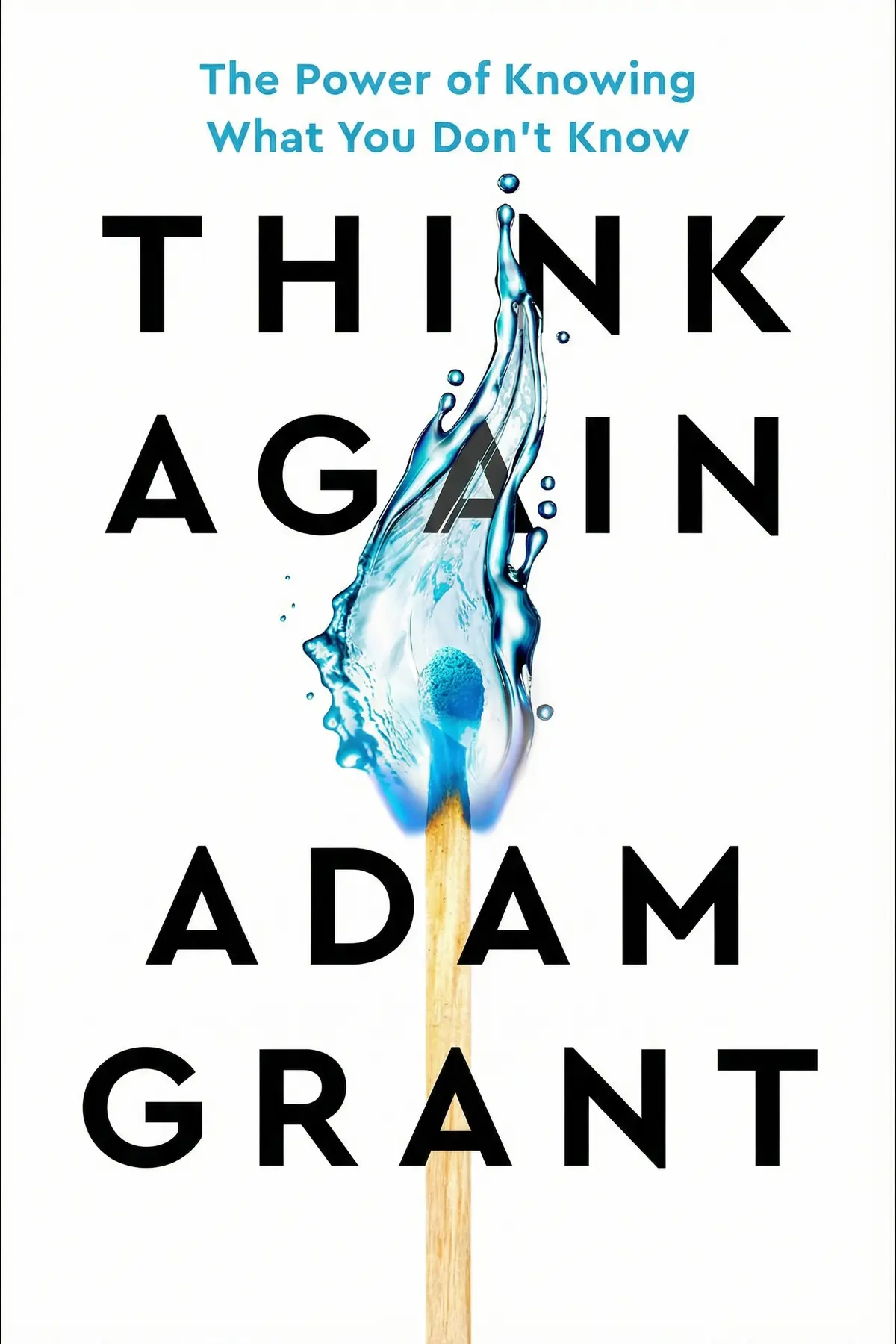
Table of Content
1. Introduction
2 min 03 sec
Have you ever found yourself locked in a heated debate, feeling your blood pressure rise as you try to convince someone—a family member, a colleague, or a friend—of something you know is absolutely, 100 percent correct? We’ve all been there. In those moments, we often tell ourselves that if we were just a little smarter, or if our arguments were just a little more logical, we could finally win. We view intelligence as a weapon to be sharpened, a tool to help us conquer the opinions of others. But what if we’ve been looking at the problem from the completely wrong angle? What if the real measure of our intelligence isn’t how much we know, but how quickly we can let go of what we thought we knew?
This is the central premise of Adam Grant’s work. In a world that is moving at a breakneck pace, the most dangerous thing we can do is hold onto outdated ideas simply because they feel comfortable. We often treat our beliefs like sacred treasures that must be defended at all costs. However, as you will soon discover, those very beliefs can become anchors that hold us back from progress. The true goal of thinking should not be to find the answer and stop; it should be to find a better question and keep going.
In this exploration of rethinking, we are going to look at why even the most successful leaders can fall into the trap of overconfidence. We will examine the psychological mechanics of why we are so blind to our own incompetence and why our biggest blind spots are often the things we think we’re best at. We’ll also dive into the art of persuasion, learning why the most effective negotiators don’t act like warriors, but like dancers.
Ultimately, the throughline here is simple but transformative: the moment you become willing to be wrong, you open the door to being right more often. By the end of this journey, you’ll understand how to foster a culture of learning around you, how to bridge deep social divides, and why the most powerful thing you can ever say is, “I don’t know, but let’s find out.” Let’s begin by looking at why the world’s most successful companies sometimes fail precisely because they refuse to change their minds.
2. The Danger of Conviction in a Fast-Moving World
3 min 12 sec
Discover how the downfall of a tech giant like Blackberry illustrates the high cost of refusing to rethink your core strategies when the environment shifts.
3. Illuminating Our Blind Spots through Humility
3 min 13 sec
Uncover why those with the least skill often have the most confidence, and how to balance self-belief with the humility to question your methods.
4. The Art of Persuasive Negotiation
3 min 01 sec
Learn why the most effective debaters avoid the ‘tug of war’ approach and instead use a scientist’s curiosity to find common ground.
5. Uprooting Prejudice through Randomness
2 min 41 sec
See how acknowledging the ‘accident of birth’ can dismantle even the most deeply held biases and open the door to genuine dialogue.
6. Motivating Change through Active Listening
2 min 28 sec
Explore the ‘Vaccine Whisperer’s’ method of motivational interviewing, where listening and curiosity prove more persuasive than any lecture.
7. The Trap of the Binary Bias
2 min 36 sec
Understand why presenting issues as ‘us versus them’ prevents rethinking and why embracing nuance makes your message more credible.
8. Fostering a Culture of Learning
2 min 31 sec
See how the difference between a ‘performance culture’ and a ‘learning culture’ can be the difference between life and death in high-stakes environments.
9. Conclusion
1 min 54 sec
As we wrap up our look at the power of rethinking, let’s return to the core idea: being wrong is not something to be feared; it is something to be embraced. Throughout this summary, we have seen that the most effective people—whether they are inventors, negotiators, or leaders—are those who have the humility to realize that their knowledge is always a work in progress. They understand that progress is not about moving from a state of being wrong to a state of being right, but about moving from a state of being wrong to a state of being slightly less wrong.
One of the most practical ways to implement this in your own life is to change how you define yourself. Most of us build our identities around our beliefs. We say, ‘I am a person who believes X.’ The problem with this is that when someone challenges ‘X,’ they are also challenging ‘you.’ This makes you get defensive and prevents you from seeing the truth. Instead, try building your identity around your values. Your values, like integrity, curiosity, or kindness, are the things that stay constant. Your beliefs are simply the current tools you are using to express those values. If you value excellence, for example, you should be the first person to want to change a belief that is no longer working, because changing that belief is the only way to stay excellent.
So, the next time you find yourself in a disagreement, or the next time you feel that surge of certainty that you are right and everyone else is wrong, take a deep breath. Ask yourself: ‘What do I not know here?’ and ‘What evidence would it take for me to change my mind?’ By making rethinking a habit, you don’t just become smarter; you become more resilient, more empathetic, and more effective in everything you do. The world is full of people who are certain. Be the person who is brave enough to think again.
About this book
What is this book about?
Think Again is a profound exploration of the psychological barriers that prevent us from questioning our own beliefs. In a world that prizes certainty and conviction, Adam Grant argues that the most valuable skill we can possess is the ability to rethink, unlearn, and stay open to new information. The book challenges the idea that being wrong is a sign of weakness, showing instead that it is the primary catalyst for growth. Grant provides a roadmap for shifting away from the rigid mindsets of preachers, prosecutors, and politicians toward the flexible, curious mindset of a scientist. Through a blend of engaging storytelling and rigorous research, the book promises to help readers navigate complex disagreements, lead more innovative teams, and build a more nuanced understanding of the world. Whether you are dealing with personal biases, organizational inertia, or social polarization, this summary provides the tools to replace stubbornness with a commitment to truth and lifelong learning.
Book Information
About the Author
Adam Grant
Adam Grant is an organizational psychologist and consultant, and the author of four New York Times best-selling books. His clients include Google, the NBA, and the Gates Foundation.
Ratings & Reviews
Ratings at a glance
What people think
Listeners consider this work essential for the modern era, valuing its abundance of practical insights and stimulating material that prompts a shift in perspective. The prose is captivating; while one listener describes the writing as having a conversational feel, another points to the inclusion of thoroughly researched anecdotes. Listeners value the hands-on guidance based on concrete recommendations, noting how it supports self-improvement and the adoption of a growth mindset.
Top reviews
Somkid
Adam Grant has a way of making complex psychology feel like a chat over coffee. This book isn't just about changing your mind; it’s about the vital importance of staying curious enough to realize when you're wrong. I loved the breakdown of the preacher, prosecutor, and politician roles we all fall into during arguments. It really highlighted how often we prioritize being right over being accurate. The practical advice on adopting a scientist’s mindset is something I’ve already started applying at work. While some examples like the Blackberry story felt a bit familiar, the overall message of intellectual humility is exactly what we need right now. It’s a fast-paced, engaging read that pushes you toward a genuine growth mindset without feeling overly academic or dry. Highly recommended for anyone feeling stuck.
Show moreLadawan
Finally got around to reading this, and the section on motivational interviewing alone made it worth the purchase. It’s rare to find a book that offers such pragmatic lessons for real-life communication while still being backed by psychological research. I’ve always struggled to talk to family members who hold radically different views, but Grant’s approach changed my entire strategy. Instead of acting like a prosecutor, I’m learning to listen for their internal motivations. The conversational tone makes the pages fly by, and the illustrations throughout are a great touch for visual learners. It’s definitely a must-read for today’s polarized world. I did find the NASA case study a bit confusing—the distinction between process and outcome felt muddled there—but the personal growth aspects are top-notch. Truly a life-changing perspective on the value of being wrong.
Show moreIff
Wow, this was exactly the mental reset I didn't know I needed this year. Grant’s writing is so engaging that I finished the whole thing in two sittings, feeling genuinely energized to rethink my own career path. He doesn't just tell you to be open-minded; he provides a roadmap for how to actually do it without losing your sense of self. I loved the anecdote about the teacher who has students rewrite their own textbooks—it’s such a powerful example of active learning. The book is filled with these kinds of aha moments that make you look at your daily habits differently. While some critics say it's just common sense, the truth is that common sense is rarely common practice. This book provides the nudge needed to turn theory into action. It’s a brilliant contribution to the field and a joy to read.
Show moreSirichai
Picked this up because I was tired of feeling stuck in my own head, and it delivered on every front. It's rare to find a business-adjacent book that is this well-researched yet still feels like a casual conversation with a brilliant friend. The pragmatic lessons on how to embrace a growth mindset are presented through stories that actually stick with you. I especially appreciated the look at super-forecasters and why they are so much more successful than the average expert. It turns out that being willing to change your mind isn't a sign of weakness; it's a competitive advantage. This is easily a must-read for anyone in a leadership position or anyone just trying to be a better person. It’s insightful, funny, and incredibly relevant to the world we’re living in right now.
Show moreDiego
Ever wonder why you’re so certain about things you’ve never actually investigated? Think Again forces you to confront that uncomfortable reality with grace and a healthy dose of humor. The way Grant describes our tendency to preach our own beliefs while prosecuting others’ views hits uncomfortably close to home. I appreciated the actionable suggestions for how to approach disagreements, especially the emphasis on asking how rather than why. It shifts the tone from a battle of egos to a collaborative search for the truth. Some of the societal-level changes discussed in the final third felt a bit optimistic, perhaps even slightly naive, given current political climates. However, the core message about the power of knowing what you don't know is transformative. It’s a thought-provoking guide for anyone looking to sharpen their mental flexibility.
Show moreRiley
The core idea of thinking like a scientist is presented here as the ultimate antidote to the Dunning-Kruger effect. Grant illustrates this beautifully through the rise and fall of companies like Blackberry, showing how the same conviction that leads to success can eventually become a cage. I found the distinction between task conflict and relationship conflict particularly helpful for my own management style. It’s a well-researched book that manages to stay light on its feet without getting bogged down in jargon. My only real gripe is that it occasionally simplifies complex historical events to fit the central theme. The world is often messier than a 200-page book can account for. Still, the emphasis on building learning cultures is something every leader should take to heart. It’s a solid read that encourages you to keep updating your mental software.
Show moreManika
In an era of deep polarization, this book feels like a necessary survival guide for our sanity and our relationships. Adam Grant tackles the binary bias that plagues our social media feeds, reminding us that most issues are far more complex than a for or against stance. I found the chapter on negotiating especially enlightening; it turns out that having fewer, stronger arguments is actually more persuasive than a laundry list of points. The writing is punchy and direct, though the pacing slows down a bit toward the end when he shifts to societal changes. I would have liked to see more on how to handle bad faith actors who have no interest in the truth. Regardless, the advice on grounding your identity in your values rather than your opinions is profound. It’s a thought-provoking read that I’ll be recommending to my friends.
Show moreGabriel
To be fair, while the writing is incredibly smooth, much of the content felt like a remix of ideas I’ve encountered elsewhere. If you’ve read Range or Thinking, Fast and Slow, the firefighter parable and the focus on cognitive biases might feel like old news. Grant is a brilliant storyteller, but I occasionally felt like he was cherry-picking anecdotes to fit his rethinking narrative. For instance, the analysis of why some companies fail versus succeed felt a bit like hindsight bias in action. That said, his section on motivational interviewing was a standout and provided some actual, concrete tools for having difficult conversations. It’s a decent introductory text for personal growth, even if it lacks the depth of more specialized psychological works. I’d recommend it to someone new to the genre, but seasoned readers might find it a bit repetitive.
Show moreAnucha
Frankly, I enjoyed parts of this, but I couldn't shake the feeling that Grant was stretching his metaphors a bit thin. The argument that NASA failed because of a results-oriented culture felt like a massive oversimplification of a very complex engineering disaster. It’s easy to look back in hindsight and say people should have rethought their decisions, but foresight is a different beast entirely. On the positive side, the breakdown of how to win a debate by finding common ground was excellent and very practical. The book is written in a very accessible, conversational tone that makes the psychology feel relevant to everyday life. It’s a good book for a weekend read, but don’t expect it to solve every cognitive hurdle you face. It’s more of a motivational primer than a deep-dive manual into the mechanics of the human mind.
Show moreRome
As an engineer who thrives on data-driven proof, I found myself frustrated by the lack of scientific rigor in some of these chapters. Several of the studies cited felt poorly designed or were presented with far more confidence than the data actually warranted. For example, the claim about pollsters and the 2016 election felt factually shaky and undermined the author's credibility for me. I’m already in an environment where we constantly seek evidence that our designs are wrong to make them better, so the scientist mindset isn't exactly a revelation. The book leans heavily on motivational platitudes rather than providing the rigorous cognitive tools needed for complex decision-making. If you're looking for something with more meat, I’d suggest sticking to Taleb or Dalio. It’s a light read, but for those in technical fields, it might feel a bit shallow.
Show moreReaders also enjoyed
Age of Propaganda: The Everyday Use and Abuse of Persuasion
Anthony Pratkanis

59 Seconds: Change Your Life in Under a Minute
Richard Wiseman

AUDIO SUMMARY AVAILABLE
Listen to Think Again in 15 minutes
Get the key ideas from Think Again by Adam Grant, plus 5,000+ more titles in English and Thai.
- 5,000+ titles
- Listen as much as you want
- 7-day free trial
- Cancel anytime







