Guns, Germs and Steel: The Fates Of Human Societies
Jared Diamond
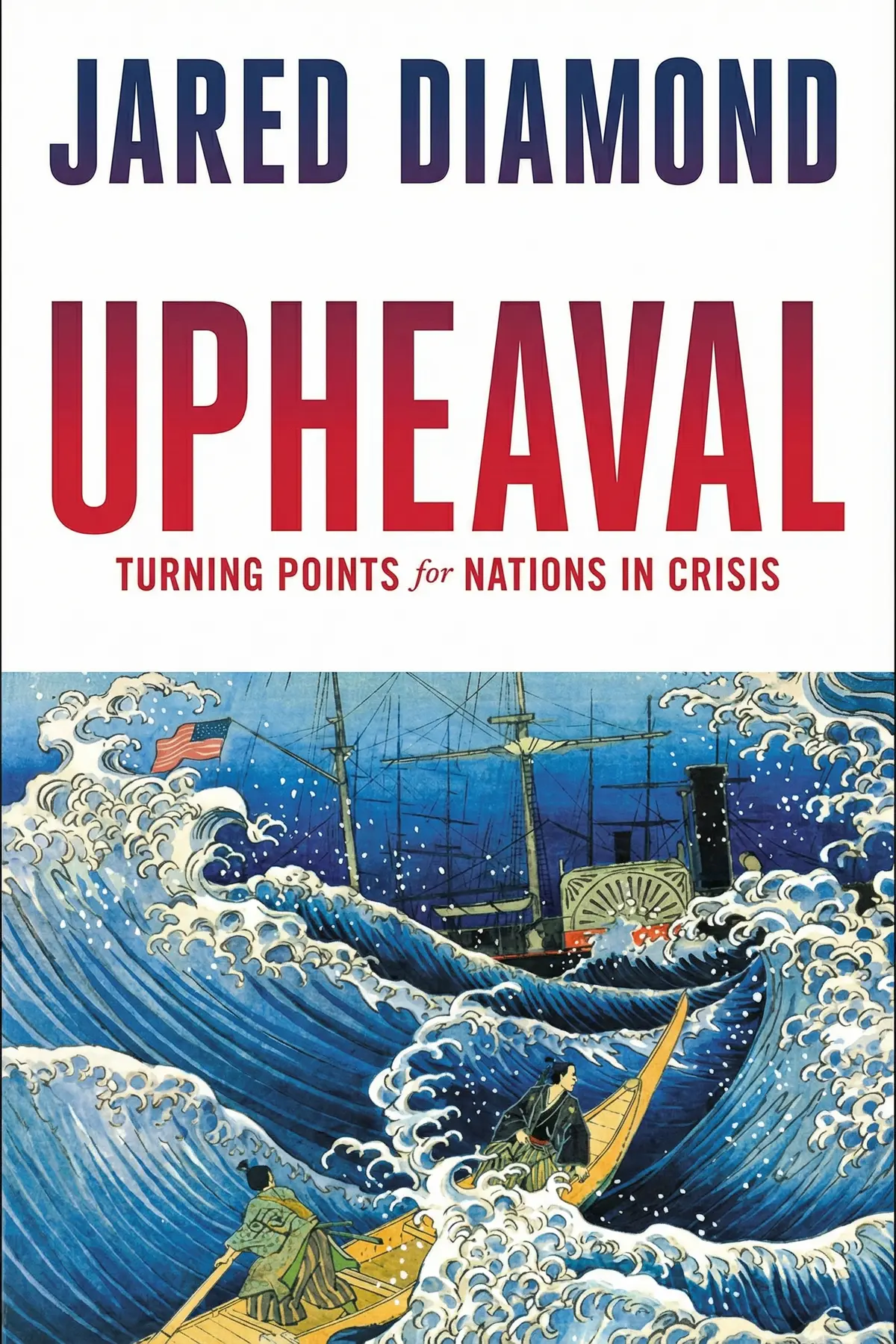
Upheaval explores how nations navigate profound crises by applying a psychological framework of selective change, drawing lessons from history to help modern societies face existential threats and internal polarization.
1 min 49 sec
It may come as a surprise, but the internal discipline required to rescue oneself from a personal setback is remarkably similar to the fortitude a nation needs to survive a geopolitical disaster. Whether you are a person facing a sudden career shift or a country grappling with a violent government takeover, the path toward a solution remains the same. It requires what we might call selective change. This is the art of looking at a broken situation and meticulously deciding what parts of your identity are non-negotiable and what parts must be transformed to ensure survival.
In this exploration of national turning points, we look at the work of author Jared Diamond, who provides a compelling profile of several nations that have stood on the brink of collapse. These countries—ranging from the snowy borders of Finland to the island chains of Indonesia—faced moments where their old ways of life were no longer viable. To move forward, they had to be brutally honest about their circumstances, stop blaming external forces for their misfortunes, and find creative ways to work within their limitations.
This journey is about more than just history; it is a blueprint for the present. By understanding how these nations navigated their darkest hours, we can see a throughline of resilience. We will see how some countries used diplomacy to keep a giant neighbor at bay, how others looked to foreign models to jumpstart their economies, and how still others struggled with the high price of political polarization. As we walk through these stories, keep the central question in mind: when the world as you know it begins to crumble, what parts of yourself will you fight to keep, and what parts are you willing to let go of to build a better future? This is the core challenge of any upheaval, and the lessons learned by these seven nations offer a roadmap for anyone—or any country—looking for a way out of the storm.
2 min 30 sec
Discover the psychological toolkit that helps both individuals and nations navigate life-altering transitions by acknowledging reality and accepting personal responsibility.
2 min 36 sec
Explore how a small nation used grit and strategic self-censorship to maintain its independence while living in the shadow of a global superpower.
2 min 36 sec
Witness Japan’s remarkable transformation from a secluded feudal society into a modern global power by selectively adopting Western innovations.
2 min 39 sec
Trace the tragic breakdown of one of South America’s oldest democracies and the complex economic recovery that followed a brutal military coup.
2 min 32 sec
Examine how a diverse archipelago emerged from colonial rule and a catastrophic internal purge to become a major player in the global economy.
2 min 34 sec
Witness the power of national accountability as West Germany navigated the shadow of the Holocaust and worked toward a peaceful, unified future.
2 min 29 sec
Trace Australia’s journey from a dependent British colony to a self-reliant nation that embraced its own unique identity and geographic reality.
2 min 41 sec
Analyze the modern threats to American democracy, from political gridlock and campaign finance to the systematic erosion of voting rights.
2 min 41 sec
Examine the existential threats facing our planet and why a coordinated, multi-national approach is the only way to ensure a sustainable future.
1 min 47 sec
In the end, the stories of these seven nations—Finland, Japan, Chile, Indonesia, Germany, Australia, and the United States—serve as a powerful reminder that crisis is an inevitable part of the human experience. Whether on a personal or a national level, we will all eventually face moments where the ground shifts beneath our feet and our old ways of being are no longer enough to carry us forward. But as we have seen, a crisis does not have to be an end; it can be a beginning. By using the framework of selective change, we can navigate these turning points with purpose and clarity.
The throughline in every successful recovery is the willingness to look in the mirror and be honest about what is broken. It is the courage to take responsibility rather than seeking a scapegoat. It is the wisdom to know what to keep and what to let go of. As we look at the modern world, with its rising political tensions and environmental threats, these lessons are more relevant than ever. We are currently living through a period of profound global upheaval, and the diagnostic tools of crisis therapy offer us a way to manage the chaos.
We must remember that the strongest nations are not those that never face trouble, but those that are flexible enough to adapt when trouble arrives. The same is true for us as individuals. As you face your own personal or professional challenges, ask yourself: Am I acknowledging the reality of my situation? Am I taking responsibility for my response? What core parts of my identity must I protect, and what habits am I willing to change to move forward? By applying these principles, we can turn our own periods of upheaval into opportunities for growth and resilience. The future is not something that just happens to us; it is something we build through the choices we make in our most difficult hours.
Upheaval takes a fascinating look at the intersection of individual psychology and national history. Jared Diamond proposes that the same strategies used in personal crisis therapy—such as taking responsibility and performing an honest self-appraisal—can be applied to entire countries facing existential threats. By examining the histories of seven diverse nations, the book illustrates how societies can successfully reinvent themselves without losing their core identities. From Finland’s struggle against the Soviet Union to Japan’s rapid modernization during the Meiji era, the narrative explains why some nations emerge stronger from turmoil while others succumb to it. The promise of the book is a clear, diagnostic framework for understanding the modern world’s most pressing issues, including political gridlock and climate change. It serves as both a historical analysis and a cautionary guide for the future of the global community.
Jared Diamond is an award-winning author and a professor of geography at UCLA. His influential research spans the diverse fields of ecology, history, biology, and anthropology, earning him high regard among his peers. Throughout his distinguished career, he has received prestigious honors such as the MacArthur Foundation Fellowship and the Tyler Prize for Environmental Achievement. His widely acclaimed book, Guns, Germs, and Steel, was published in 1997 and earned him the Pulitzer Prize.
Listeners find this an essential read that showcases remarkable academic depth and high-quality writing, as one listener points out its ability to simplify complex subjects. Furthermore, they value the historical significance of the text, with one listener emphasizing its focus on major historical episodes and pivotal moments. The book also earns praise for being accessible and intellectually stimulating; listeners also admire the tempo, with one review mentioning its concise treatment of significant events. Nevertheless, opinions on the narrative style are somewhat divided.
Jared Diamond has this incredible knack for blending disciplines that usually don't talk to each other. By applying the principles of crisis therapy to the history of entire nations, he gives us a completely fresh lens through which to view global stability. It’s truly fascinating to see how the 12 success factors—things like acknowledging a problem and separating core values—play out in places like Finland or Germany. Frankly, the influence of his wife’s psychological background is evident throughout the narrative and adds a layer of empathy often missing in history books. While some might find the scholarly research a bit dense, I found the way he breaks down complicated geopolitical shifts to be masterful. It’s not just a history book; it’s a manual for survival in an increasingly polarized world. This is a thought-provoking read that stays with you long after the final page.
Show moreAfter loving Guns, Germs, and Steel, I had high expectations for this new volume, and Diamond mostly delivers on that promise. He has a way of taking these massive, sweeping historical turning points and making them understandable for the average reader without dumbing them down. The section on Japan and the arrival of Commodore Perry was particularly enlightening, showing how a nation can pivot toward modernity without losing its cultural soul. I'll admit, the pacing is a bit uneven in the later chapters, but the scholarly research remains top-notch throughout. It’s a thought-provoking look at how we handle external threats and internal malaise in the modern era. Not gonna lie, I was worried it would be a total 'downer' like his previous work on collapse, but this feels much more hopeful. It shows that there is a path through the fire if we choose to take it.
Show moreFinally got around to reading this and I'm walking away feeling unexpectedly optimistic about our global future. Diamond doesn't shy away from the massive challenges we face—climate change, political polarization, and economic inequality—but he shows that history is full of examples where things looked just as bleak. The influence of his wife Marie Cohen adds a layer of human empathy to the book that I really appreciated. It’s a refreshing change from the usual doom-and-gloom of modern non-fiction that offers no solutions. The way he examines turning points in Germany and Japan proves that we aren't stuck in our current ruts forever. Frankly, it’s a thought-provoking call to action for every citizen. It breaks down the complicated barriers we put up against change and shows that selective reform is the only way forward for a healthy democracy.
Show moreThe chapter on Finland alone is worth the price of admission for any history buff. I never fully realized how precarious their position was during the Winter War, yet they managed to maintain their democracy through sheer realism and strategic sacrifice. Truth is, Diamond’s 12-part model is a useful tool, though checking off every single point for every single country gets a bit repetitive by the third case study. You might find yourself skimming the structural bits once you get the hang of his rhythm and can anticipate the next factor. However, the historical value here is undeniable because he takes these massive turning points, like the Meiji restoration or the coup in Chile, and makes them feel personal. It’s a well-written exploration of how societies can choose to evolve rather than collapse under pressure.
Show moreEver wonder if a country can actually learn from its own breakdowns? Diamond argues that they can, provided they drop the myth of exceptionalism and look outward for better models. I loved how he challenged the idea that the United States has nothing to learn from places like Canada or Western Europe regarding healthcare and education. The comparison between personal crisis management and national survival is actually quite brilliant once you get past the initial oddity of the concept. To be fair, the book is quite long, but the pacing usually keeps things moving at a brisk clip through the various case studies. It’s a necessary read for anyone feeling anxious about the current state of American political polarization. This book really forces you to ask hard questions about which of our national values are worth keeping and which are just bad habits.
Show morePicked this up on a whim and was surprised by how accessible the prose is for such a heavy, multi-disciplinary subject. Diamond avoids the dry, academic jargon that usually plagues these kinds of massive history tomes, making it perfect for a casual reader. Instead, he treats the reader to a series of fascinating case studies that feel like deep-dive documentaries into the heart of national identity. The insights into how Finland navigated its relationship with the Soviet Union were eye-opening and felt very relevant to today’s headlines. To be fair, some of the political conclusions felt a little too neat, as if he was forcing the facts to fit his specific model. But overall, it’s an impressive work of research that successfully breaks down complicated topics. It really forces you to look at the current state of the world with a more analytical eye.
Show moreNot what I expected, but in a good way. I thought this would be a standard history book, but the focus on 'national psychology' makes it something else entirely. Diamond’s 12 success factors provide a really clear way to break down complicated topics that usually feel overwhelming to the average person. I found the section on Australia’s identity shift particularly interesting, especially the way they moved away from being a 'little Britain' to embrace their own geography. The pacing is quite good, and he manages to cover a lot of ground without getting bogged down in tiny details. My only real complaint is that the narrative quality can be a bit hit-or-miss depending on which country he’s discussing. Some chapters feel much more researched than others. Still, it’s a must-read for anyone interested in why some nations thrive while others stall.
Show moreWhile the premise is brilliant, the execution felt a bit like a slog in the middle sections of the book. Diamond is clearly a brilliant scholar, and his ability to synthesize complex topics into a readable format is impressive as always. However, the 12-factor checklist becomes a rigid cage that stifles the natural flow of the historical stories he is trying to tell. Each case study—be it Japan or Indonesia—starts to feel like a repetitive exercise rather than a living history after a while. I appreciate the concise way he covers key events, but the mixed narrative quality made it hard to stay engaged for all five hundred pages. Personally, I think he could have made his point with half the word count and a less formulaic structure. It’s still a solid piece of research, but it lacks the organic spark that made his earlier work so revolutionary.
Show moreTo be fair, the metaphor of individual therapy applied to geopolitical entities is a bit of a stretch for me. Diamond is a great writer, but at times it feels like he’s trying to fit a square peg into a round hole with his 12 factors. Is a nation really like a person mourning a death or facing a mid-life crisis? I’m not entirely convinced that societies function with that kind of singular emotional logic. That said, the historical value of the individual case studies is high and very informative. I learned a lot about the Indonesian transition and the Meiji era that I simply didn't know before reading this. The book is scholarly and well-written, even if the central thesis feels a little thin at times. It’s an interesting experiment in discipline-bending, but I found myself more interested in the raw history than the psychological framework.
Show moreI found this deeply problematic from a historical standpoint, even if the prose flows well enough. While Diamond is an impressive polymath, his analysis of the Chilean coup and the Indonesian massacres feels dangerously one-sided and sanitizes the reality of those events. He paints Allende as the primary cause of his own downfall while treating Pinochet’s sadistic regime with a bizarre level of 'flexibility' and pragmatism. It’s a bit of a Cold War warrior rant that ignores the role of outside interventions in making these developing economies 'scream' through sanctions. Look, the research is extensive, but the narrative quality suffers when you realize how much is being omitted to fit his 12-factor psychological framework. If you’re looking for a balanced view of 20th-century political upheaval, you might want to supplement this with more critical sources. It’s readable, sure, but the underlying bias is hard to ignore.
Show more
Yanis Varoufakis
Yuval Noah Harari

Jacinda Ardern
Pankaj Mishra
Michael Axworthy
James Comey
Anthony Pratkanis
AUDIO SUMMARY AVAILABLE
Get the key ideas from Upheaval by Jared Diamond, plus 5,000+ more titles in English and Thai.