Extra Life: A Short History of Living Longer
Steven Johnson
Explore the biological and social patterns that drive innovation. This summary reveals how great ideas emerge from environments that encourage collaboration, slow hunches, and the creative repurposing of existing tools.
1 min 36 sec
We often imagine that a great idea arrives like a lightning bolt in a clear blue sky. We picture the lone genius, working in isolation, suddenly shouting ‘Eureka!’ as the world changes in an instant. But if we look closely at the history of innovation, we find a much more complex and organic story. Great ideas aren’t just thoughts that happen inside a brain; they are products of the environments we inhabit. They are more like coral reefs or sprawling cities—ecosystems where many different parts interact to create something entirely new.
In this exploration of Steven Johnson’s work, we are going to look at the natural history of innovation. We will see how the same patterns that govern the evolution of life on Earth also govern the evolution of human technology and culture. We will move away from the myth of the solitary inventor and toward a world of networks, platforms, and ‘slow hunches.’ This journey takes us from the primordial soup of early life to the bustling coffee houses of the Enlightenment, all the way to the digital architecture of the modern web.
The throughline of this summary is simple but profound: creativity is a collaborative process. By understanding the specific conditions that allow new ideas to emerge, we can better design our lives, our workplaces, and our societies to be more innovative. We’ll see that breakthroughs are almost always built out of existing parts, found within the realm of what is currently possible, and nurtured over long periods of time. Let’s dive into the structures and habits that turn a fleeting thought into a world-changing reality.
2 min 27 sec
Discover why breakthroughs only happen when the right pieces are already in place and how the limits of today define the innovations of tomorrow.
2 min 03 sec
Learn why the most significant breakthroughs are rarely sudden epiphanies but are instead ideas that have been quietly maturing for years.
2 min 07 sec
Explore how certain ‘keystone’ innovations create foundations that allow countless other creators to build and thrive.
2 min 09 sec
Discover why the best environments for new ideas are those that balance order and chaos, allowing information to flow freely.
2 min 01 sec
Challenge the idea that markets are the only drivers of progress by looking at the impact of open, collaborative networks.
1 min 58 sec
Learn how embracing a little bit of mental messiness and random connection can lead to the solutions you’ve been looking for.
2 min 07 sec
Understand why mistakes are not just hurdles to be overcome, but are often the very things that lead us to new discoveries.
2 min 05 sec
See how the most revolutionary tools often come from taking an old invention and using it for a completely different purpose.
1 min 39 sec
As we look back at the patterns of innovation, one thing becomes incredibly clear: good ideas are not isolated events. They are the result of a long, messy, and collaborative process that mirrors the very evolution of life. We’ve seen how the adjacent possible sets the boundaries of what we can achieve, and how slow hunches need time and a supportive environment to grow. We’ve explored the importance of liquid networks, where ideas can flow and collide, and the role of platforms that provide a foundation for others to build upon.
We also learned that things we usually think of as negative—like chaos, error, and noise—are actually essential ingredients for creativity. Mistakes lead to new discoveries, and the ‘productive chaos’ of a dreaming brain or a bustling city can spark serendipity in ways that a perfectly ordered system never could. Finally, we saw that we don’t always need to invent something brand new; sometimes the most revolutionary act is simply to take something old and use it in a way no one else has considered.
The actionable takeaway from this journey is to change the way we think about our own creative lives. Stop waiting for the lightning bolt of inspiration. Instead, start building your own ‘commonplace book’ of hunches. Seek out diverse networks of people who don’t think like you do. Create spaces where you can afford to make mistakes. By fostering an environment that welcomes connection, patience, and the creative reuse of the past, you make it much more likely that your next great idea will find its way to the surface. Innovation isn’t just a talent; it’s a way of being in the world.
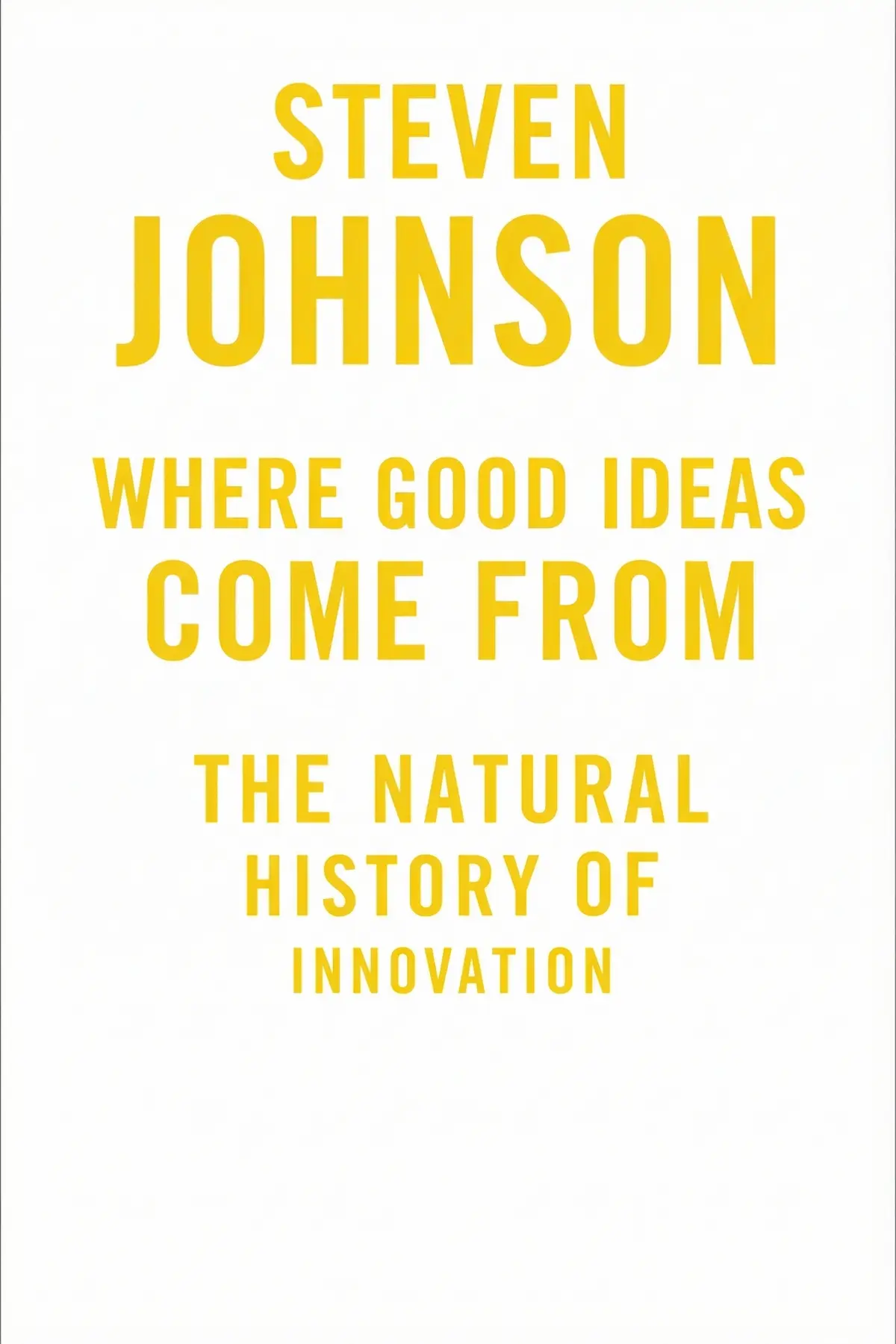
Where Good Ideas Come From examines the history of human ingenuity through a unique lens, drawing parallels between biological evolution and technological progress. Steven Johnson argues that breakthroughs are rarely the result of solitary genius or sudden flashes of inspiration. Instead, they are the product of specific environmental conditions—what he calls the adjacent possible, liquid networks, and platforms. The book promises to demystify the creative process by showing how ideas need time to mature and spaces where they can collide with others. From the development of the printing press to the birth of the World Wide Web, the narrative traces how shared environments, serendipity, and even productive errors facilitate the leaps in logic that change the world. By understanding these patterns, readers can learn to foster more innovative thinking in their own lives and organizations.
Steven Johnson is a prominent American author specializing in popular science and the history of innovation. He is a frequent contributor to major publications, including The New York Times, The Wall Street Journal, and The Financial Times. Johnson has written several bestsellers, such as Everything Bad is Good for You and The Ghost Map, and is celebrated for his ability to connect complex scientific concepts with cultural history.
Steven Johnson

Steven Johnson
Listeners find this book to be an essential read for businesses, full of deep insights and practical examples. Furthermore, the prose is well-crafted and concise, acting as a compelling narrator that keeps audiences hooked. Listeners also value the straightforward nature of the material; one listener notes how the ideas are simple to implement, while others highlight the book's creative lessons and stimulating insights.
Ever wonder why some environments seem to practically bleed genius while others remain stagnant? Johnson's deep dive into "liquid networks" and the "adjacent possible" offers a compelling roadmap for anyone trying to foster creativity in a professional setting. The writing is incredibly succulent, moving from historical anecdotes about coffeehouses to the complex structure of coral reefs without ever losing the reader's attention. Frankly, the concept of the "slow hunch" changed how I view my own project management style because I no longer feel the need to rush toward a "Eureka" moment. While some critics might find the Darwinian parallels a bit of a stretch, the overarching narrative is so engaging that it hardly matters. This is a must-read for business leaders who want to build a culture where innovation isn't just a buzzword but a natural outcome of the environment.
Show moreWow. This book is a total game-changer for anyone working in a creative or collaborative field. Johnson takes complex concepts like "exaptation" and makes them feel completely intuitive and applicable to everyday life. I loved the idea that serendipity isn't just luck, but something we can actually foster by opening ourselves up to different disciplines and "walking through" new environments. The storytelling is so well-crafted that I found myself highlighting passages on almost every page to share with my team. Look, if you’re tired of the same old "how-to" business manuals, this is the refreshing, intellectual boost you need. It’s a thought-provoking journey that proves our best ideas come from the connections we make with others, not from sitting in a dark room alone.
Show moreLook, if you want to understand how the world actually moves forward, you need to stop thinking about "Eureka" moments and start thinking about ecosystems. Steven Johnson’s "Where Good Ideas Come From" is an essential read because it deconstructs the myth of the lone genius in such a convincing way. By looking at the "natural history" of innovation, he shows us that we are at our best when we are sharing, borrowing, and "exapting" ideas from one another. The book is filled with insightful concepts and helpful examples that stay with you long after you’ve put it down. Personally, I found the discussion on how the web fosters serendipity to be a fantastic rebuttal to those who claim the internet is making us less creative. It’s a succinct, well-paced, and ultimately hopeful book about the power of human connection.
Show moreAs an entrepreneur constantly searching for a competitive edge, I found Johnson's insights into the history of innovation to be surprisingly practical. The book argues that great ideas aren't lightning bolts from a lone genius but rather the result of "ideas having sex" in collaborative environments. Truth is, the storytelling here is top-notch; he manages to make the invention of the vacuum tube or the printing press feel as exciting as a thriller. The "liquid networks" concept is particularly relevant for today’s remote-work debate, showing why physical or digital spaces that allow for cross-pollination are so vital. My only real gripe is that he occasionally wanders into evolutionary biology analogies that feel a bit forced and don't always strengthen his main point. Still, the core lessons on how to cultivate a "slow hunch" are worth the price of admission alone.
Show moreSteven Johnson is a master at weaving disparate historical threads into a cohesive and thought-provoking narrative. He challenges the "Eureka" myth, showing us that the most significant breakthroughs often incubate for decades before they finally click. The section on "error" was a personal favorite, as it reframes failure not as a dead end, but as a necessary catalyst for exploration and new discoveries. In my experience, most business books are dry and clinical, but this reads more like a natural history of human cleverness. The prose is succinct and keeps you moving, though I did find myself skimming some of the later chapters on "platforms" that felt a bit dated. Overall, it’s a brilliant examination of why we should all be keeping "commonplace books" to track our evolving thoughts.
Show moreThe chapter on the "adjacent possible" is worth the price of the book by itself, providing a brilliant lens through which to view technological progress. Johnson explains how certain inventions—like the printing press—could only happen because the wine press and movable type had already "opened the doors" to that specific space. It’s a humbling thought that suggests many of our "brilliant" discoveries were actually inevitable once the right components were in place. Gotta say, the way he links the structure of a coral reef to the layout of a modern city is genuinely eye-opening and changed how I think about urban planning. My only complaint is that the writing style can be a bit yuppie-centric, focusing heavily on Silicon Valley success stories. Nevertheless, it's a succinct and engaging read for anyone interested in the mechanics of human progress.
Show moreFinally got around to reading this, and it’s easy to see why it’s considered a staple for modern innovative thinking. The way Johnson describes "liquid networks"—places where ideas can bump into each other and recombine—is incredibly relevant for how we design our workspaces and digital platforms. I particularly enjoyed the section on the "slow hunch," which validates the feeling that some of my best ideas have been brewing in the back of my mind for years. The writing is very accessible and the principles are easily applicable, making it a great choice for a company-wide book club. It’s not perfect—some of the historical examples feel a bit cherry-picked to fit his seven-pattern framework—but the overall message is powerful. It certainly makes you want to go out and start your own "commonplace book" immediately.
Show morePicked this up after seeing his TED talk, but the book feels a bit like an over-extended blog post at times. Johnson breaks down innovation into seven patterns—like exaptation and serendipity—which is a helpful framework, but the execution becomes repetitive after the first few chapters. Each section follows the exact same formula: an inventor anecdote, a definition, and then a few more supporting stories that don't always add much depth. I found the discussion of the "adjacent possible" to be the strongest part, illustrating how new technologies are limited by the tools available at the time. However, by the time I hit the section on platforms, it felt like the author was just plugging modern tech like Twitter. To be honest, the 40 pages of appendices at the end felt like unnecessary padding to make the volume look more substantial than it actually is.
Show moreTo be fair, there are some genuinely brilliant observations hidden within these pages, particularly the distinction between market-driven and networked innovation in the "Fourth Quadrant." Johnson does a great job of showing how open-source environments often outperform private, guarded laboratories. However, the book suffers from a lot of "popular science" fluff that feels designed to fill pages rather than provide value. Some of the analogies between neuronal networks and office floor plans are a bit of a stretch, and the author's tone can occasionally come off as a bit self-congratulatory. I also agree with other reviewers that the massive appendix of "key innovations" feels like a lazy way to bulk up the book. It’s a decent read for a flight or a weekend, but don’t expect it to provide a revolutionary new philosophy of life.
Show moreNot what I expected at all, and frankly, I’m disappointed given the hype surrounding this title. While the initial premise about "liquid networks" is interesting enough, the book quickly devolves into a series of shallow anecdotes that lack any real scientific rigor. Johnson spends way too much time flirting with Darwinian metaphors that don't actually prove the points he’s trying to make about human innovation. It feels like a "popular science" book that prioritizes being "easy to read" over providing deep, original insights that you couldn't find in a basic Wikipedia search. Also, the physical book is incredibly padded—the actual content ends around page 245, followed by nearly 100 pages of useless bibliographies and timelines. If you're looking for a serious study on how ideas evolve, you'd be much better off reading someone like Kevin Kelly or Steven Jay Gould instead.
Show moreAUDIO SUMMARY AVAILABLE
Get the key ideas from Where Good Ideas Come From by Steven Johnson, plus 5,000+ more titles in English and Thai.