
20 min 50 sec
Manufacturing Consent: The Political Economy of the Mass Media
Explore the structural forces that shape our news. This summary breaks down the propaganda model, showing how economic interests, advertising, and elite power influence the information we receive and the way we see the world.
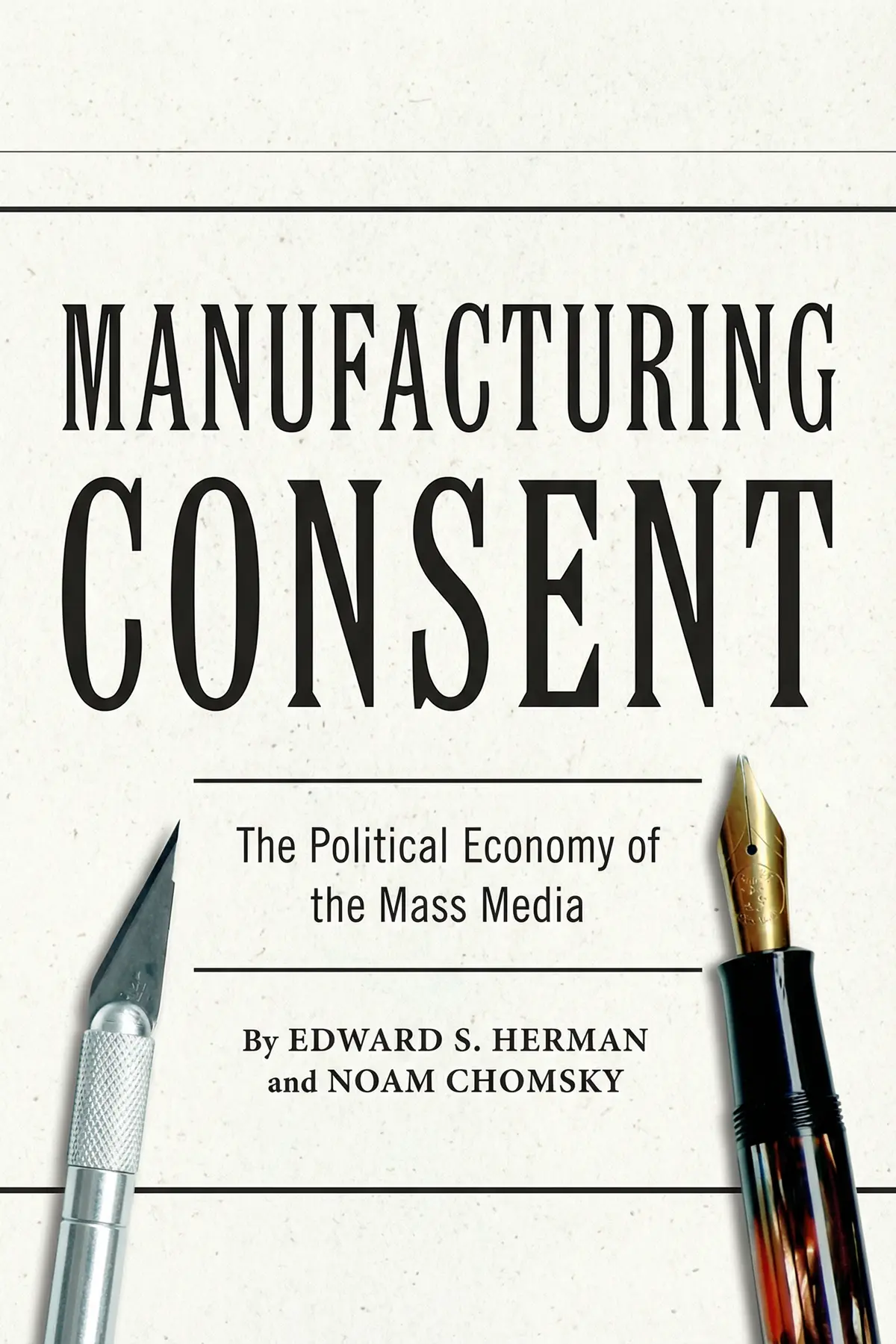
Table of Content
1. Introduction
1 min 42 sec
When we turn on the evening news or browse a major digital publication, we generally assume we are being presented with a reasonably accurate window into the world. We rely on journalists to be the ‘Fourth Estate’—the brave men and women who speak truth to power and keep our democratic institutions honest. But what if the very structure of the media industry prevents this from happening?
In this exploration of the landmark work by Edward S. Herman and Noam Chomsky, we are going to pull back the curtain on the mass media to see how it really functions. The core argument here is both simple and startling: in a society defined by massive inequalities of wealth and power, the media serves as a tool for indoctrination. Its true job isn’t just to inform or entertain; it’s to integrate the general population into the social, economic, and political systems of the ruling elite.
Think of it as a ‘manufacturing’ process. Just as a factory produces physical goods, the media industry produces a particular kind of public consensus. It filters the vast complexity of world events until only the narratives that support the status quo remain. This isn’t necessarily a secret conspiracy involving a few people in a dark room. Instead, it is the result of a set of institutional ‘filters’ that naturally favor elite perspectives. Over the next several sections, we will walk through the components of this ‘propaganda model.’ We’ll look at how ownership, advertising, and even the way reporters gather their information create a bias so pervasive that it often goes unnoticed. By the end, you’ll have a new lens through which to view every headline you see, helping you understand not just what is being said, but why it’s being said—and what is being left out.
2. The Media’s Role in Maintaining Social Hierarchies
1 min 47 sec
Discover why the media isn’t just a source of information, but a vital mechanism for ensuring the public accepts an inherently unequal and stratified society.
3. Strategic Criticism and the Illusion of Dissent
1 min 40 sec
Ever wonder why some scandals result in massive media coverage while others are ignored? Learn how elite disagreements create the appearance of a feisty, independent press.
4. The Structural Filters of the Propaganda Model
1 min 48 sec
Explore the invisible machinery that cleanses the news, ensuring that only information friendly to the powerful ever makes it to the public eye.
5. Corporate Ownership and the Death of Radical Press
1 min 43 sec
Learn how the free market, rather than government force, eventually silenced the voices of the working class and consolidated media power.
6. The Invisible Hand of Advertising
1 min 35 sec
Discover how the need to keep advertisers happy shapes the mood and the content of everything you watch and read.
7. The Dependency on Official News Sources
1 min 44 sec
Find out why the news often sounds like a government press release and how this reliance allows the elite to set the daily agenda.
8. The Use of Flak to Enforce Conformity
1 min 37 sec
Learn about the ‘flak’ system—the organized backlash used to punish any journalist or outlet that dares to stray from the approved narrative.
9. Ideology as a Final Filter
1 min 55 sec
Discover how the creation of a common enemy, like the fear of communism, binds society together and silences internal criticism.
10. The Strategic Use of Expert Opinions
1 min 48 sec
Understand why the ‘experts’ you see on TV often seem to agree with each other and how their presence adds a false sense of authority to biased reporting.
11. The Concept of Worthy and Unworthy Victims
1 min 49 sec
Explore the disturbing double standard in how the media values human life, depending on whether a death helps or hurts the government’s narrative.
12. Conclusion
1 min 42 sec
As we wrap up our journey through the ‘propaganda model’ described by Herman and Chomsky, the central message is clear: our mass media is not a neutral observer of world events. Instead, it is an institution shaped by powerful economic and political forces that ensure its output aligns with the interests of the elite. Through the filters of ownership, advertising, official sourcing, flak, and ideology, the news is systematically refined to promote a vision of the world that justifies inequality and supports the status quo.
This doesn’t mean that every journalist is a propagandist or that every story is a lie. Rather, it means that the system itself is designed to favor certain narratives while making others almost impossible to tell. The media ‘manufactures consent’ by narrowing the range of what is considered acceptable debate, making sure that while we might argue about the details, we rarely question the underlying foundations of power.
So, what can we do with this knowledge? The first step is to become a more critical consumer of information. When you see a story, ask yourself: Who owns this outlet? Who are the advertisers? What are the ‘official’ sources being used? Is there an ‘enemy’ being invoked to simplify a complex issue? By understanding the structural biases of the media, you can begin to see through the manufactured consensus and seek out the voices that the filters are designed to keep out. True democracy requires an informed public, and being truly informed means understanding not just the news, but the machinery that produces it. Stay curious, stay skeptical, and always look for the stories that aren’t being told.
About this book
What is this book about?
Have you ever wondered why certain stories dominate the headlines while others, perhaps more important, seem to vanish? Manufacturing Consent offers a provocative look at the internal mechanics of the mass media. It challenges the conventional view of the press as an independent watchdog of democracy. Instead, it argues that the media functions as a systemic tool for indoctrination, designed to align the public with the interests of a powerful elite. The book introduces the concept of the propaganda model, a framework that explains how information is filtered long before it reaches our screens or doorsteps. By examining the roles of corporate ownership, the influence of advertisers, and the reliance on official government sources, the authors reveal how the media narrows the scope of public debate. Through several case studies—ranging from foreign policy to election coverage—you will see how the media manufactures a consensus that supports the status quo and suppresses dissent, often without the need for direct government censorship.
Book Information
About the Author
Edward S. Herman
Edward S. Herman was a distinguished academic and author specializing in finance and political economy. His research focused extensively on the intersection of corporate power and media influence. Noam Chomsky is a globally recognized scholar whose work spans linguistics, philosophy, and political critique. Known for his deep analysis of American power and global systems, he has written dozens of influential books, including Hegemony or Survival and Deterring Democracy, cementing his status as a leading voice in contemporary political discourse.
Understanding Power: The Indispensible Chomsky
Noam Chomsky
What Kind of Creatures Are We?
Noam Chomsky
Who Rules the World?
Noam Chomsky
Ratings & Reviews
Ratings at a glance
What people think
Listeners find the work thoroughly researched, with every fact verifiable and the text easy to read. They describe it as a profoundly eye-opening and impactful look into modern society, with one listener mentioning that it shifted their view of their own nation. The content quality receives positive feedback, and one review points out the numerous instances of media bias. Although the strength of the arguments draws varied responses, listeners concur that it is worth the price.
Top reviews
Vilaiporn
This book is a complete paradigm shift for anyone who still believes the evening news provides a neutral window into the world. Herman and Chomsky dismantle the myth of the 'free press' by exposing the structural filters that dictate what stories make the cut and which ones vanish. Their breakdown of 'worthy' versus 'unworthy' victims is particularly haunting, showing how our empathy is often curated based on geopolitical alliances. While the case studies focus on the Cold War era, the underlying logic of the propaganda model feels more relevant today than ever. It is meticulously researched, with every assertion backed by a mountain of verifiable evidence. You might find the density of the prose challenging at times, but the effort pays off in spades. Frankly, it’s impossible to look at a headline the same way after finishing this. It forces you to question the very foundation of your information diet.
Show moreDavid
Finally got around to this classic and I'm genuinely stunned by how much it changed my perspective on my own country's role in global affairs. Chomsky and Herman don't just complain about the news; they provide a rigorous framework to understand how consent is manufactured among the populace. The level of detail regarding the Vietnam War and the role of 'official sources' is staggering. It makes you realize that the media often acts as a stenographer for power rather than a watchdog. I especially appreciated the discussion on 'flak' and how it keeps journalists in line. The truth is, this book is deeply uncomfortable because it shatters the illusion of an objective democratic press. It’s an influential work that demands your full attention. Every citizen who cares about actual democracy should have this on their shelf. It is powerful, well-researched, and absolutely vital.
Show moreVarinee
Wow, the level of research here is staggering and honestly a bit overwhelming at times. I picked this up thinking it would be a light critique of media bias, but it’s actually a surgical deconstruction of the political economy. The way they explain how the media 'inculcates' individuals with specific values to integrate them into institutional structures is brilliant. It’s a frightening look into how our thoughts are steered without us even realizing it. The book is filled with verifiable facts that make it hard to dismiss as mere ideology. I found the section on the 'national religion' of anticommunism during the Cold War to be a perfect illustration of their filters. Even if you don't agree with every conclusion, you cannot ignore the evidence they present. This is the kind of book that stays with you for years. It is a monumental achievement in media criticism.
Show morePang
Look, the propaganda model described here isn't some wild conspiracy theory; it’s a logical result of market forces and power structures. The authors meticulously show how media firms, which are often parts of larger conglomerates, have a vested interest in maintaining the status quo. This book is a must-read for anyone who feels like the news is just a series of 'adult children's books' mistaken for information. The contrast between how the press covers 'friendly' dictators versus 'enemy' states is chilling and perfectly documented. Personally, I found the analysis of the 1980s elections in El Salvador and Nicaragua to be a highlight of the book. It’s a heavy, academic read, but the implications are world-shaking. If you want to understand the invisible chains that bind our public discourse, start here. It is an essential, eye-opening masterpiece.
Show moreAubrey
I've been a journalist for years and reading this felt like someone finally turned the lights on in a dark room. It perfectly explains the internalized assumptions and self-censorship that occur within major media outlets every single day. The idea that we are 'manufacturing consent' is a powerful way to describe the subtle shaping of the public mind. This book provides abundant examples of media bias that are simply impossible to ignore once you see them. It is an incredible work of scholarship that avoids cheapest simplifications or black-and-white painting. Instead, it offers a nuanced, data-driven look at how money and power filter our reality. While it's a grueling read at over 400 pages, every page is packed with insights that are vital for a functioning democracy. This is easily one of the most important books I have ever read. Truly influential.
Show morePla
Ever wonder why certain international atrocities get wall-to-wall coverage while others are buried in a tiny column on page seventy-four? This classic text provides the answer through its brilliantly articulated five-filter propaganda model. The authors argue that media bias isn't necessarily a result of a conscious conspiracy, but rather an inevitable outcome of corporate ownership and the hunt for advertising revenue. To be fair, some of the specific examples from the eighties feel a bit dated, and the writing can get quite dry during the statistical breakdowns. However, the core thesis remains incredibly robust and eye-opening. The comparison between how the media treated the murder of a Polish priest versus the systematic killing of religious figures in Latin America is a masterclass in analytical journalism. It’s a dense read, yet essential for anyone trying to navigate the modern misinformation landscape. Definitely worth the price for the intellectual clarity it provides.
Show moreMarco
As someone who has always been skeptical of mainstream narratives, I found this book provided the vocabulary I was missing. Herman and Chomsky lay out a map of the media landscape that explains the 'madness' of our current political and financial circuses. The chapter on the Vietnam War is especially revealing, debunking the myth that the press was responsible for losing the war by being too critical. Instead, they show how the media actually favored the aggression from the start. Gotta say, the writing style is quite formal and can be a bit of a hurdle. I also wish there was more focus on domestic issues rather than just foreign policy. Nevertheless, the framework is solid and incredibly useful for deconstructing any modern news story. It's an influential read that will definitely sharpen your critical thinking skills. Five stars for content, four for readability.
Show moreAdam
The chapter on Latin America left me reeling from the sheer scale of the media's complicity in covering up atrocities. Herman and Chomsky demonstrate how the press actively marginalized dissent to allow dominant private interests to get their messages across. It’s a brutal look at the 'limited nature' of media critiques that we often mistake for genuine independence. I've been reading a lot of media theory lately, and this remains the most influential work in the field for a reason. My only gripe is that it can be a bit repetitive, as they apply the same model to multiple different scenarios. However, that repetition does serve to drive the point home quite effectively. The writing is sharp, analytical, and uncompromising. Even though it was written decades ago, it feels like it was published yesterday given the state of modern journalism. Highly recommended for the intellectually curious.
Show moreLaddawan
Truth is, I found parts of this book incredibly dry and repetitive to the point of frustration. The authors often hammer the same point over and over through dozens of pages of data that could have been summarized more effectively. While the concept of the propaganda model is fascinating and clearly influential, the academic tone makes it a bit of a slog for the average reader. Not gonna lie, I almost put it down during the long sections on Indochina. That said, the insights into how corporate interests shape the narrative are undeniably important. The sections on how advertising revenue dictates content were particularly eye-opening for me as a casual consumer of media. It’s a significant piece of scholarship, but it definitely requires a lot of patience to get through. If you want a quick summary, this isn't it, but for a deep dive, it’s the gold standard.
Show moreSupranee
Picked this up after seeing it referenced in so many political documentaries, but it was just too depressing and dense for me. The authors seem to have a very cynical view of everything, and by the end, I felt like there was no point in even trying to stay informed. Every chapter is filled with endless tables and footnotes that make it feel more like a textbook than a book for a general audience. While I get the main point about corporate ownership, the constant repetition of the 'worthy vs unworthy victims' theme felt like being hit over the head with a hammer. It’s definitely well-researched, I'll give it that, but it offers zero solutions for the problems it identifies. I appreciate the intellectual rigor, but it's just not an enjoyable or particularly accessible read for someone looking for a balanced take.
Show moreReaders also enjoyed
A Promised Land
Barack Obama

A River in Darkness: One Man’s Escape from North Korea
Masaji Ishikawa
A Theory of Justice
John Rawls
A Warning
Miles Taylor
Abolish Rent: How Tenants Can End the Housing Crisis
Tracy Rosenthal
Abortion: Our Bodies, Their Lies, and the Truths We Use to
Jessica Valenti
AUDIO SUMMARY AVAILABLE
Listen to Manufacturing Consent in 15 minutes
Get the key ideas from Manufacturing Consent by Edward S. Herman, plus 5,000+ more titles in English and Thai.
- 5,000+ titles
- Listen as much as you want
- 7-day free trial
- Cancel anytime







