Distancing: How Great Leaders Reframe to Make Better Decisions
L. David Marquet
Discover how a Navy commander transformed a failing nuclear submarine by rejecting traditional top-down authority and empowering every crew member to lead through a revolutionary leader-leader organizational model.
1 min 29 sec
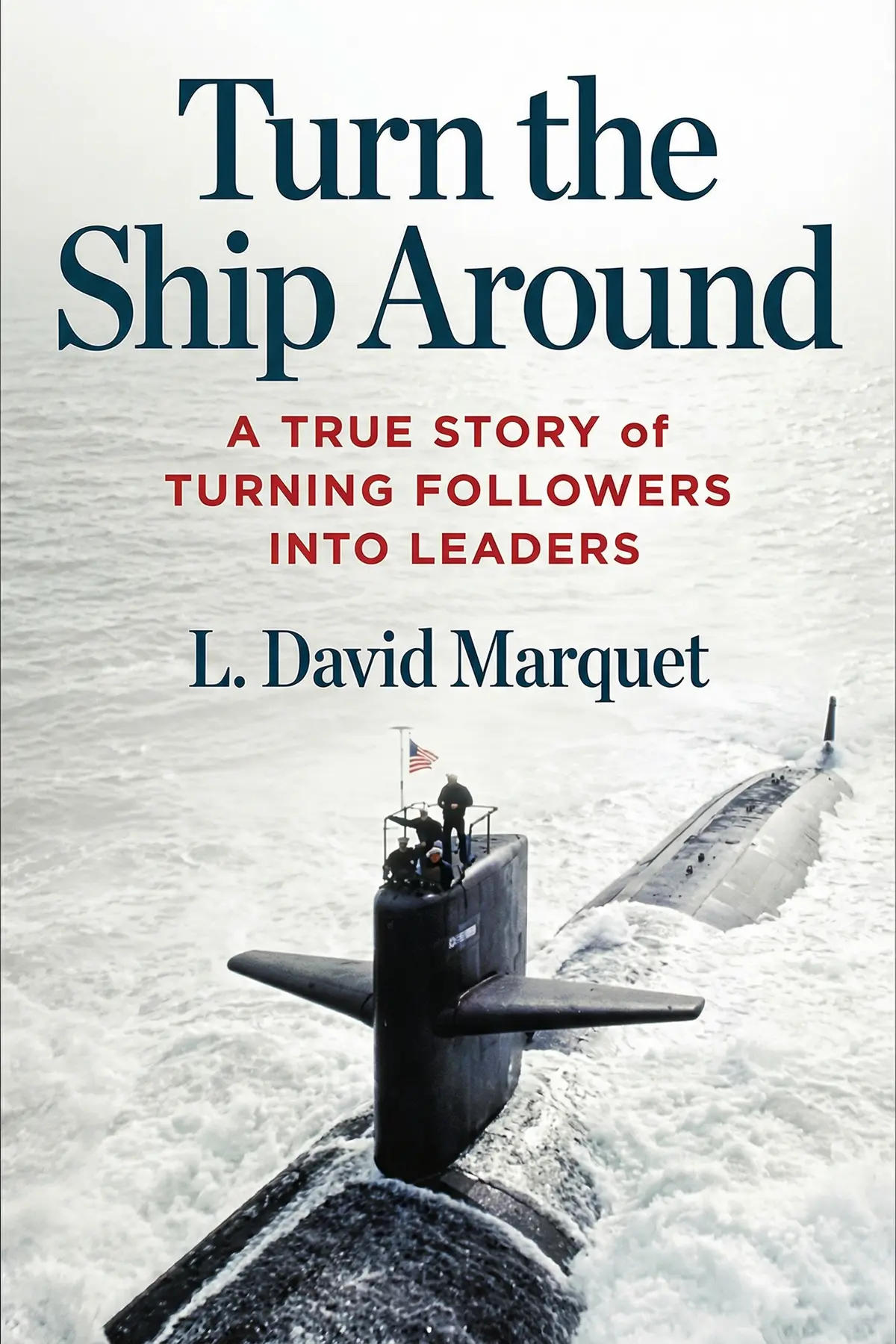
Imagine finding yourself at the helm of one of the most complex machines ever built by man—a nuclear-powered, fast-attack submarine. Now, imagine that this multi-billion dollar vessel and its crew are currently ranked as the absolute worst in the entire United States Navy. This was the daunting reality facing L. David Marquet when he took command of the USS Santa Fe. Most leaders in that high-pressure environment would lean into the traditional command-and-control structure, barking orders more loudly and tightening the reins of authority. But Marquet realized that the very system designed to ensure order was actually the root cause of the ship’s failure.
What follows is a narrative of radical transformation. It is the story of how a rigid, hierarchical organization moved away from the ‘leader-follower’ model and toward a ‘leader-leader’ approach. This shift wasn’t just about being a ‘nice boss.’ It was a calculated, strategic overhaul of how humans interact within a system to achieve peak performance. As we dive into this summary, we will explore why our traditional ideas of management are failing us and how a shift in communication and responsibility can turn any struggling ‘ship’ around—whether that ship is an underwater vessel, a corporate department, or a small startup team. Through this throughline, we see that true leadership isn’t about having all the answers, but about creating an environment where everyone is expected to think, act, and lead for themselves.
2 min 12 sec
Traditional management styles were designed for physical labor and simple tasks. Discover why these methods fail in a modern world driven by complex thinking and decision-making.
1 min 55 sec
Moving power to where the information is can save an organization from disaster. See how the leader-leader approach changes the flow of authority.
1 min 59 sec
Small shifts in how we speak can lead to massive changes in how we act. Learn the magic behind a simple three-word phrase.
2 min 08 sec
Empowerment without skill is a recipe for disaster. Discover the mechanisms that ensure your team is actually ready to lead.
2 min 19 sec
When everyone is a leader, you need a common North Star. Learn how to align a team through core values and immediate feedback.
1 min 34 sec
The transformation of the USS Santa Fe serves as a powerful testament to what happens when we stop trying to control people and start trying to release their potential. L. David Marquet didn’t just fix a submarine; he proved that the traditional, top-down hierarchy is an antiquated relic that is poorly suited for the challenges of the modern age. By shifting from a leader-follower mindset to a leader-leader model, he created an environment where every individual felt responsible for the mission, where competence was a daily practice, and where clarity of purpose guided every decision.
This journey suggests that the most effective leaders are those who strive to make themselves obsolete. When you build a team of leaders, you create a system that is resilient, innovative, and highly productive—even when the person at the top isn’t in the room. This is the ultimate goal of the leader-leader approach: to move authority to where the information is, to trust in the intelligence of your team, and to provide them with the tools and the clarity they need to succeed.
As you think about your own ‘ship’—be it a family, a small business, or a massive corporation—consider where you can start delegating not just tasks, but authority. Start using the language of intent. Ask your team what they intend to do rather than telling them what to do. Foster a culture of deliberate action where people pause to think before they act. By making these small but profound shifts, you can begin your own journey of turning the ship around, creating a legacy of leadership that will endure long after your watch has ended.
This summary explores the transformative journey of David Marquet, who took command of the USS Santa Fe—the worst-performing submarine in the fleet—and turned it into a gold standard for leadership. It challenges the traditional leader-follower dynamic that has dominated organizations for centuries, arguing that this archaic model stifles initiative and productivity in the modern cognitive era. Through the lens of Marquet's naval experience, you will learn how to shift decision-making power to those with the best information, foster a culture of competence through deliberate action, and ensure mission clarity through shared values. The promise of this approach is a more engaged, satisfied, and effective workforce that doesn't just follow orders but takes ownership of every outcome.
David Marquet is a highly distinguished graduate of the U.S. Naval Academy. From 1999 to 2001, he served as the commanding officer of the USS Santa Fe, a nuclear-powered, fast attack submarine. Following his successful military career, he transitioned into leadership consulting and holds a lifetime membership with the Council on Foreign Relations.
Listeners describe this leadership title as a functional handbook that flows like a novel, providing superb case studies and introspective exercises. The text incorporates actual events and is simple to follow, with one listener remarking on how the metaphors enhance its clarity. They value its ability to foster strong teams and evolve corporate structures, as one review points out its effectiveness in uncovering deep-seated organizational flaws.
This book completely changed how I view authority in the workplace. Marquet’s shift from the standard leader-follower model to a leader-leader framework is nothing short of revolutionary for anyone managing a team. I personally found the real-life stories about the USS Santa Fe gripping, as they provide a concrete backdrop for his more abstract management theories. Instead of dry formulas, you get a practical guide that reads almost like a suspenseful novel. The self-examination questions at the end of each chapter are particularly helpful for identifying organizational problems you might be ignoring. Not gonna lie, I started using the 'I intend to' phrase with my own staff immediately, and the results have been incredible. It is a must-read for anyone looking to foster genuine empowerment and build high-performance teams.
Show moreAfter hearing Marquet speak at a leadership conference, I finally dove into the full text of his philosophy. It is one of the best books on leadership I have ever encountered because it avoids the usual preachy formulas. Instead, we get a gritty, honest look at what it takes to turn around an underperforming crew. The analogies make complex organizational structures easy to understand, even if you have zero interest in military history. Frankly, the way he describes pushing authority down the chain of command is the most logical approach to management I’ve seen. It really helps you identify where excellence is created in your own company. The book isn't just about submarines; it's about giving people the technical knowledge and the clarity they need to lead themselves.
Show moreWow, it is rare to find a management book that actually reads like a gripping military thriller while delivering such high-value content. I loved that this wasn't just a collection of anonymized case studies but a real story of turning a ship around. Marquet’s willingness to share his mistakes and the corresponding learnings along the way makes the advice feel much more authentic. In my experience, most leadership books focus on 'what' to do, but this one actually dives into the 'how' through vivid examples. The way he removed the requirement for the Captain to sign off on shore leave is a perfect illustration of his principles. It’s a very inspiring look at how to build a team of leaders. This book will definitely help you identify where excellence is actually generated in your specific organization.
Show moreFinally got around to reading this staple of leadership literature, and it truly lived up to the hype for me. The 'I intend to' technique is a simple yet profound way to shift responsibility back to the team members. I found the book to be a practical guide that avoids the fluff usually found in business books. It reads like a novel, keeping you engaged with the fate of the Santa Fe and its crew while teaching valuable lessons. The way Marquet highlights the need to push information down so that decisions can come up is a vital insight. It has helped me identify several bottlenecks in my own organization that I was previously blind to. If you want to build a team of leaders rather than followers, this is the book you need. Truly excellent stuff.
Show moreEver wonder why your team is constantly waiting for your permission before taking a single step forward? This book explains exactly how to break that cycle of dependency. Marquet does a great job illustrating how to move decision-making authority to where the information actually lives. To be fair, the writing style can occasionally feel a bit simplistic or even cheesy, but the core concepts are rock solid. Some of the submarine jargon and the focus on naval acronyms like FFV got a little tedious after a while. However, the overarching message about cascading context instead of giving orders is powerful. It’s an accessible read that offers a clear blueprint for transforming an organization’s culture from the bottom up. I would recommend this to any manager who feels like they are drowning in micro-decisions.
Show morePicked this up on a whim after a recommendation from a mentor who swore by the 'leader-leader' model. The transition Marquet describes—moving from being the smartest guy in the room to someone who provides context—is fascinating. Look, the anecdotes are definitely wrapped up a little too nicely, and some of it feels like a motivational speaker's script. However, the practical application of 'I intend to' is a game changer for reducing automatic thinking in the workplace. It forced me to do some serious self-examination about my own micromanagement tendencies. The book is easy to understand and provides a clear roadmap for developing effective teams. While the military setting is very specific, the underlying principles regarding competence and clarity are universal. I think it’s a valuable addition to any leader's library.
Show moreAs someone who has struggled with the bottlenecks caused by top-down management, Marquet's framework provided a much-needed wake-up call. The book is packed with details of his experiences with the crew of the Santa Fe, which makes the lessons feel grounded in reality. Personally, I found the technical knowledge requirements he discusses to be the most underrated part of the book. You can't just delegate authority if your team doesn't have the skills to handle it. My only gripe is that he occasionally makes the implementation sound easier than it actually is in a non-military corporate environment. Still, the analogies are accessible and the questions for self-reflection are genuinely useful for any manager. It’s a practical guide that moves beyond the typical generic statements found in this genre.
Show moreNot what I expected from a book written by a former nuclear submarine commander, as it was surprisingly humble in parts. The focus on 'deliberate action' to counteract mistakes is a brilliant concept that any high-stakes industry should adopt. I appreciate how the book features real-life stories that illustrate the tension between old-school discipline and new-school empowerment. To be fair, some of the Navy jargon (like FFV for fresh fruit) was unnecessary and slowed the pace. However, the book excels at showing how to transform a culture of followers into a culture of owners. It’s an easy-to-understand manual for anyone trying to develop effective teams in a complex environment. Even if you aren't into submarines, the leadership takeaways are too good to ignore. It definitely helps you see organizational problems from a fresh perspective.
Show moreThe core concepts are undoubtedly brilliant, but the delivery often left me feeling frustrated. The author uses a very simplistic structure—problem, solution, lesson—that feels a bit amateurish at times and requires some leaps of faith from the reader. Truth is, the narrator for the audiobook, who was the author himself, had a tone that came off as slightly pretentious. I also found the heavy emphasis on submarine mechanics and US naval jargon a bit of a slog to get through. While the ideas about empowerment and deliberate action are meaningful, the writing style is occasionally obnoxious with its self-promotion. If you can look past the cringeworthy passages of American exceptionalism, there are some clever ideas here that could be applied to many scenarios with some cherry-picking. It’s a decent book, just not a particularly enjoyable read.
Show moreFrankly, I found the heavy emphasis on submarine mechanics and naval jargon a bit of a slog to get through. The ideas are clever, but the writing is quite amateurish and the structure feels repetitive after the first few chapters. Each anecdote follows the same predictable pattern, which made the middle of the book feel rather tedious. I agree that the concepts of the leader-leader model are valuable, but the author’s tone can be a bit over-the-top with the self-promotion. It takes some work to translate his specific military context into something useful for a standard office setting. While I would recommend it for the exposure to the concepts, there are better-written management books out there. If you’re not fascinated by US submarines, you might find yourself skimming large portions of this text just to get to the actual advice.
Show more
Margaret Heffernan


Joseph A. Maciariello



Deborah Gruenfeld
Mike Michalowicz
AUDIO SUMMARY AVAILABLE
Get the key ideas from Turn the Ship Around by L. David Marquet, plus 5,000+ more titles in English and Thai.