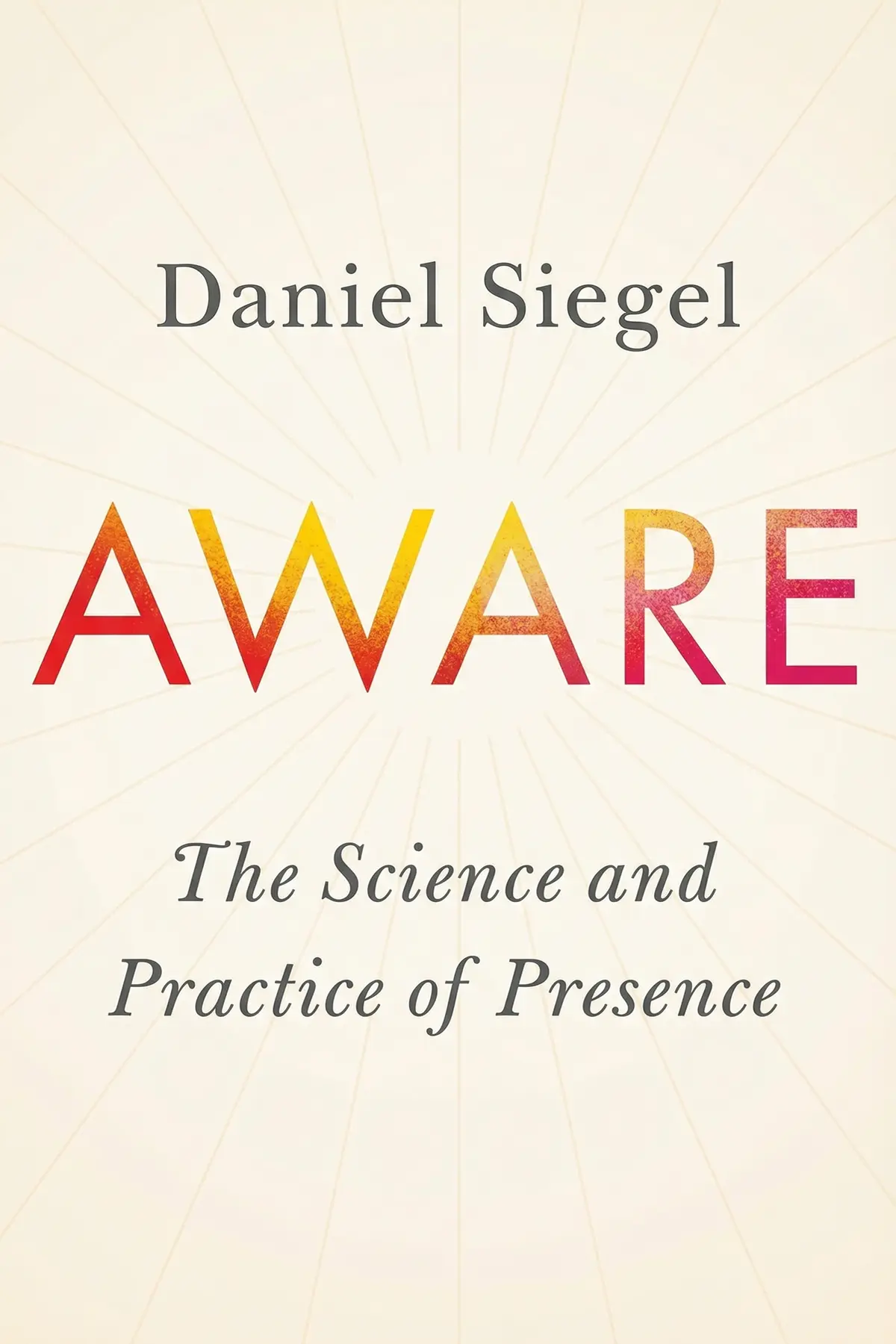
Aware: The Science and Practice of Presence
Daniel Siegel
Explore the transformative power of mindsight, a blend of neuroscience and psychology that allows you to regulate emotions, heal past trauma, and cultivate deep empathy for yourself and others through targeted mental exercises.
1 min 39 sec
Have you ever wondered why you react the way you do in the heat of a moment? Perhaps you’ve been in a standard disagreement that suddenly spiraled into an explosive argument, or maybe you’ve felt your mind go completely blank during a high-stakes meeting. These moments can be deeply disorienting, leaving us to wonder who that reactive person was and where our rational self went. We often think of our minds as mysterious, uncontrollable forces, but what if you could peek under the hood of your own consciousness? What if you had a tool that allowed you to see the internal workings of your brain and, more importantly, change them for the better?
This is the core promise of Daniel Siegel’s work on mindsight. Mindsight is essentially a potent combination of self-awareness and empathy—a unique lens that allows us to perceive the inner world of ourselves and others with clarity. It’s not just a philosophical concept; it’s a practical skill rooted in the physical reality of our biology. Throughout this summary, we are going to explore how this “seventh sense” can help you navigate the often-turbulent waters of human experience. We’ll look at how childhood experiences leave blueprints in our nervous systems and how we can redraw those maps to find balance.
We will journey through the architecture of the brain, from the prefrontal cortex to the depths of our emotional centers, and learn how to foster what Siegel calls a harmonic self. By the end of this exploration, you’ll understand how to move away from rigid or chaotic reactions and toward a life defined by receptivity, resilience, and a deeper connection to the people around you. Let’s begin by looking at how this tool connects our biological hardware with our psychological software.
2 min 19 sec
Discover how mindsight acts as a bridge between your physical sensations and your emotional reactions, giving you the power to stay calm when life gets overwhelming.
2 min 04 sec
Explore the metaphor of the river of integration to find the sweet spot between a rigid life and a chaotic one.
1 min 52 sec
Learn how the physical structure of your brain changes when you focus your attention, proving that your mind can actually reshape your biology.
1 min 57 sec
Discover techniques like the body scan to bridge the gap between your analytical thoughts and your raw emotional experiences.
2 min 00 sec
Use the ocean metaphor to realize that your thoughts and feelings are just surface waves that don’t define the calm depths of who you really are.
1 min 49 sec
Uncover how your childhood experiences created a hidden script for your life, and learn how to edit that story for a better future.
2 min 01 sec
Learn the difference between being reactive and receptive, and how a simple ‘timeout’ can save your most important connections.
2 min 09 sec
See how mindsight can unlock repressed memories stored in the body and provide a way to negotiate with the urges of OCD.
1 min 33 sec
As we wrap up our journey through the world of mindsight, it’s clear that this isn’t just a set of abstract theories. It is a vital, life-changing skill that resides at the intersection of our biological hardware and our psychological experience. We’ve explored how your heart rate can dictate your temper, how your childhood can draft a script for your adulthood, and how your brain can literally be rewired through the simple act of directed attention.
The core message is one of profound hope: you are not a finished product, and you are not a victim of your past or your biology. By cultivating the ability to observe your mind with objectivity, openness, and curiosity, you can move away from the rigid banks of routine and the chaotic waters of emotional instability. You can find the center of the river, where life is integrated, harmonic, and resilient.
To start applying this today, remember the simple phrase: “name it to tame it.” The next time you feel a wave of anxiety, anger, or sadness, don’t just let it sweep you away. Stop for a moment. Observe what is happening in your body. Notice your heart rate. Notice the tension in your shoulders. Give the feeling a name. By acknowledging the emotion as a temporary state—a wave on the surface of your ocean—you regain your power. This small act of mindsight is the first step toward a life of greater kindness, deeper connection, and lasting well-being. You have the tools to transform your brain; now, it’s just a matter of looking inside.
Mindsight introduces a groundbreaking concept at the intersection of brain science and emotional intelligence. It addresses the common struggle of feeling overwhelmed by our internal reactions, whether through sudden anger, paralyzing anxiety, or a sense of disconnection from others. Dr. Daniel Siegel explains how the physical structure of the brain influences our mental well-being and provides a roadmap for restructuring these neural pathways. The book promises a path toward a more integrated and harmonic life. By learning to observe the mind’s internal workings without being swept away by them, readers can discover how to bridge the gap between their rational and emotional selves. It offers practical techniques for improving relationships, overcoming childhood patterns, and managing psychological challenges like obsessive tendencies or repressed trauma. Ultimately, it is a guide to becoming more receptive to the world and finding internal stability amidst external chaos.
Dr. Daniel Siegel is a clinical professor of psychiatry at the UCLA School of Medicine and received his medical degree from Harvard University. He is the author of numerous scientific articles, has contributed to several books and also wrote The Developing Mind, a book that gained international acclaim.
Listeners find this work provides profound understanding of the brain and mind, using case histories to clarify complicated ideas. They value the way it transforms perspectives on emotional intelligence and provides actionable methods, making it particularly advantageous for therapists. Listeners describe the narrative as captivating, accessible, and high-quality, while one listener notes its effectiveness with long-term stress and anxiety issues.
The hand model of the brain mentioned in the early chapters is worth the price of admission alone. By simply folding your thumb into your palm and wrapping your fingers over it, Siegel provides a visceral way to understand the prefrontal cortex’s relationship with the limbic system. This book isn't just a collection of dry facts about neurons; it’s a deep dive into how we can consciously influence our own mental health through focused attention. I found the case studies particularly moving, especially the ones dealing with childhood trauma and the 'blank pages' of memory. While the clinical terminology gets dense in the middle, the payoff in understanding neuroplasticity is massive. It’s an essential read for anyone looking to bridge the gap between their emotional reactions and their rational mind.
Show moreRarely does a book bridge the gap between hard neuroscience and spiritual wisdom so gracefully. Siegel convinces the reader that we aren't just victims of our biology, but active participants in shaping our neural pathways. The concept that neurons that fire together, wire together is presented not as a cliché, but as a biological mandate for change. I was gripped by the idea of 'integration'—the harmony between different parts of the brain that leads to genuine peace of mind. By weaving together complex science with relatable human stories, he makes the daunting field of interpersonal neurobiology accessible to the layperson. My brain truly feels different after finishing this; I feel more connected to my own subjective world and to those around me. This is a transformative masterpiece that I’ll be returning to for years.
Show moreEver wonder why you react the way you do in high-stress situations? Mindsight offers a roadmap to understanding those hidden triggers by blending neuroscience with heart-centered mindfulness. Siegel explains that by monitoring the flow of energy and information in our nervous systems, we can actually change our brain's physical structure. This isn't just 'new age' fluff; it's grounded in the reality of neuroplasticity and the way our neurons wire together through focused attention. I found the sections on memory loss particularly eye-opening, as they explained why some of my childhood remains a blur. This book provided me with a sense of peace and control that I haven't found in years of traditional talk therapy. It is a masterpiece of interpersonal neurobiology that I will be recommending to everyone I know.
Show morePicking this up felt like entering a masterclass on the intersection of the mind and the body. Dr. Siegel presents a holistic view where the 'mind' isn't just a brain function, but a process involving the entire nervous system. I was especially moved by the case study of the 92-year-old patient, which proves that it is never too late for neuroplasticity to work its magic. The book teaches you to transform the painful stories we tell ourselves by repairing the connections between our physical and mental selves. Gaining 'mindsight' has allowed me to observe my meaner impulses and stop them before they fly out of my mouth. It’s an enlightening, comforting, and deeply joyful read that has been more productive for me than years of formal education. Truly, this is the ultimate gift for anyone seeking peace of mind.
Show moreWhile the core concept of 'mindsight' is undoubtedly powerful, I found the book's structure a bit lopsided. The first half is packed with heavy theory that, frankly, felt a bit outdated with its intense focus on left-brain versus right-brain distinctions. Then, the second half shifts into case studies that occasionally bordered on self-indulgent, as if the author were showcasing his wins rather than the science. Truth is, the actual practical advice could have been summarized in a much shorter volume. I did appreciate the 'Complexity Choir' metaphor for mental integration, though. It’s a decent enough read if you’re into interpersonal neurobiology, but be prepared to skim through some of the more repetitive clinical anecdotes. Not a total waste of time, but it definitely left me feeling a bit meh compared to the hype.
Show moreFinally got around to reading this after a friend recommended it for my recurring anxiety and long-term stress. I love that Dr. Siegel doesn't immediately reach for the prescription pad, instead focusing on how mindfulness can rewire our internal responses. The exercise of counting breaths up to ten without letting a stray thought creep in was surprisingly difficult but incredibly revealing. It taught me to notice my thoughts from a distance rather than letting them dictate my actions or mood. Personally, I found the section on 'The Crepes of Wrath' to be one of the most engaging parts of the entire text. It’s a fascinating look at how our conscious selves are often unaware of what the brain is actually processing in the background. My perspective on emotional intelligence has completely shifted.
Show moreAs a clinician, I appreciate how Siegel translates complex neurological processes into metaphors my clients can actually grasp. The way he explains 'mindsight' as a lens through which we can observe our own mental flow is incredibly practical for therapy. Some of the case studies feel a bit polished, perhaps even a little self-congratulatory, which might turn off some readers looking for a more humble approach. However, the underlying science regarding neuroplasticity and trauma-induced memory loss is solid and deeply relevant. I’ve already started using the 'Complexity Choir' example to explain differentiation and integration to my patients. It’s a well-written, engaging guide that offers a clear path toward emotional regulation and healthier relationships. This should be required reading for anyone in the mental health field or those struggling with past trauma.
Show moreDr. Siegel’s writing style is engaging, though he does tend to dwell on his own clinical successes quite a bit. Despite that, the book offers a marvelous perspective on how we can cultivate power over our own emotions. I learned so much about the structure of the brain and the importance of communication between the upper and lower regions. Before reading this, I never realized how much my 'implicit memories' were running the show behind the scenes. The techniques provided for 'seeing' the mind have helped me feel more in control during tough moments. It’s not a quick fix, but rather a slow, clinical approach to changing how you interact with your own thoughts. It’s definitely more of a science book than a 'new age' self-help guide, which I appreciated.
Show moreLook, I’m all for self-improvement, but some of this felt like a very long-winded way to tell me to meditate and journal more. Don't get me wrong, the science of how neurons wire together is fascinating. However, I struggled with the esoteric tone Dr. Siegel takes when describing the 'flow of energy' in the mind. The chapter titled 'The Crepes of Wrath' was a clever highlight in an otherwise fairly dry, clinical text. If you enjoy reading numerous case studies about people rewiring their brains through mindfulness, you will likely love this. For me, it was a bit too much 'doctor-speak' and not enough direct action. It’s a solid three stars for the insights, even if the delivery felt a bit self-indulgent at times.
Show moreTo be fair, the science here feels a decade out of date, particularly the heavy reliance on rigid left-brain versus right-brain lateralization theories. I’m not a psychologist, but the constant focus on these binary distinctions felt like a massive oversimplification of much more complex processes. While the case studies are intended to be illustrative, they often felt like promotional pieces for Siegel's own practice rather than objective science. It became difficult to stay engaged when the narrative veered into self-congratulatory territory. The prose is often clinical and dry, making it a slog for anyone not already deeply invested in the field. I was hoping for practical, modern tools, but instead, I got a lot of anecdotes that felt more like ego-stroking than educational material. It just didn't resonate with me at all.
Show more
Anthony Pratkanis
Alcoholics Anonymous World Services
Richard Wiseman
AUDIO SUMMARY AVAILABLE
Get the key ideas from Mindsight by Daniel Siegel, plus 5,000+ more titles in English and Thai.