
18 min 57 sec
Read People Like a Book: How to Analyze, Understand, and Predict People’s Emotions, Thoughts, Intentions, and Behaviors
By Patrick King
Master the art of interpreting human behavior by decoding body language, psychological motivations, and personality types to navigate social interactions with greater confidence, accuracy, and emotional intelligence.
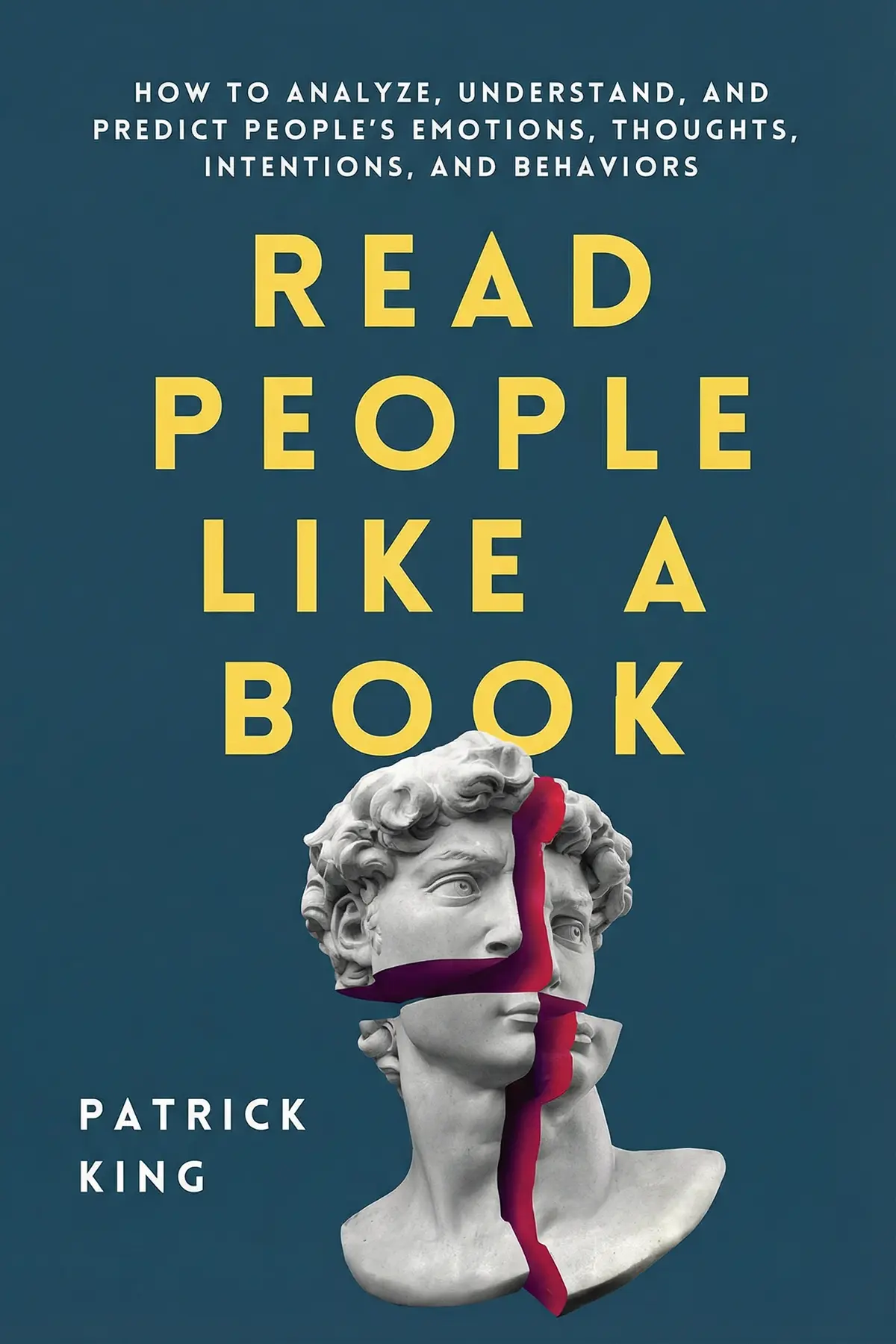
Table of Content
1. Introduction
2 min 16 sec
Have you ever walked away from a conversation feeling like you missed something crucial? Perhaps it was a flicker of hesitation in a colleague’s eye or a subtle shift in a friend’s posture that didn’t quite match their supportive words. We have all experienced that nagging sensation that there is a deeper story playing out beneath the surface of our daily interactions. This is because human communication is rarely just about the words we choose. It is a complex dance of psychology, history, and physiology. To truly understand the people around us, we need to learn how to see past the curtain they present to the world.
In this exploration, we are diving into the art and science of reading people. It’s important to start with the understanding that this isn’t some mystical ‘sixth sense’ or a psychic gift reserved for a lucky few. It is a structured, learnable skill that relies on keen observation and an understanding of human nature. At the core of this ability is a psychological concept known as the ‘Theory of Mind.’ This is our innate capacity to recognize that other people have beliefs, desires, and intentions that are different from our own. We are constantly building mental models of what is happening inside someone else’s head. However, the catch is that our mental models are often based on guesswork or our own biases.
The goal here is to replace that guesswork with high-quality data. We want to move from ‘I have a feeling’ to ‘I am observing specific patterns.’ This involves looking at the hidden drives that motivate people, the involuntary signals their bodies send, and the stable personality traits that define their worldviews. By the time we finish, you will have a framework for navigating social waters with much more clarity. You’ll be able to spot when someone is masking their true feelings, understand why a friend might be overreacting to a minor comment, and even detect when the truth is being stretched. This isn’t about manipulation; it’s about empathy and accuracy. It’s about building a bridge of understanding that allows for smoother, more fruitful navigation of every relationship in your life. Let’s begin by looking at the hidden forces that drive every human action.
2. Understanding the Hidden Drivers of Behavior
3 min 20 sec
Discover how the interplay of repressed desires, childhood experiences, and fundamental needs creates the invisible blueprint for every person’s actions and reactions.
3. Decoding the Body's Involuntary Language
2 min 54 sec
Words can be rehearsed, but the body rarely lies; learn to spot the fleeting facial cues and physical tells that reveal a person’s genuine emotional state.
4. Mapping the Landscape of Personality
3 min 05 sec
Explore the structured frameworks that turn the chaos of human individuality into predictable patterns, allowing you to tailor your communication to anyone’s unique type.
5. Developing a Filter for Deception
2 min 46 sec
Learn the sophisticated techniques used to unmask dishonesty by strategically increasing cognitive pressure and spotting the gaps in fabricated stories.
6. Mastering the Art of High-Speed Observation
2 min 57 sec
Hone your ability to make rapid, accurate deductions by analyzing ‘behavioral residue,’ environmental clues, and the subtle data hidden in everyday interactions.
7. Conclusion
1 min 39 sec
As we reach the end of this journey into the human psyche, it is clear that people are not the mysteries we often imagine them to be. While every individual is unique, we all operate according to fundamental biological and psychological laws. By learning to identify the hidden motivations of the shadow and the inner child, we can approach others with a deeper sense of empathy and less personal frustration. By decoding the silent language of microexpressions and body tells, we can see the emotional truth that words often hide. And by using personality frameworks, we can navigate social complexity with a clear map in hand.
The throughline of all these techniques is the shift from passive listening to active observation. Reading people like a book requires you to be a dedicated ‘reader’—someone who pays attention to the footnotes, the subtext, and the way the story is constructed. The most important thing to remember is that this is a practice, not a one-time achievement. The more you apply these tools in your daily life—at the grocery store, in boardrooms, and at the dinner table—the more naturally they will come to you.
In the end, the goal of mastering these skills isn’t just to ‘win’ social interactions or catch people in lies. It is about connection. When you truly understand where someone is coming from, what drives them, and how they see the world, you can build bridges that were previously impossible. You can communicate in a way that truly resonates, resolve conflicts before they explode, and foster deeper, more authentic relationships. You now have the toolkit to turn every interaction into an opportunity for insight. Go out and start reading the stories that are unfolding all around you.
About this book
What is this book about?
Have you ever wondered what people are really thinking when they speak? This summary explores the intricate world of human dynamics, offering a systematic approach to reading the hidden signals we all broadcast. It moves beyond simple intuition, providing a toolkit based on psychological frameworks and behavioral science to help you understand the 'why' behind people's actions. You will learn how to identify the deep-seated motivations that drive behavior, from childhood influences to fundamental human needs. The guide breaks down the complexities of facial expressions and body language, teaches you how to categorize personalities using established models, and provides strategies for detecting deception. By the end, you'll have a clearer perspective on how to predict intentions and build more authentic connections in both your professional and personal life.
Book Information
About the Author
Patrick King
Patrick King is an expert in social interaction and a best-selling author recognized for his deep understanding of communication and human behavior. His notable works include Make Friends Easily, Social Fluency, and Awkward Silences and How to Prevent Them. King’s unique approach combines rigorous academic findings with practical, real-world experience, establishing him as a prominent figure in the study of emotional intelligence and interpersonal dynamics.
Ratings & Reviews
Ratings at a glance
What people think
Listeners find this work informative and well-researched, noting that scientific studies effectively support the material. They appreciate how the content aids in decoding human thoughts and actions while boosting emotional intelligence. Furthermore, the advice proves highly applicable and beneficial for both career and personal life, and listeners find the text straightforward and easy to navigate. Conversely, the writing style draws varied reactions; some consider it well-crafted, whereas others report that it is poorly formatted. Perceptions of the book's value also differ, with some believing it is a worthwhile investment and others feeling it is overpriced.
Top reviews
Niramai
Wow. I am absolutely in love with this book and how it has changed my perspective on social interaction. I used to feel lost in large groups, but now I have a toolkit for understanding what people are actually thinking versus what they're saying. The information is backed by studies and feels very credible, yet it is written in a casual tone that's easy to follow. I felt like a completely different person after finishing the chapters on value-based questioning. It is a must-read for anyone who wants to sharpen their intuition and navigate the world with more confidence. Truly life-changing stuff for those of us who weren't born with high social IQ!
Show moreJan
The truth is, most people are blind to the signals they are sending, and this book is the perfect antidote to that ignorance. It covers everything from facial expressions to the subtle ways we reveal our morals through word choice. I found the practical exercises extremely helpful for building my own emotional intelligence and reading the room during high-stakes negotiations. Every page is packed with useful insights that you can start using immediately in your personal and professional life. It is well-written, engaging, and worth every penny if you are serious about self-mastery. I will definitely be keeping this on my shelf as a permanent reference for future social interactions.
Show moreSawit
Picked this up to help with my sales job and I have already noticed a difference in how I read my clients. The breakdown of facial expressions and body language cues is practical and very easy to apply in real-time conversations. Frankly, I don't get the harsh reviews saying it's for 'stupid people' because sometimes the most obvious things are what we miss most often. It is well-researched and provides a great framework for anyone looking to boost their emotional intelligence or social standing. I especially liked the part about analyzing hypothetical questions to uncover someone's true mindset and values. Definitely worth the time for the practical applications alone.
Show morePear
Ever wonder why some people just seem to get others instantly? This book attempts to bridge that gap by offering actionable steps to decode human behavior. While some parts are a bit basic, the overall structure is logical and the advice is grounded in real-world scenarios. I appreciated how King didn't just focus on one method but looked at word choice, social media, and physical posture. It is an engaging read that kept me interested from start to finish. My only real gripe is that the formatting could be cleaner, but the content itself is solid for anyone wanting to improve their people skills in a casual way.
Show moreNuk
This book was a great tool for analyzing people in my daily life. I liked the focus on macro and micro-expressions, which helped me understand my coworkers' underlying tensions during meetings. The author presents the information in a way that isn't overly academic, making it accessible for someone without a PhD in psychology. It is a functional guide that provides immediate value, especially if you struggle with social cues. While it does quote a lot of other experts, I found those references helpful for further reading later on. A solid four stars for the clarity and ease of use, despite some of the formatting issues mentioned by others.
Show moreSomsak
As someone who already has a basic grasp of psychology, I found this book to be a decent, if surface-level, refresher course. Most of the revelations here are common sense wrapped in academic-sounding terminology, but there are a few nuggets of wisdom regarding trivial questions that reveal core values. Look, it’s a quick read—I finished the whole thing in a single afternoon—which makes it accessible for people who hate dense literature. However, it lacks the scientific rigor I was hoping for and feels a bit too much like an entry-level primer. It is a solid 3-star book for high schoolers or someone just starting their self-improvement journey without much prior knowledge.
Show moreLucas
The chapter on social media behavior was surprisingly insightful, even if the rest of the book felt a bit uneven. King does a good job of breaking down complex behavioral cues into bite-sized pieces that anyone can understand. On the flip side, the writing style is occasionally clunky and the author relies far too much on quoting other, more established psychologists. I didn't hate it, but I didn't feel like a different person after finishing it either. It works best as an introduction to the topic for beginners. Not gonna lie, I expected a bit more depth given the bold title, but it serves its purpose as a basic guide.
Show moreAurora
Finally got around to reading this and I have mixed feelings about the overall value. On one hand, the research cited is interesting and provides a good foundation for understanding non-verbal communication in professional settings. On the other hand, the physical quality of the book is lacking; the font is huge and the margins are weirdly wide. It almost feels like a self-published blog series that was rushed to print without a proper editor. Is it useful? Sure, for some people who lack social intuition. Is it a masterpiece of behavioral science? Not even close. I would recommend it only if you can find it on sale or at the library.
Show moreArnav
After hearing so much hype about Patrick King, I finally picked this up, but the experience was disappointing. Some of the tips about micro-expressions were okay, but the rest of the book leaned heavily into manipulative tactics rather than genuine empathy. The advice on steering conversations to catch liars felt more like social gaming than actual connection. It is definitely written for a very specific type of person—someone who wants an edge at work but doesn't have much natural social awareness. The layout is also quite poor, making it a chore to read through the repetitive sections that offer very little new information for the price.
Show moreNong
Not what I expected at all. To be fair, it feels like the author just spent a weekend reading Wikipedia and cobbled together a bunch of random psychological studies into a single PDF. The formatting on the physical copy is atrocious, with giant font sizes that seem designed to mask the lack of actual substance or depth. I found the section on personality tests particularly insulting to my intelligence because it felt like something out of a middle-school magazine. If you want real insight into the human psyche, go read Jung or a proper textbook instead of this glorified blog post. It is essentially a collection of quotes from smarter people without any original synthesis to back it up.
Show moreReaders also enjoyed
A Liberated Mind: How to Pivot Toward What Matters
Steven C. Hayes
Acting with Power: Why We Are More Powerful Than We Believe
Deborah Gruenfeld
Age of Propaganda: The Everyday Use and Abuse of Persuasion
Anthony Pratkanis
AUDIO SUMMARY AVAILABLE
Listen to Read People Like a Book in 15 minutes
Get the key ideas from Read People Like a Book by Patrick King, plus 5,000+ more titles in English and Thai.
- 5,000+ titles
- Listen as much as you want
- 7-day free trial
- Cancel anytime







