
18 min 04 sec
The Art of Witty Banter: Be Clever, Quick, and Magnetic
By Patrick King
Discover the secrets to becoming a magnetic conversationalist. This guide provides actionable frameworks and psychological strategies to master quick-witted banter, build instant rapport, and navigate any social interaction with effortless charm and confidence.
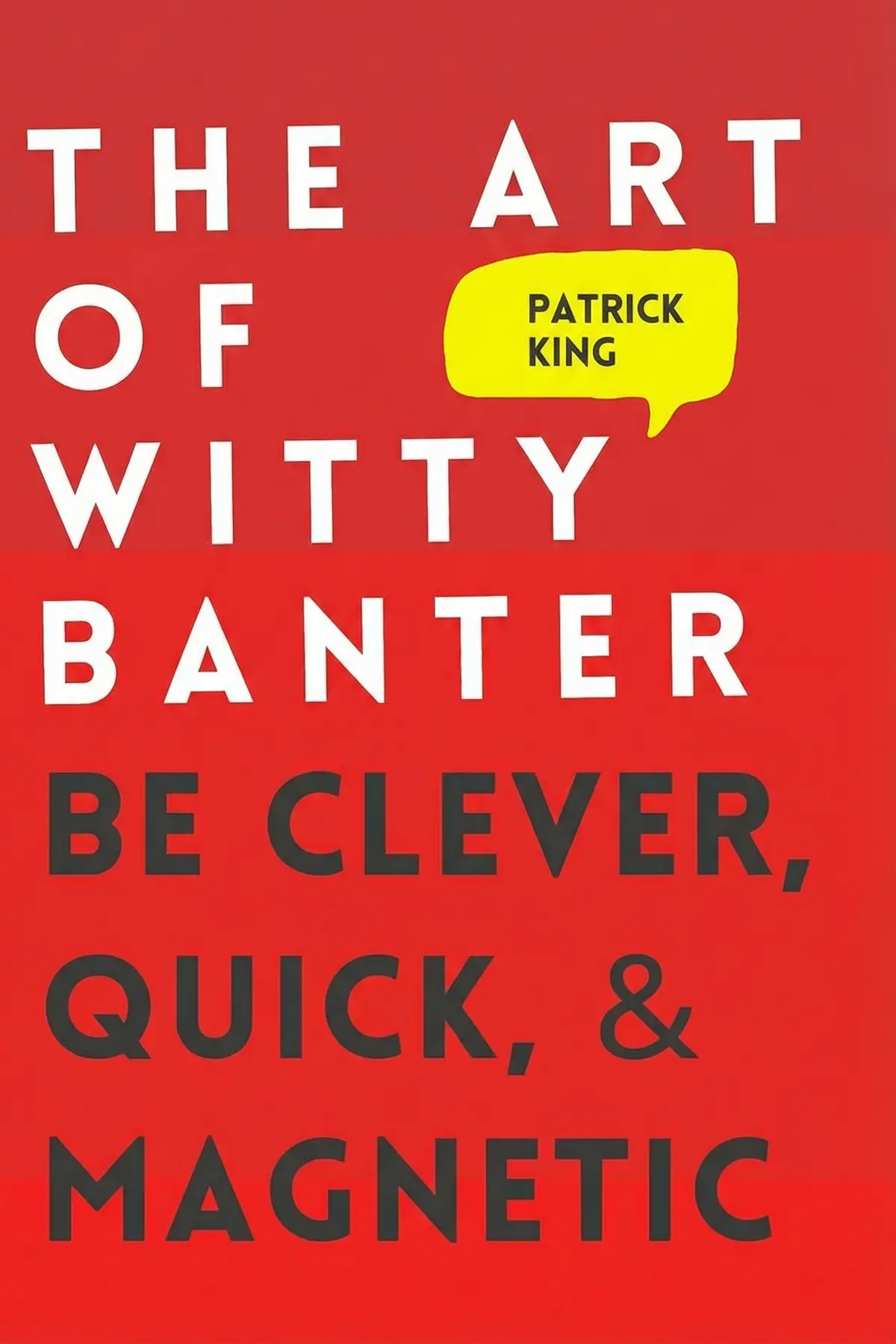
Table of Content
1. Introduction
1 min 48 sec
We have all been there. You are standing in a room full of people, or perhaps just sitting across from someone new, and the conversation suddenly hits a wall. There is that heavy, suffocating silence where you can practically hear your own brain scrambling to find something—anything—to say. Then, of course, the perfect, witty remark finally pops into your head, but it is twenty minutes too late, and you are already on the drive home. It is a frustrating feeling, but it is one that can be managed once you realize that being witty is not a magical gift you are born with. It is a set of skills and frameworks that can be learned, practiced, and deployed with precision.
The essence of a great conversation is not just about what you say, but how you facilitate the flow of the interaction. It is about making the other person feel comfortable while simultaneously presenting yourself as someone interesting, observant, and fun to be around. In this summary, we are going to explore the mechanics of magnetic dialogue. We will look at specific toolkits that help you never run out of things to say, the psychological tricks that make people feel like they are part of your inner circle, and the delicate art of using humor to build tension and then release it.
Throughline for our discussion today is this: witty banter is less about being the smartest person in the room and more about being the most responsive and present person in the room. When you master these techniques, you are not just talking; you are dancing through a social interaction with grace. You will learn how to turn a dry exchange of facts into a lively play of ideas, and how to use your personality to bridge the gap between two strangers. By the end, you will have a clear understanding of how to keep the momentum going, how to handle teasing, and how to ensure that you are never left searching for words again. Let’s begin our journey into the art of the clever and the magnetic.
2. The Three Essential Conversation Frameworks
2 min 22 sec
Discover how structured response patterns like HPM, SBR, and EDR can ensure you never hit a conversational dead end again.
3. Escaping the Trap of Absolute Questions
1 min 56 sec
Learn why asking about ‘favorites’ can actually kill a conversation and how to replace them with low-pressure alternatives.
4. Breaking the Fourth Wall of Social Interaction
1 min 40 sec
Discover how to step outside the conversation to comment on its dynamics, creating a unique sense of intimacy and humor.
5. The Power of the 'Us Against the World' Dynamic
1 min 42 sec
Build instant rapport by creating a shared ‘in-group’ through common observations of the environment.
6. Leveraging Time Boundaries for Better Engagement
1 min 35 sec
Counterintuitively, telling someone you have to leave soon can actually make them more willing to talk to you.
7. Preparing for the Lulls with Fallback Stories
1 min 46 sec
Master the art of the ‘narrative bridge’ to smoothly transition from a dying topic into a compelling new anecdote.
8. The Delicate Balance of Playful Teasing
1 min 53 sec
Learn the rules of ‘safe’ teasing to inject humor and personality into your relationships without causing offense.
9. Mastering the Art of the Witty Comeback
1 min 49 sec
Equip yourself with the tools to respond to light jabs with grace, confidence, and a touch of James Bond-style coolness.
10. Conclusion
1 min 33 sec
As we wrap up our look into the art of witty banter, it is important to remember that all of these techniques—from the HPM frameworks to the James Bond-style comebacks—are tools to serve a larger purpose: connection. The goal of banter is not to perform a comedy routine or to prove that you are the cleverest person in the room. Rather, it is to act as a social lubricant, making every interaction smoother, warmer, and more memorable for everyone involved.
By learning how to avoid absolute questions, you remove the pressure from others. By setting time boundaries, you grant them psychological safety. And by using fallback stories and breaking the fourth wall, you invite them into a more authentic and playful version of reality. These skills transform you from someone who simply participates in a conversation into someone who actively shapes it. You become a person who people look forward to talking to, because they know the experience will be effortless and fun.
The most actionable advice you can take away today is to start small. You don’t need to master every framework at once. Tomorrow, try setting a simple time boundary when you start a conversation, or try using the “Us Against the World” technique to comment on something in your environment. Watch how people respond. You will likely find that they open up more quickly and that the conversation feels less like work and more like play. With practice, these methods will become second nature, and that dreaded search for the right thing to say will become a thing of the past. You have the tools; now, go out there and bring a little more wit and magnetic energy to your world.
About this book
What is this book about?
The Art of Witty Banter serves as a practical blueprint for anyone who has ever felt tongue-tied in a social setting. It moves beyond generic advice like "just be yourself" and instead provides specific, structured techniques to keep dialogue flowing and engaging. The book promises to transform your social presence by teaching you how to react in the moment, rather than thinking of the perfect response hours too late. You will explore various conversational frameworks that allow you to pivot between personal anecdotes, deep inquiries, and lighthearted observations. The book delves into the nuances of humor, explaining how to use playful teasing and clever comebacks to build a unique connection without crossing the line into offense. By understanding the psychological barriers that make people hesitant to talk, you can learn to create a sense of safety and exclusivity that makes others want to engage with you. Ultimately, it is a guide to becoming the kind of person people remember for their warmth, intelligence, and magnetic wit.
Book Information
About the Author
Patrick King
Patrick King is a social interaction specialist and bestselling author known for his expertise in communication, emotional intelligence, and social skills. With a background in psychology and self-development, he has authored numerous bestsellers, including Better Small Talk and Improve Your People Skills, which offer practical insights for enhancing interpersonal relationships and building social confidence.
Ratings & Reviews
Ratings at a glance
What people think
Listeners describe the book as educational and accessible, specifically mentioning its value for introverts and its effective tips for improving social interactions. The humor content is appreciated, with one listener highlighting the comprehensive chapter on this topic. Its tempo receives praise, as one listener notes the vast amount of information covered. Although some listeners believe it is well-written, others consider the writing subpar, and several suggest the guide does not justify the investment of time or money.
Top reviews
Tee
Finally, a guide that actually breaks down why some people are just naturally 'charming' and how the rest of us can replicate it! I’ve always been described as a bit stiff in social situations, but the HPM and SBR frameworks gave me a concrete path to follow. It’s not just about being funny; it’s about making the other person feel heard and comfortable, which King explains beautifully. The book is informative, easy to read, and provides great tips for better conversations that you can implement immediately. I loved the word association exercises at the end—they really help with thinking on your feet. For the love of all things good, if you feel like you’re constantly 'internally screaming' during small talk, just buy this book. It’s a quick read that packs a punch and has definitely boosted my social confidence.
Show moreKiattisak
This was exactly what I needed to navigate high-stakes social events without feeling like a total robot. As someone who struggles with social anxiety, having a 'flexible toolkit' of responses like the SBR method really lowered my stress levels. I no longer feel like I’m being 'put on the spot' when someone asks me a broad question because I have a system to pivot the topic. The book is particularly suitable for introverts who want to understand the mechanics behind what makes a conversation 'flow.' King explains the 'Us Against the World' strategy in a way that feels natural, not manipulative, which I really appreciated. It’s a comprehensive guide that actually delivers on its promise to help you leave a lasting impression. I’ve already recommended it to several friends who find small talk exhausting.
Show moreThanit
Picked this up on a whim after seeing it on social media and I’m actually quite impressed with the practical frameworks. The 'Us Against the World' technique is a clever way to build instant rapport by creating a shared observation with your partner. I used it at a wedding last weekend and it really helped break the ice with a group of strangers. Some of the examples King uses are a little dated—I don’t think anyone is really looking to David Letterman for modern social cues anymore—but the core principles are sound. The book is well-paced and covers a vast amount of information without feeling overwhelming. I especially liked the section on avoiding absolute questions, as I never realized how much 'what's your favorite movie' can actually stall a chat. It’s a solid 4-star guide for anyone looking to polish their social gears.
Show moreAroon
After hearing about 'The Art of Witty Banter' from a colleague, I decided to give it a go to see if I could improve my office small talk. The chapter on the 'conversation resume' alone was worth the price of admission for me. It forced me to actually sit down and think about my hobbies and career facts in a way that makes them shareable rather than just dry data. I also appreciated the tip about complimenting things people have clearly put effort into, like a specific style choice, rather than just generic praise. The pacing is excellent, and I finished the whole thing in one sitting. My only gripe is that some of the banter examples feel a little forced, like something out of a bad sitcom. Still, if you take the concepts and apply your own personality, it’s a very useful tool for professional growth.
Show moreEmma
The chapter on breaking the fourth wall was a total game-changer for me, though I can see how it might be polarizing. King's focus on 'mutual comfort' as the ultimate goal of any interaction is a perspective shift that I desperately needed. Instead of trying to 'win' the conversation or be the funniest person in the room, I’m now focusing on making sure my partner feels at ease. There are some strange moments, like the aforementioned cannibalism thought experiments, that you should probably just ignore. However, the overarching advice on mirroring and emotional connection is top-tier. The writing is conversational and witty itself, making it an enjoyable read even if you don't agree with every single tip. It's a great overview of conversational dynamics that provides more hits than misses.
Show moreGame
As an introvert who struggles with awkward silences, I found the 'conversation resume' idea to be an absolute lifesaver. King suggests preparing a list of interesting accomplishments and weekly events ahead of time, which took a lot of the pressure off my last networking event. However, I’ve got to say that some of the humor techniques, like 'disagreeing and amplifying,' felt a bit risky for a professional setting. If you use them incorrectly, you just come off as rude or confrontational rather than funny. The writing style is very accessible and the chapters are short, which kept me engaged, but the advice feels geared toward a specific type of loud, extroverted personality. It’s a helpful enough primer for someone who needs a basic toolkit, but don't expect it to turn you into David Letterman overnight.
Show moreKevin
While King is clearly a personable guy, this book felt like a mixed bag of great structural advice and questionable social tactics. The EDR (Emotion, Detail, Restatement) approach is a fantastic way to show you’re actually listening, and I’ve found it very effective in my day-to-day interactions. On the other hand, the 'teasing' section is a bit of a minefield; King doesn't really account for how this might come off to women or people you don't know well. Some of the examples felt more like 'boomer humor' than actual witty banter. To be fair, the book is very easy to digest and doesn't waste time with fluff, which is a plus. It’s a decent resource for neurodivergent folks looking for a 'manual' on human interaction, even if some of the scripts feel a bit robotic.
Show morePla
The title is a bit of a bait-and-switch since only about twenty percent of the book actually addresses wit. Most of the text is a repetitive slog through various acronyms like HPM, SBR, and EDR that are supposedly meant to help you navigate small talk. Personally, I found trying to remember what 'History, Philosophy, Metaphor' stood for in the middle of a live conversation made me more anxious, not less. It’s a fast read, which I appreciate, but it lacks the depth needed to truly master conversational flow. Truth is, a lot of these techniques are just common sense social cues rebranded with fancy names to fill pages. There are a few nuggets of wisdom about creating mutual comfort, but they are few and far between. It’s not the worst book on the shelf, but it’s certainly not the masterclass in banter the cover promises.
Show moreSebastian
Look, some of the psychological concepts here are solid, but the delivery feels incredibly smarmy and 'pick-up artist' adjacent. King encourages a level of inauthenticity that makes me uncomfortable, basically telling readers to rehearse stories and use meta-comments to manipulate the vibe of a room. In my experience, people can smell a 'technique' from a mile away, and using these scripted lines often leads to more awkwardness, not less. There is a weird section on 'breaking the fourth wall' that feels more like a way to insult people under the guise of being witty. While the advice on 'free association' is decent, the rest of the book feels like it was written for men who want to be Machiavellian but end up just being annoying. It’s poorly written in parts and feels like a collection of blog posts thrown together.
Show moreChanpen
I’m genuinely baffled by the positive reception this gets because some of the advice is straight-up bizarre. King suggests using thought experiments about cannibalism to spark 'witty' banter, which is a fantastic way to ensure no one ever talks to you again at a party. To be fair, the concept of a 'conversational resume' is actually a decent tool for preparation, but it's buried under a mountain of smarmy, pick-up artist-style tactics. It feels like getting social advice from that one loud uncle in a Hawaiian shirt who thinks he's the life of the party while everyone else is just looking for the exit. Frankly, the tone is inauthentic and borders on being manipulative rather than genuinely charming. If you want to learn how to be a 'boisterous boss' that people only tolerate out of necessity, this is your manual. Skip it and find something that encourages being a real person instead of a collection of rehearsed anecdotes.
Show moreReaders also enjoyed
AUDIO SUMMARY AVAILABLE
Listen to The Art of Witty Banter in 15 minutes
Get the key ideas from The Art of Witty Banter by Patrick King, plus 5,000+ more titles in English and Thai.
- 5,000+ titles
- Listen as much as you want
- 7-day free trial
- Cancel anytime







