Energy: A Beginner's Guide
Vaclav Smil
A comprehensive analysis of meat consumption through human history, exploring the biological necessity, the environmental toll of industrial farming, and a pragmatic path toward a more sustainable and rational future for global nutrition.
1 min 46 sec
Picture our earliest ancestors on the African savannah. They weren’t just gathering berries; they were strategizing, communicating, and eventually hunting. This transition to regular meat consumption was not just a change in diet; it was a pivot point in human history. It provided the concentrated energy and high-quality proteins required to fuel the development of the most complex organ in the known universe: the human brain. For millennia, meat remained a symbol of status, a centerpiece of ritual, and a dense source of nutrition that helped our species thrive and spread across the globe.
Fast forward to the present day, and the scene has changed dramatically. The hunt has been replaced by the industrial production line. We are now producing meat on a scale that would have been unimaginable to our ancestors, with tens of billions of animals slaughtered every year. This explosion in availability has made meat a staple for billions, but it has also brought us to an environmental crossroads. The sheer volume of land, water, and energy required to sustain this system is placing an unprecedented strain on our planet’s resources.
In this exploration of Vaclav Smil’s work, we aren’t going to engage in a simple moral debate about whether eating animals is right or wrong. Instead, we are going to look at the facts—biological, historical, and environmental. We will see how meat made us who we are, why the current industrial model is hitting its limits, and why the solution might not be a world of total vegetarians, but rather a world of rational meat-eaters. This is the story of our relationship with meat: where it came from, the consequences of its current trajectory, and how we can steer it toward a more sustainable future.
2 min 15 sec
Humans are biologically designed to process meat, which provides the dense nutrients essential for our physical and cognitive development.
1 min 58 sec
Beyond nutrition, the act of hunting and sharing meat was a primary driver for the development of language and social hierarchy.
1 min 58 sec
Technological leaps in the nineteenth century shifted meat from a local luxury to a global, mass-produced commodity.
1 min 59 sec
Today’s meat industry operates as a systematic, high-volume chain that prioritizes output over traditional farming practices.
1 min 57 sec
The modern meat system is built on a massive agricultural foundation designed to feed animals rather than people directly.
2 min 02 sec
The dominance of livestock has drastically altered the Earth’s biological makeup and is a major contributor to greenhouse gas emissions.
1 min 43 sec
Producing meat requires astronomical amounts of water, most of which is ‘hidden’ in the production of animal feed.
2 min 13 sec
While cutting meat has benefits, cultural and nutritional hurdles make total global vegetarianism an unlikely solution.
2 min 04 sec
By shifting our focus to more efficient animals and reducing waste, we can enjoy the benefits of meat while minimizing its environmental impact.
1 min 33 sec
As we have seen, the story of human meat consumption is one of deep contradictions. On one hand, meat was the fuel for our evolution, the catalyst for our social structures, and remains one of the most efficient ways to provide essential nutrients to a global population. On the other hand, the industrial system we’ve built to satisfy our modern cravings is pushing the Earth to its limits, consuming vast amounts of land and water while contributing to a changing climate.
But the conclusion we should draw isn’t one of despair or the need for a total dietary revolution. Instead, the throughline of Vaclav Smil’s analysis is a call for rationality. We can continue to enjoy the benefits of meat if we are willing to be smarter about it. This means making conscious choices: favoring more efficient proteins like chicken and eggs, reducing our overall portion sizes to match what our bodies actually need, and supporting production methods that prioritize environmental health over pure speed and volume.
The most actionable takeaway is to look at the ‘Japanese model’—a diet where meat is an important component but not the overwhelming focus of every meal. By moving toward a more balanced, moderate approach, we can ensure that the nutritional benefits of meat are available for future generations without sacrificing the planet that sustains us. Meat helped make us human; now, it’s up to our human intelligence to ensure its production is sustainable for the long haul.
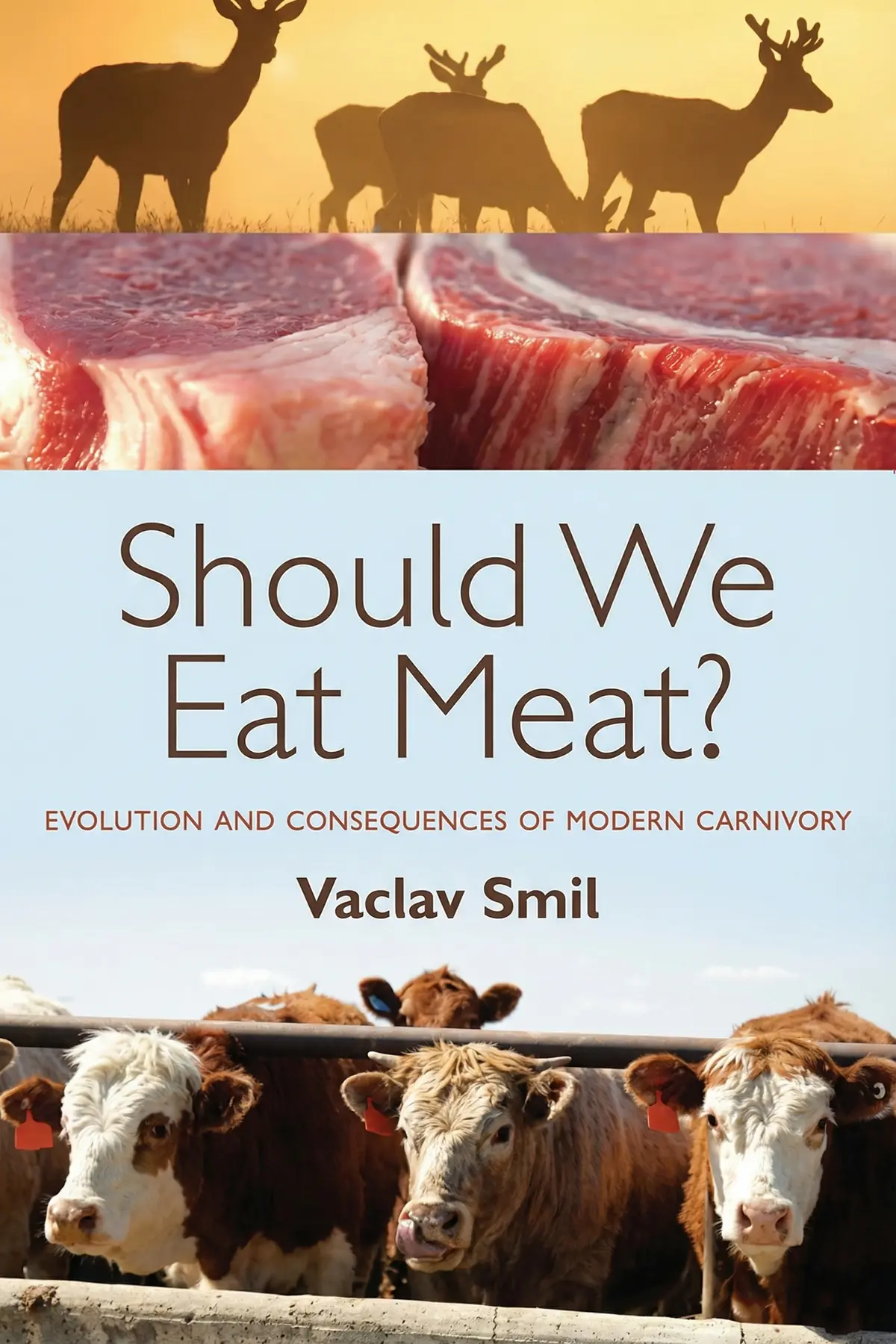
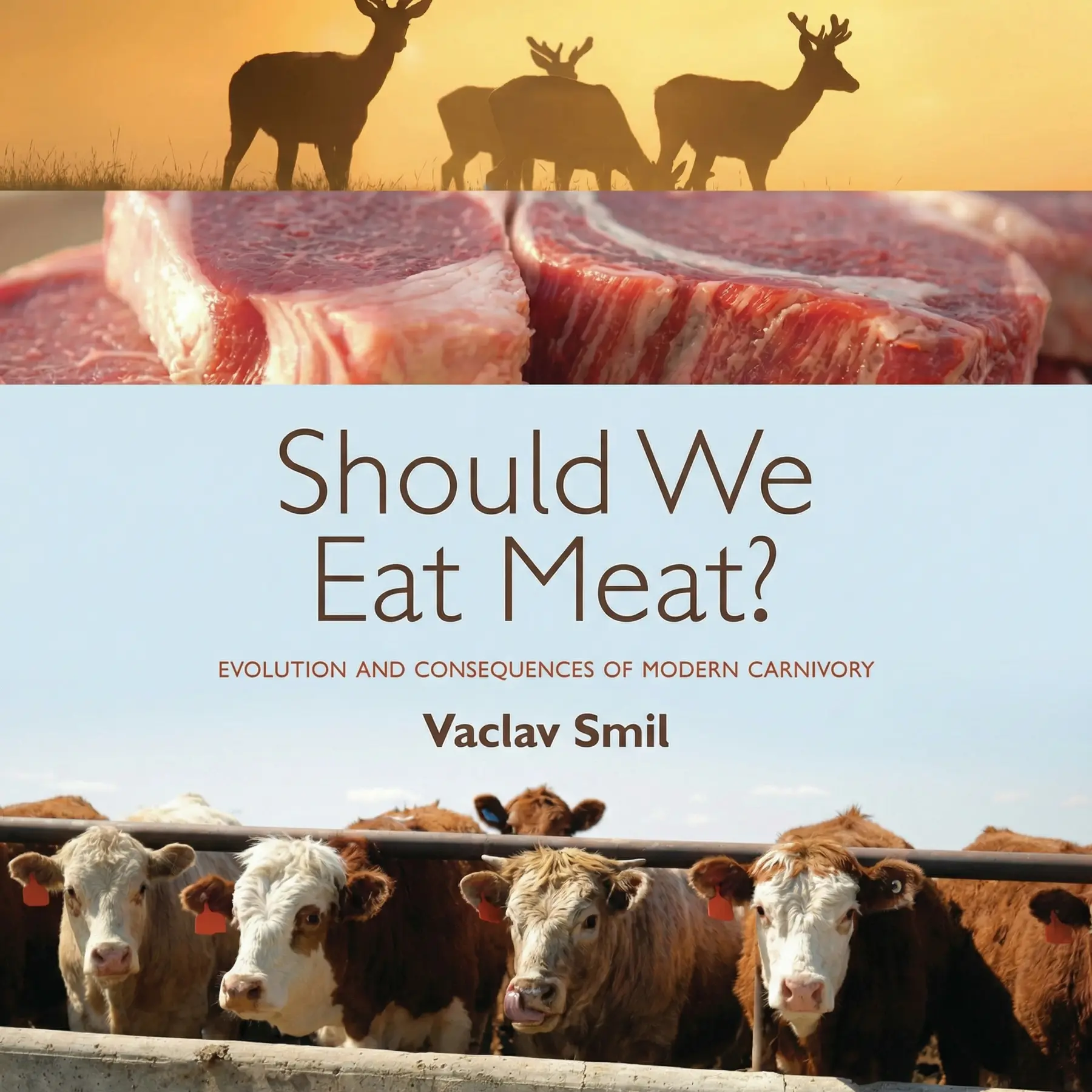
Should We Eat Meat? by Vaclav Smil provides a rigorous, interdisciplinary examination of one of humanity's most foundational habits. Smil moves beyond the polarizing debates of vegetarianism versus carnivory to look at the hard data. He begins by tracing how meat consumption fueled the evolution of the human brain and the development of complex social structures. From the ancient savannah to the modern supermarket, the book maps the transition from hunting and traditional husbandry to the massive, energy-intensive industrial complexes of the twenty-first century. The core promise of the book is to offer a realistic middle ground. Smil details the undeniable environmental costs of modern meat—including its impact on land use, water scarcity, and atmospheric health—while simultaneously acknowledging the high nutritional value and cultural importance of animal products. By analyzing the inefficiencies of current production, Smil outlines a vision for rational carnivory that prioritizes efficiency and environmental stewardship without demanding a global shift to total vegetarianism.
Vaclav Smil is a distinguished professor emeritus at the University of Manitoba, known for his interdisciplinary research spanning energy, environmental studies, population change, and nutrition. A prolific author, Smil was named one of Foreign Policy’s top 100 global thinkers in 2010 for his contributions to public policy and risk assessment.
Listeners find the work extensively researched and packed with detailed analysis, with one listener noting its thorough coverage of a complex subject. The quality of writing earns praise; one listener describes the author as a gifted writer. While listeners consider it an excellent book, they mention it is not an easy read.
Smil is a gifted writer who manages to turn what could have been dry, boring data into a masterful study of human civilization. This is the most comprehensive look at carnivory I have ever encountered. He traces our history from prehistoric overkill to the modern efficiencies of poultry production. I was fascinated by the discussion on how meat contributed to the development of larger brains and social structures in early hominids. The truth is, the world isn't going to go vegan overnight, so Smil’s proposal for 'rational meat-eating' is the most pragmatic solution I've seen. He argues for reducing consumption and improving animal husbandry rather than outright abolition. If you want a book that respects your intelligence and provides a wealth of information, this is the one to get. Truly a brilliant piece of work.
Show moreWow, this book really challenged my assumptions about the future of global food security. Smil’s objective approach to such a passionate topic is refreshing. He makes a compelling case that while the current meat industry is full of malpractices, meat itself is not the enemy. He suggests that by focusing on animals like chickens or fish with better feed-conversion ratios, we can sustain a growing population without destroying the biosphere. The level of detail regarding the history of livestock in civilization is unparalleled. He doesn't shy away from the cruelty of modern farming, but he offers a rational path forward through better management and reduced waste. This is a must-read for anyone who wants to move past the 'meat is good vs. meat is bad' binary. It's a deep, rewarding dive into a truly global issue.
Show moreAs someone who cares deeply about environmental impacts, I found this to be an incredibly well-researched and in-depth analysis of our meat-centric culture. Vaclav Smil provides a much-needed rational middle ground in a debate that is usually dominated by extreme rhetoric. He explores how humans and their livestock now totally dominate the biosphere, which is a staggering thought. The section on Concentrated Animal Feeding Operations (CAFOs) was particularly illuminating, detailing the industrial and globalized web that brings cheap meat to our tables. Personally, I appreciated that he doesn't just tell you what to think but presents the data on land use and emissions. It’s not an easy read by any means, but it is necessary for anyone who wants to understand the true cost of their dinner. It really makes you rethink the scale of modern production.
Show moreEver wonder why we chose cows and pigs for livestock instead of bears or other large mammals? Smil covers this in fascinating detail, explaining the history of domestication and the role of animals in human survival. He provides a sober accounting of the facts that is a welcome alternative to the polarized shouting matches we see online. I learned a lot about the energy cost of meat and how much by-product from other food processes can be used as animal feed. The book is very thorough, but be warned: you will need to exert a lot of attention to get through the sections on nitrogen cycles and carbon emissions. It’s a great resource for understanding the globalized manufacturing of food, even if the reference-heavy style is a bit exhausting. Definitely a solid addition to any environmentalist's library.
Show morePicked this up because I wanted a deep dive into the numbers behind the meat industry, and Smil definitely delivered. This isn't an easy read; it requires the kind of focus you'd give to a graduate-level college course. The book is packed with facts about everything from prehistoric overkill to the modern manufacturing of pelleted feed. I found his discussion on the 'prehistoric overkill' hypothesis particularly illuminating. He manages to be neutral and objective in a field where that is almost impossible. While I didn't agree with every one of his conclusions regarding the health value of meat, I respected the sheer amount of work that went into this. It's an in-depth analysis that shows how livestock totally dominate the planet's biomass. If you can get past the dense writing style, there is a lot of gold in here for the patient reader.
Show moreFinally finished this after three separate attempts over the last year. My main takeaway is that Smil is undoubtedly smart, but the writing is quite a mess. He acknowledges that humans can live perfectly healthy lives without meat, yet he argues we should keep eating it because we simply like it too much to stop. It feels like a bit of a circular argument at times. The book is packed with enough footnotes to fill a second volume, which disrupts the flow of every single chapter. Frankly, if you just accept what he says uncritically, you’ll get the general gist, but you’ll miss the nuances regarding human health where he seems to ignore major studies like the China Study. It’s a decent data dump for your desk, but it’s definitely not a page-turner for the average person.
Show moreFrankly, the information in this book is vital, but the delivery is a total mess. Smil is clearly an expert, but he writes like he’s trying to punish the reader with every sentence. It is just stats upon stats, making it a very slow read. One page he's talking about the biomass of wild land mammals, and the next he's diving into the obscure details of pig feed in the US versus Europe. I found the section on how humans and livestock dominate the planet to be the most valuable part. However, his dismissal of vegetable protein felt a bit dated and lacked the same level of rigorous scientific backing he gave to other topics. It’s a polarizing read. You’ll come away more informed, but you might have a headache from trying to untangle his prose. Proceed with caution.
Show moreNot what I expected when I bought a book about the ethics of eating meat. I thought it would be a philosophical debate, but it’s actually a 200-page data dump. Smil is clearly a smart guy, and he’s done his research, but he’s not interested in making the reading experience enjoyable. He focuses heavily on the numbers—how many units of feed produce a unit of weight gain, the exact percentage of live weight that ends up as meat, and so on. Gotta say, it’s useful if you’re writing a thesis, but as a general reader, I struggled. He lands on a very middle-of-the-road perspective: eat less meat, but don't stop entirely. It feels like a very safe conclusion after so much technical build-up. It's an okay book, just very dry.
Show moreThis felt more like wading through a complex spreadsheet than reading a cohesive book. While the author is clearly a distinguished professor with immense academic credibility, he tries to cram every single statistic he ever found on Wikipedia into these pages. The sentences are often broken and incredibly difficult to parse because of the dense reference style. To be fair, the research on feed conversion ratios—like the 7:1 ratio for cattle versus 1.1:1 for fish—is impressive and eye-opening. However, the sheer volume of data makes it a very hard read for anyone who isn't already a graduate-level researcher. I tried reading this twice and still felt like I was drowning in numbers. It is a thorough treatment of a complicated topic, but it lacks a compelling narrative to keep a casual reader engaged.
Show moreThe truth is that the logic in this book is completely circular and ultimately disappointing. Smil’s best rationale for why we should continue eating meat basically boils down to 'our ancestors did it.' He acknowledges the environmental devastation and the animal rights issues inherent in CAFOs, yet he still lands on a defense of moderate consumption. Why? Because humans are used to it. That isn't a scientific argument; it’s an ideological one. The book is a dense catalog of studies and citations that eventually feels like a middle schooler’s presentation trying to sound sophisticated. It’s Lowkey a very difficult read because of the sentence structure. If you are looking for a solid argument against veganism, you won't find it here—you'll just find a lot of numbers that don't actually justify the author's predetermined conclusions.
Show moreAUDIO SUMMARY AVAILABLE
Get the key ideas from Should We Eat Meat? by Vaclav Smil, plus 5,000+ more titles in English and Thai.