
13 min 46 sec
In the Realm of Hungry Ghosts: Close Encounters with Addiction
By Gabor Maté
A deeply compassionate look at the biological and psychological roots of addiction, challenging the stigma of substance abuse by framing it as a desperate search for relief from trauma and emotional pain.
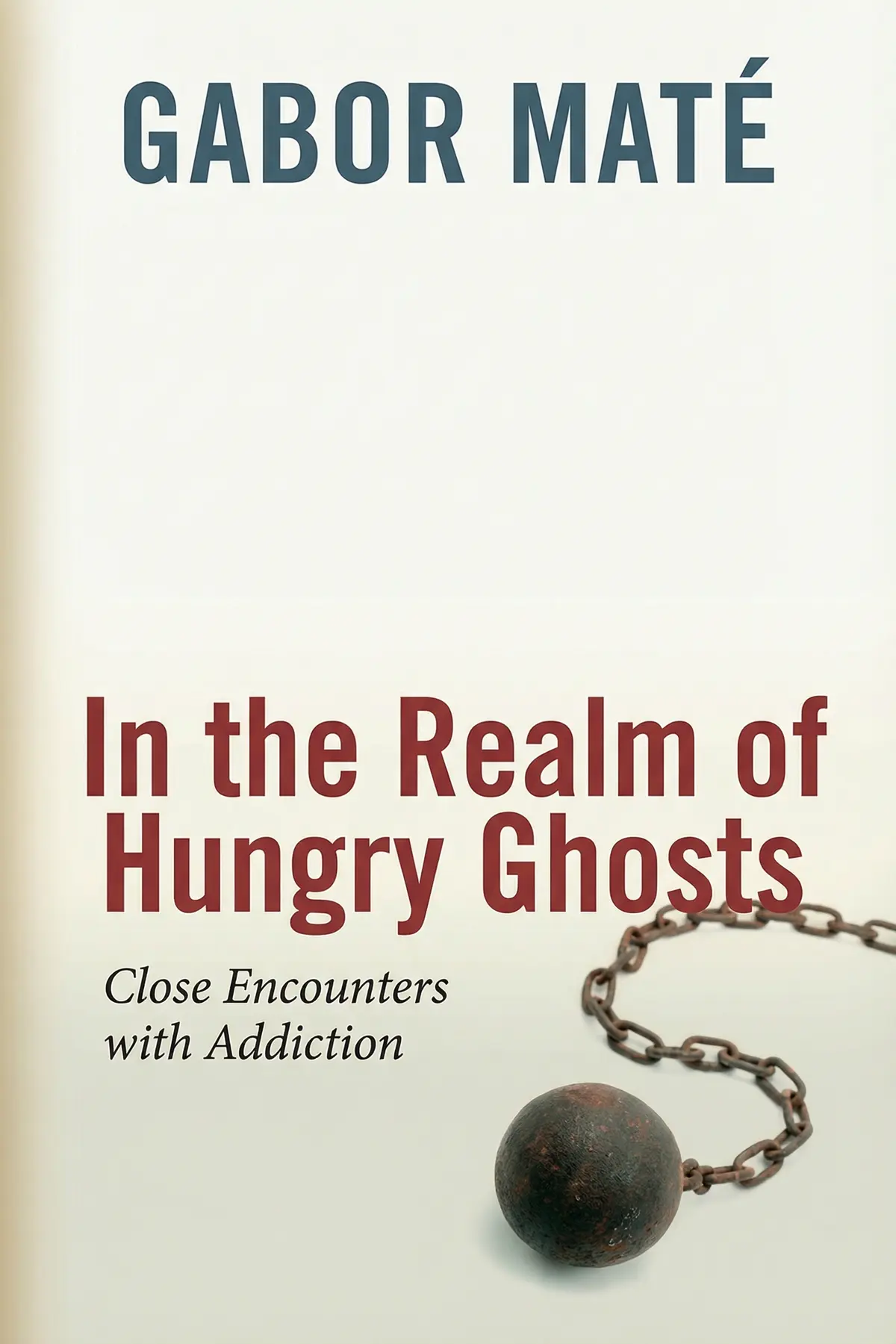
Table of Content
1. Introduction
1 min 41 sec
In Buddhist cosmology, there is a realm inhabited by creatures known as ‘hungry ghosts.’ These beings are depicted with massive, bloated bellies and impossibly thin, pin-sized necks. They are perpetually driven by an insatiable hunger, yet they can never consume enough to find satisfaction. This haunting image serves as a powerful metaphor for the experience of addiction, where a person is driven by a deep, gnawing void that no amount of substance or behavior can truly fill.
When we look at the world of severe addiction, we often see it through a lens of judgment or fear. We see the street-level struggle, the crime, and the physical decay, and we distance ourselves from it. We treat the individuals involved as if they are fundamentally different from the rest of us—as if they are making simple ‘bad choices’ that we would never make. But what if we’ve been looking at it all wrong? What if the addicts we see on the margins are not a separate category of humanity, but rather people at the far end of a spectrum that includes almost everyone?
Dr. Gabor Maté, through his years of medical practice in Vancouver’s most challenged neighborhood, invites us to look past the external chaos and into the internal reality of the person. This journey isn’t just about drugs; it’s about the universal human condition. It’s about the way our brains are shaped by our earliest experiences, the way we seek relief from pain, and the ways our society fails those who are hurting the most. By the time we finish this exploration, the line between ‘us’ and ‘them’ will likely have blurred, replaced by a much more profound and necessary sense of shared humanity and compassionate curiosity.
2. The Spectrum of Human Dependency
2 min 14 sec
Addiction isn’t just found in back alleys; it exists in corporate offices and living rooms, manifesting in everything from narcotics to a compulsive need for new things.
3. The Biological Hijack of the Brain
2 min 14 sec
Explore how certain brain chemicals and neural circuits are altered by dependency, making the concept of ‘choice’ much more complicated than most people realize.
4. The Roots of Vulnerability in Early Trauma
2 min 05 sec
Discover why the environment of our earliest years determines who is most susceptible to addiction, revealing that the ‘drug’ is often a form of self-medication.
5. The Failure of Criminalization and the Case for Compassion
1 min 58 sec
Traditional approaches to drug use often do more harm than good. Learn why shift towards harm reduction could save lives and stabilize communities.
6. Healing Through Curiosity and Attachment
2 min 08 sec
Recovery isn’t about ‘winning a war’ against oneself, but rather about developing a new, compassionate relationship with your own mind and your loved ones.
7. Conclusion
1 min 26 sec
As we conclude this look into the realm of the hungry ghost, we find ourselves back where we started: with a person in pain. We have seen that the roots of addiction are deep and complex, reaching back into the very beginning of life and embedding themselves in the intricate wiring of the human brain. We have seen how our societal systems of punishment and shame often serve only to deepen the trauma and make the cycle of dependency harder to break.
The throughline of this journey is the urgent need for empathy. When we recognize that addiction is a human response to suffering—a desperate attempt to fill a void that we all, in some measure, possess—the wall of stigma begins to crumble. We are forced to admit that the person on the street corner and the person in the mirror are not so different after all. Both are looking for a way to be at peace.
Moving forward, the lesson is clear: healing, whether for ourselves or for our communities, cannot come from a place of war. It can only come from a place of understanding. By replacing ‘why the addiction’ with ‘why the pain,’ we open the door to true recovery. We can choose to support policies that prioritize health over punishment and to offer those around us a presence that is compassionate rather than critical. In the end, the path out of the realm of the hungry ghost is paved with curiosity, dignity, and the simple, radical recognition of our shared human struggle.
About this book
What is this book about?
This exploration of the human psyche dives into the heart of Vancouver’s most marginalized community to reveal the painful realities of severe drug dependency. Rather than viewing addiction as a simple failure of character or a legal problem, the narrative connects the dots between early childhood trauma, brain chemistry, and the universal human desire to escape suffering. By weaving together moving patient stories with rigorous neuroscientific research, the text promises to reshape your understanding of why people become trapped in self-destructive cycles. It offers a radical argument for harm reduction and empathy, suggesting that the path to healing begins with addressing the deep-seated voids that substances and behaviors are meant to fill. Ultimately, it reveals that the struggle of the addict is a more extreme version of the common human search for comfort in an often-unforgiving world.
Book Information
About the Author
Gabor Maté
Dr. Gabor Maté is a Canadian physician who in his multi-decade career has run a family practice, served as the medical coordinator at a hospital palliative care unit, and been the staff physician at a facility for patients with severe addiction. For his work in addiction treatment and mental health, he received the 2011 Civic Merit Award of the City of Vancouver; in 2018, he received the Order of Canada, the country’s highest civilian honor. He has written numerous best-selling books, including Scattered Minds, When the Body Says No, and The Myth of Normal.
Ratings & Reviews
Ratings at a glance
What people think
Listeners consider this an outstanding listen that offers deep perspectives on addiction, and one individual points out that it’s filled with decades of real-life observations. The delivery is easy to follow, and listeners value the empathetic tone, with one noting it broadened their personal definition of compassion. Listeners characterize the experience as heart-wrenching, useful, and vital for their personal comprehension of addiction.
Top reviews
Suthee
Gabor Maté has crafted something profoundly rare here, blending the gritty reality of Vancouver’s Downtown Eastside with high-level neurobiology. He successfully challenges the stale 'choice vs. disease' dichotomy by presenting addiction as a sophisticated, albeit destructive, response to deep-seated pain. The case studies from the Portland Hotel are haunting and visceral, ensuring the reader never loses sight of the human being behind the diagnosis. While the science can get dense when discussing dopamine receptors and brain development, his writing style remains accessible for a general audience. This book fundamentally shifted my understanding of how childhood trauma shapes the physical structures of the brain. It is an essential, heart-wrenching read for anyone working in healthcare or social services.
Show moreViroj
Few authors can bridge the gap between clinical observation and raw human suffering as effectively as Maté does in this volume. He dismantles the failed 'War on Drugs' with surgical precision, arguing for decriminalization not as a radical political move, but as a basic requirement for public health. His 'hungry ghost' metaphor perfectly captures the void that addicts try so desperately to fill with external substances. The truth is that our society often punishes the most traumatized people for finding the only relief they know. This book is heavy and at times quite depressing, yet it offers a necessary roadmap for systemic change. It is a powerful plea for a kinder, more rational approach to human suffering.
Show morePichaya
Ever wonder why we keep doing the things that hurt us even when we know better? This book provides the most comprehensive answer I've ever found. Maté shows that addiction isn't a moral failure, but a biological adaptation to an environment that lacked safety and attunement. The writing is incredibly easy to understand, even when he dives into the complexities of the prefrontal cortex and the opioid system. I particularly appreciated his critique of the legal system and how we criminalize mental health issues. It changed how I view the homeless population in my own city forever. It is a brilliant, necessary work that demands we rethink everything we thought we knew about willpower and recovery.
Show moreRoo
Wow, this was a difficult but life-changing experience. The stories of the residents at the Portland Hotel will stay with me for a long time. Maté doesn't look down on his patients; he treats them with a level of dignity that is rarely seen in medical literature. He argues that we must stop asking 'why the addiction?' and start asking 'why the pain?' This simple shift in perspective has massive implications for how we treat people in our communities. His prose is elegant and his arguments are backed by decades of real-life observations. If you want to expand your capacity for compassion, read this book. It is instrumental in understanding the 'hungry ghosts' that dwell within all of us.
Show moreAria
As someone who has struggled with behavioral compulsions, I found this book to be incredibly validating and healing. Maté’s honesty about his own flaws makes his medical advice feel much more grounded and less like a lecture from on high. We are all on a continuum of addiction, whether it’s to drugs, work, power, or shopping. He shows that the brain's reward system can be physically hijacked, but also that the brain’s plasticity offers a glimmer of hope for change. The stories of his patients are heart-wrenching, yet they serve as a vital reminder of our shared humanity. This isn't just a book about drugs; it’s a book about what it means to be a person in a broken world.
Show moreWittaya
Look, if you think addiction is just a matter of 'poor choices' or lack of willpower, you need to read this immediately. Maté provides decades of evidence showing that the brain's ability to regulate impulses is physically compromised by early life adversity. You cannot simply 'say no' to a neurological deficit. This book is a gut-punch of reality mixed with profound clinical wisdom and a radical call for social change. While it’s quite a long read, the easy-to-follow writing style ensures you stay engaged with the complex topics. It is easily one of the most important books on human behavior written in the last twenty years. It challenges your biases and demands a more compassionate worldview.
Show moreMan
I wasn't prepared for how much this book would make me look in the mirror. Maté is incredibly brave for including his own struggle with a compulsive shopping addiction for classical music CDs, which helps bridge the gap between 'them' and 'us.' It illustrates his point that we are all on a continuum of craving and dissatisfaction. To be fair, some of the middle chapters felt a bit repetitive as he hammered home the same theories on trauma. However, his compassionate approach to the residents of Terminal City is a masterclass in empathy. The sections on how the brain's reward systems are hijacked by substances were particularly enlightening and well-explained.
Show moreFort
The intersection of prenatal stress and later-life vulnerability was the most eye-opening part of this text for me. Maté explains with great clarity how the human brain does most of its developing outside the womb, making infants incredibly susceptible to their parents' emotional states. If the attachment is severed or stressed, the neural pathways for self-soothing never properly form. I found this perspective much more useful than the typical 12-step approach, though the spiritual sections near the end weren't quite as compelling to me as the hard science. Not gonna lie, some of the patient vignettes are very difficult to get through because they are so tragic. Overall, it's an exceptional read that provides deep insights into the human condition.
Show moreBoy
Finally got around to reading this after hearing so much praise in my psychology circles. It lives up to the hype for the most part, especially in how it contextualizes addiction within our fast-paced, consumerist society. Maté’s focus on 'self-medication' is a powerful lens that makes sense of even the most self-destructive behaviors. I do think he dismisses the role of genetics a bit too quickly to favor his environmental theories, but his arguments for the importance of early childhood development are robust. The section on mindfulness as a path to recovery was a nice, practical touch to wrap up such a theoretical book. It’s a solid resource for anyone looking to understand the mechanics of craving.
Show moreRatchanee
To be fair, Maté's compassion for his patients is undeniable, but his 'Grand Theory' of addiction often feels like an oversimplification. He attributes nearly every instance of substance abuse to childhood trauma, which seems to dismiss other environmental or genetic factors that researchers have documented. While the stories from the Downtown Eastside are moving, the book's pacing suffers from being over 400 pages long. Frankly, comparing his own habit of buying too many classical CDs to the life-shattering heroin addictions of his patients felt a bit tone-deaf at times. It’s a well-intentioned book with some great insights into brain plasticity, but it’s far from the definitive scientific word on the subject.
Show moreReaders also enjoyed
ADHD an A-Z: Figuring It Out Step by Step
Leanne Maskell
Alcoholics Anonymous
Alcoholics Anonymous World Services
A Liberated Mind: How to Pivot Toward What Matters
Steven C. Hayes
AUDIO SUMMARY AVAILABLE
Listen to In the Realm of Hungry Ghosts in 15 minutes
Get the key ideas from In the Realm of Hungry Ghosts by Gabor Maté, plus 5,000+ more titles in English and Thai.
- 5,000+ titles
- Listen as much as you want
- 7-day free trial
- Cancel anytime







