
Beyond Good and Evil
Friedrich Nietzsche
A profound investigation into the origins of our moral values. Friedrich Nietzsche challenges the idea that good and evil are eternal truths, revealing them instead as products of historical power struggles.
47 sec
Have you ever stopped to wonder why we consider certain behaviors ‘good’ and others ‘evil’? Most of us treat our moral compass as if it were an objective map of the universe, but Friedrich Nietzsche argues that this map was drawn by human hands with specific agendas. In his landmark work, he explores the idea that morality is not a set of eternal truths, but a shifting landscape that has evolved over centuries. By looking back at the history of how these values were formed, he invites us to question whether our current rules actually help us thrive or if they are simply artifacts of past power struggles. Today, we will look at how the definitions of right and wrong have transformed and why that matters for our freedom today.
1 min 12 sec
What if the rules of right and wrong are constantly shifting beneath our feet? Explore how societal changes redefine our most basic ethical principles over time.
1 min 17 sec
Discover the psychological roots of modern ethics and how the resentment of the oppressed transformed strength into a vice and weakness into a virtue.
1 min 10 sec
Learn why re-evaluating our values is essential for progress and how shifting our focus can lead to a more liberated and flourishing existence.
45 sec
In the end, Nietzsche’s investigation serves as a powerful reminder that our moral landscape is not a permanent fixture of nature. It is an ongoing conversation, shaped by history, power, and our collective needs. By recognizing that ‘good’ and ‘evil’ are evolving concepts, we gain the freedom to question the norms we’ve inherited. This doesn’t mean we should live without any values at all, but rather that we should be the architects of a morality that celebrates life, strength, and human potential. As you move forward, consider which of your beliefs are truly yours and which are simply echoes of the past. By doing so, you take the first step toward a more authentic and flourishing life.
This exploration deconstructs the history of ethics by asking where our notions of right and wrong actually originate. Nietzsche proposes that moral codes are not divine or natural laws, but are instead forged through social conflict and psychological shifts. He introduces the contrasting concepts of master and slave morality, explaining how the resentment of the weak eventually overturned the values of the strong to create modern ethics. The promise of this work is to liberate the listener from inherited, life-denying dogmas. By understanding the genealogy—the family tree—of our values, we can begin to see them as flexible tools. Ultimately, the text encourages us to move toward a way of living that celebrates strength, creativity, and human vitality rather than just conforming to traditional rules that may no longer serve our flourishing.
Friedrich Nietzsche was a German philosopher, cultural critic, and poet. His work has exerted significant influence on a large range of academic fields, particularly in philosophy, literature, and psychology. Nietzsche’s thoughts on morality, religion, and truth challenge conventional wisdom, making him one of the most cited philosophers in history.
Friedrich Nietzsche
Friedrich Nietzsche
Friedrich Nietzsche
Friedrich Nietzsche
Friedrich Nietzsche
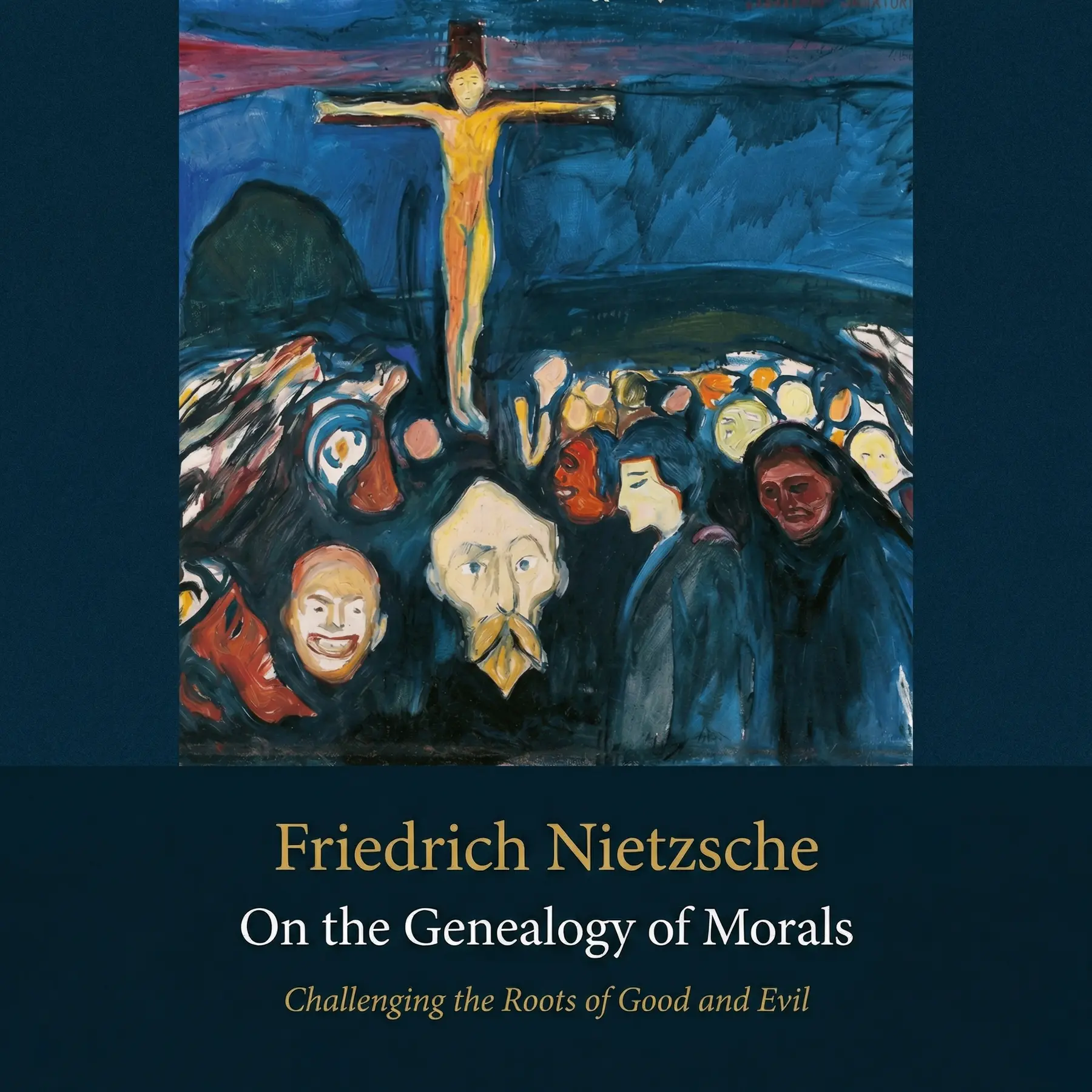
Listeners find Nietzsche’s investigation into the roots of ethics to be intensely demanding yet thought-provoking. Although some listeners consider his points somewhat conjectural, they value the work's daring contrast between "master" and "slave" morality. Furthermore, listeners are often struck by the writer’s incisive and expressive prose, with one listener highlighting the text as a "superbly brilliant and penetrating" analysis of human nature. Besides this, they point out that the book's perspectives on the "will to power" continue to be highly significant in contemporary philosophical circles. They also remark that, while unconventional, this masterpiece remains a fulfilling experience for anyone exploring the foundations of moral thought.
This book is a total wrecking ball directed at the foundation of Western ethics. Nietzsche doesn't just question our values; he performs a brutal autopsy on where they actually came from. I found his distinction between master and slave morality absolutely chilling yet undeniably logical in its own vacuum. He argues that what we call 'good' today is often just a glorified version of the resentment felt by the weak against the strong. It’s a dense read, and frankly, you have to be in the right headspace to handle his intensity. His 'blonde beast' imagery is provocative and certainly uncomfortable, but it forces you to confront the animalistic roots we try so hard to bury. If you want a book that challenges every assumption you have about kindness and justice, this is it. It is easily one of the most transformative pieces of philosophy I have ever encountered.
Show morePicked this up expecting a dry philosophy text but found a visceral autopsy of the human spirit instead. The way Nietzsche describes the 'slave revolt in morality' is nothing short of revolutionary. He posits that our modern concepts of 'evil' were born out of the 'ressentiment' of those who couldn't compete with the noble, warrior class. It's a harsh, elitist perspective that makes you squirm, but it also explains so much about human jealousy and social dynamics. His writing style is incredibly aggressive; he doesn't just state a point, he hammers it into your skull. Look, you don't have to agree with his praise of the 'noble' aristocrat to appreciate the genius of his genealogical method. He peels back the layers of tradition to show the raw power struggles underneath. It is a superbly brilliant and penetrating analysis of how we became the 'sick' animals we are today.
Show moreThe chapter on the origins of bad conscience is perhaps the most haunting thing I have read this year. Nietzsche argues that when we couldn't release our animal instincts outward, we turned them on ourselves, creating the soul. It’s a wild, terrifying thought that makes perfect sense when you look at the history of religious repression. He has this way of making you feel like you're in on a secret that the rest of the world is too cowardly to face. His perspectivism is a game-changer; it basically says there is no objective 'truth' in morality, only different interpretations driven by different wills. The book is dense and the language is often archaic, but the raw energy behind his words is palpable. He doesn't want you to agree with him; he wants you to wake up. This is essential reading for anyone who wants to understand modern philosophy.
Show moreNietzsche doesn't just argue; he screams from the page with an intensity that is both exhausting and exhilarating. This book is a masterpiece of psychological deconstruction. He takes things we consider sacred, like justice and mercy, and shows the messy, violent roots they grew from. The final line about man willing nothingness rather than not willing at all is a perfect summary of his dark but profound outlook. I loved how he challenged the idea that 'good' has always meant the same thing. Truth is, we are all just competing 'wills to power' trying to make our own perspective the dominant one. It’s a heavy, provocative, and often offensive journey, but it’s one that every thinking person should take at least once. His style is superb, and his insights into the human drive for meaning remain deeply relevant today.
Show moreEver wonder why we feel so much crushing guilt over things that probably shouldn't matter? Nietzsche explores this in the second essay, and his theory about debt and punishment is fascinating. He suggests that guilt originally had nothing to do with morality and everything to do with a creditor-debtor relationship. To be fair, some of his historical claims feel like he’s just making them up to fit his narrative. However, the psychological insight into how we turn our aggressive instincts inward is brilliant. He calls it 'bad conscience,' and seeing it as a form of self-torture changed how I view my own anxieties. The writing is sharp and rhetorical, though it can get a bit circular at times. It’s not an easy stroll, but the intellectual payoff for finishing each essay is massive. Definitely a foundational text for anyone interested in the darker corners of the human psyche.
Show moreNietzsche’s prose is like a fever dream that occasionally hits you with a bolt of pure, icy clarity. Unlike his other works that rely heavily on short aphorisms, these three essays feel more like a sustained attack on the status quo. I was particularly struck by his analysis of ascetic ideals and why people choose to suffer for a 'higher' purpose. He concludes that humans would rather will nothingness than not will at all, which is a haunting thought to sit with. While I don't agree with his dismissive attitude toward compassion, his 'will to power' concept provides a unique lens for viewing social hierarchies. The book is intellectually stimulating, though his ego occasionally gets in the way of his arguments. You have to sift through a lot of vitriol to find the gems. Still, his influence on modern thought is everywhere, and reading the source material is deeply rewarding.
Show moreAs someone who usually finds philosophy too detached, Nietzsche feels dangerously personal. He talks about 'will to power' not just as a political thing, but as a fundamental drive in everything we do. This book really helped me understand the transition from the old 'master' values to the 'slave' values that dominate our world now. It’s a heavy lift, and his tone can be incredibly arrogant, which might turn some people off. However, the way he links our psychological health to our moral systems is something I’m still thinking about weeks later. He wants us to stop being ashamed of our natural instincts. Gotta say, his take on the 'meaning of asceticism' was the highlight for me; it really puts modern self-care and self-denial trends into a weirdly clear perspective. It is a challenging but essential read for any serious thinker.
Show moreFinally got around to this 'most conventional' of his works and I can see why it’s the gateway drug for many. The essay structure makes his ideas much easier to follow than the erratic aphorisms found in his other books. He lays out the evolution of 'good and evil' with a sharp, rhetorical flair that makes even his most controversial points sound plausible. I particularly liked the third essay on ascetic ideals and how even science can become a form of self-denial. There’s a constant tension in his writing between brilliance and total eccentricity. While I think he oversimplifies the origins of Christianity, his point about morality being a tool for power is hard to ignore. It’s a rewarding read that forces you to define your own values against his. Be prepared for a lot of talk about 'sickness' and 'health' in a moral sense.
Show moreTo be fair, I spent half the time rolling my eyes at his blatant lack of historical evidence. Nietzsche makes these huge, sweeping claims about the origins of words like 'schlecht' and 'gut' as if his etymology alone proves his entire worldview. He is a master of the 'because I said so' school of philosophy, which can be incredibly frustrating if you prefer systematic logic. He’s more of a poet than a scientist, and his hatred for the 'priestly class' feels deeply personal and biased. That being said, his critique of how morality can be used as a weapon by the powerless is a stinging observation. It’s a provocative read that keeps you engaged even when you want to throw the book across the room. Just don't go into it expecting a fair or balanced historical account of human development. It's a polemic, plain and simple.
Show moreNot what I expected given the hype around his 'genius' and supposed deep insights into the human condition. Honestly, I found the first essay to be a collection of wild generalizations and some pretty uncomfortable prejudices against the priestly class. He spends so much time praising 'blonde beasts' and warriors that he forgets to actually defend his positions with anything resembling a coherent argument. His style is undeniably unique, but it often feels like he's hiding behind metaphors because he can't prove his points. I found the whole 'debt equals pain' theory in the second essay to be a bit of a stretch, even for a thought experiment. It feels like the ramblings of someone who is deeply angry at the world and wants to justify that anger. I can see why he's influential, but the actual experience of reading this was more exhausting than enlightening for me.
Show more
William B. Irvine
Nigel Warburton
John Rawls
Kate Kirkpatrick
Jean-Paul Sartre
Martin Heidegger
AUDIO SUMMARY AVAILABLE
Get the key ideas from On the Genealogy of Morals by Friedrich Nietzsche, plus 5,000+ more titles in English and Thai.







