
Beyond Good and Evil
Friedrich Nietzsche
Explore Friedrich Nietzsche’s radical critique of traditional morality and religion. This summary reveals how to dismantle inherited beliefs and construct a personal value system rooted in individual strength and authenticity.
1 min 05 sec
Imagine standing in a grand hall filled with ancient statues, each representing a core belief of our society. For centuries, people have bowed to these figures, assuming they are solid and eternal. But what if those statues were actually hollow? This is the starting point for the challenging ideas Friedrich Nietzsche explored in his late works, Twilight of the Idols and The Anti-Christ. Written in the late 1880s, these texts represent a final, intense push to make us think for ourselves. Nietzsche isn’t just asking us to be skeptical; he is inviting us to participate in a total reevaluation of what it means to live a good life. He wants us to look beyond the false truths we’ve been taught to believe and instead find the inner strength to define our own reality. As we walk through these ideas, the goal isn’t just to tear things down, but to clear the path for a more authentic and powerful version of yourself. Let’s explore how Nietzsche’s hammer strikes the idols of our age and what he suggests we build in their place.
1 min 38 sec
Discover why the age of a belief doesn’t guarantee its worth and how ancient values might actually be hollow shells of their former selves.
1 min 38 sec
Explore the provocative idea that common virtues like humility might be limiting your potential, while suppressed traits like pride could be essential for your growth.
1 min 35 sec
Learn the difference between following inherited rules and building a personal value system that truly reflects who you are as an individual.
1 min 04 sec
As we reach the end of this exploration into Nietzsche’s late writings, the central message becomes clear: the quest for an authentic life requires us to be the ultimate judges of our own values. Twilight of the Idols and The Anti-Christ serve as a powerful reminder that we don’t have to be defined by the expectations or the ‘idols’ of the past. By daring to question even our most fundamental beliefs, we find the strength to discard what limits us and keep what empowers us. This process isn’t a one-time event but a continuous journey of self-refinement. The takeaway is simple yet profound: stop looking for truth in ancient statues and start finding it within your own experiences. When you take the responsibility to define what is good and what is meaningful for yourself, you not only reclaim your own life but also contribute to a world that values genuine expression over blind obedience. It’s time to pick up the hammer, test your own beliefs, and start building a life that is truly your own.
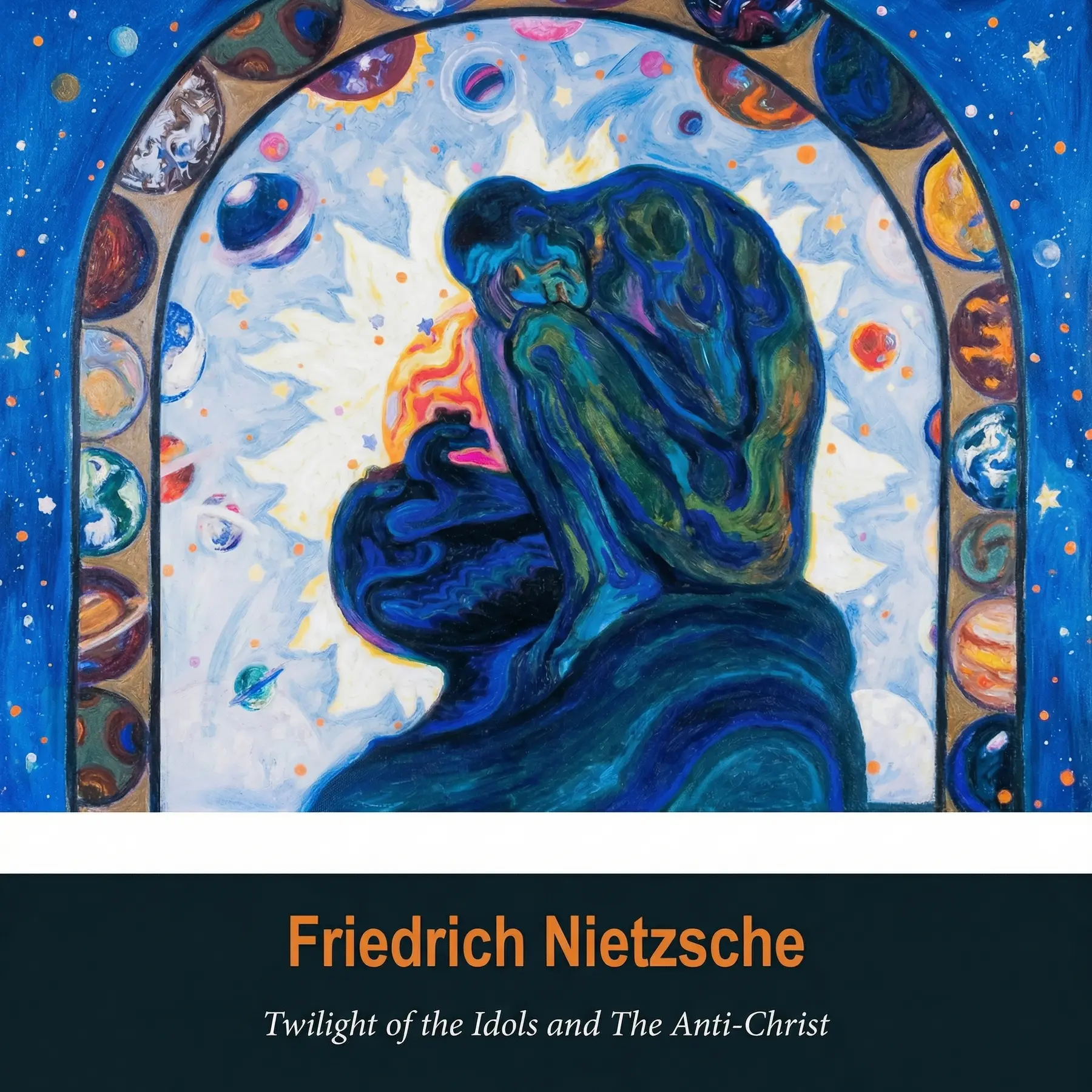
Twilight of the Idols and The Anti-Christ represents the fiery culmination of Friedrich Nietzsche’s philosophical journey. These late-career works serve as a sharp intellectual tool, designed to tap against the most sacred beliefs of Western civilization to see which ones are hollow. Nietzsche challenges the reader to look past the 'idols'—those long-held truths about religion and morality that we often accept without question. The promise of these writings isn't just a critique of the past; it is a blueprint for the future of the individual. By examining the foundations of concepts like humility, pride, and societal virtue, Nietzsche offers a path toward a more authentic existence. He argues that true strength comes from the ability to define one's own values rather than submissively following those handed down by tradition. This summary explores the provocative idea that by dismantling the old, we create the necessary space for personal growth, self-respect, and a more vibrant way of living.
Friedrich Nietzsche was a German philosopher, cultural critic, poet, and philologist, known for his profound and provocative thoughts on morality, culture, philosophy, and science. His work has had a significant impact on both philosophical thought and modern intellectual history.
Friedrich Nietzsche
Friedrich Nietzsche
Friedrich Nietzsche
Friedrich Nietzsche
Friedrich Nietzsche
Listeners find the writing accessible and value its philosophical perspectives, while one listener emphasizes the work's potent historical and psychological critique of Christianity.
Nietzsche is at his most explosive here, truly living up to the subtitle about philosophizing with a hammer. It is a powerful, historical-psychological critique that aims to shatter the idols of Western morality, particularly the 'slave morality' he identifies in Christianity. I found the section on the 'Four Great Errors' to be surprisingly grounded in human psychology, even if his tone is one of constant, near-mock fury. He doesn't just argue; he attacks. The writing is less like a traditional textbook and more like a series of intellectual lightning strikes. You don't have to agree with his dismissal of pity to appreciate the sheer rhetorical force he brings to the table. It is easily one of his most readable works, provided you can handle the vitriol.
Show moreI’m still trying to wrap my head around the chapter on Socrates. It is so bizarre and yet fascinating—how can a philosopher argue that Socrates was wrong simply because he was ugly? It sounds like a pathetic argument at first, but Nietzsche uses it to claim that Socrates was a symptom of Greek decadence, a 'criminal' against the instincts of life. He views the reliance on pure reason as a 'tyrant' that destroys the natural human drive. This book is a wild ride from start to finish. It feels like the work of a man standing on the edge of a void, screaming his truths before the darkness sets in. It’s vibrant, arrogant, and totally unforgettable.
Show moreLook, if you want a polite conversation about ethics, go elsewhere. This book is a scorched-earth campaign against everything the West holds sacred. Nietzsche’s righteous, white-hot anger is infectious, especially when he starts deconstructing how Christianity inverted classical values. He sees pity as something that thwarts the will to power, and while that’s a hard pill to swallow, his psychological analysis of why we feel pity is fascinating. The chapters are concise and pack a punch, especially 'The Four Great Errors.' It’s a book that demands you grow up and face the void without the safety net of traditional morality. Even if you don't agree with his 'noble' vs. 'slave' dichotomy, you can't deny the sheer power of his prose.
Show moreAbsolute fire. This is Nietzsche at his most unhinged and brilliant. He doesn't hold back on his contempt for Socrates or the 'improvers' of mankind, and his writing has a ratiocinated force that is just ravishing. He isn't interested in making sense to the herd; he is writing for the masters. The chapter on 'Morality as Anti-Nature' is a must-read for anyone interested in how we define what is 'natural.' It’s a quick read but one that stays with you, forcing you to question whether your own morals are actually yours or just something you inherited from a dying system.
Show moreWait, didn't he promise to teach the eternal recurrence? The book ends with him calling himself the teacher of it, yet the theme is barely touched upon. It’s classic Nietzsche—obscure, frustrating, and brilliant all at once. Even without that specific teaching, the book is a masterpiece of psychological critique. His attack on the Apostle Paul for distorting Christ's message is particularly devastating. He manages to be both a philosopher and a poet, creating a work that feels like a call to arms for the soul. It's not about 'the truth' in a scientific sense; it's about the force of style and the courage to live an authentic life in a world without God.
Show moreFinally tackled this via a LibriVox recording while commuting, and I have to say, the reader’s tone really matched the sense of 'bloody-mindedness' Nietzsche is known for. Some readers can be a bit stilted, but this one captured the aggressive energy of the text perfectly. The critique of Christianity in 'The Anti-Christ' is devastatingly pointed, treating the religion as the ultimate symbol of decadence and the denial of the will to power. I was especially struck by the aphorisms at the start of 'Twilight.' They are witty, poetic, and sometimes so skillful they leave you untying knots for days. While his view of women is definitely dated and hard to swallow, the core of the book—the idea of creating one's own meaning in a world where the old gods are dead—remains incredibly compelling.
Show moreTo be fair, this is probably the most accessible gateway into Nietzsche’s late-period madness. He is obsessed with the idea that we have replaced the 'noble' soul with a bland, mediocre herd animal through the influence of the church. The critique of 'The Anti-Christ' is particularly sharp because it feels like an attack from the inside; you can tell he wrestled with these themes deeply. While I find some of his social Darwinism hard to take, his call to grab life by the throat and live authentically is inspiring. He wants us to be artists of our own lives. It’s a dense, challenging read, but the historical-psychological insights into how we formed our current values are worth the effort.
Show moreThe concept of 'slave morality' hits differently when you see it applied to modern society as a form of decadence. Nietzsche argues that we’ve been taught to view our weaknesses as virtues, and 'The Anti-Christ' is his attempt to snap us out of that delusion. I loved the aphorisms; some are almost like intellectual puzzles. 'To live alone one must be a beast or a god... or a philosopher.' That’s gold. I did find his attacks on the Germans of his day a bit repetitive, and his obsession with 'burning flesh' metaphors is a little sickly sweet. However, as a synthesis of his final thoughts, this volume is essential for understanding how he wanted to 'revalue all values.'
Show moreIs it possible to admire the prose while loathing the logic? Nietzsche’s writing is undeniably beautiful, yet his scientific arguments are frequently a mess. He attempts to use the Law of Selection to justify his views on pity, but he treats evolution as a social law rather than a natural one, which is just fundamentally false. Evolution has no goal and doesn't care about 'superiority.' To be fair, he calls himself a 'practitioner of science,' but his lack of rigor makes it hard to take his social theories seriously. I enjoyed the 'Maxims and Arrows' section for their sharpness, but the blatant sexism and the way he repeats the word 'decadence' every other sentence eventually became exhausting. It's a stimulating read, but one that lacks internal consistency.
Show moreWhy does this man hate everyone? I had to read this for a class, and frankly, I was just annoyed the whole time. Between the constant rants against the 'weak' and the 'degenerate' and that ridiculous quote about truth being a woman who wants her modesty killed, it was hard to find any actual philosophy. He dismisses altruism and charity as signs of decline, which feels incredibly cynical. He claims to be the last disciple of Dionysus and the teacher of the eternal recurrence, but he doesn't even explain the recurrence in this book! It feels like the incoherent ramblings of someone who is just angry at the world. I don't see the appeal of this 'hammer' style at all.
Show more
William B. Irvine
Daniel Goleman
Nigel Warburton
John Rawls
Eckhart Tolle
AUDIO SUMMARY AVAILABLE
Get the key ideas from Twilight of the Idols and The Anti-Christ by Friedrich Nietzsche, plus 5,000+ more titles in English and Thai.







