
Beyond Good and Evil
Friedrich Nietzsche
Explore the radical philosophy of Friedrich Nietzsche through the journey of Zarathustra. This summary breaks down the quest for the Overman, the will to power, and the challenge of creating personal meaning in a world without absolute truths.
1 min 36 sec
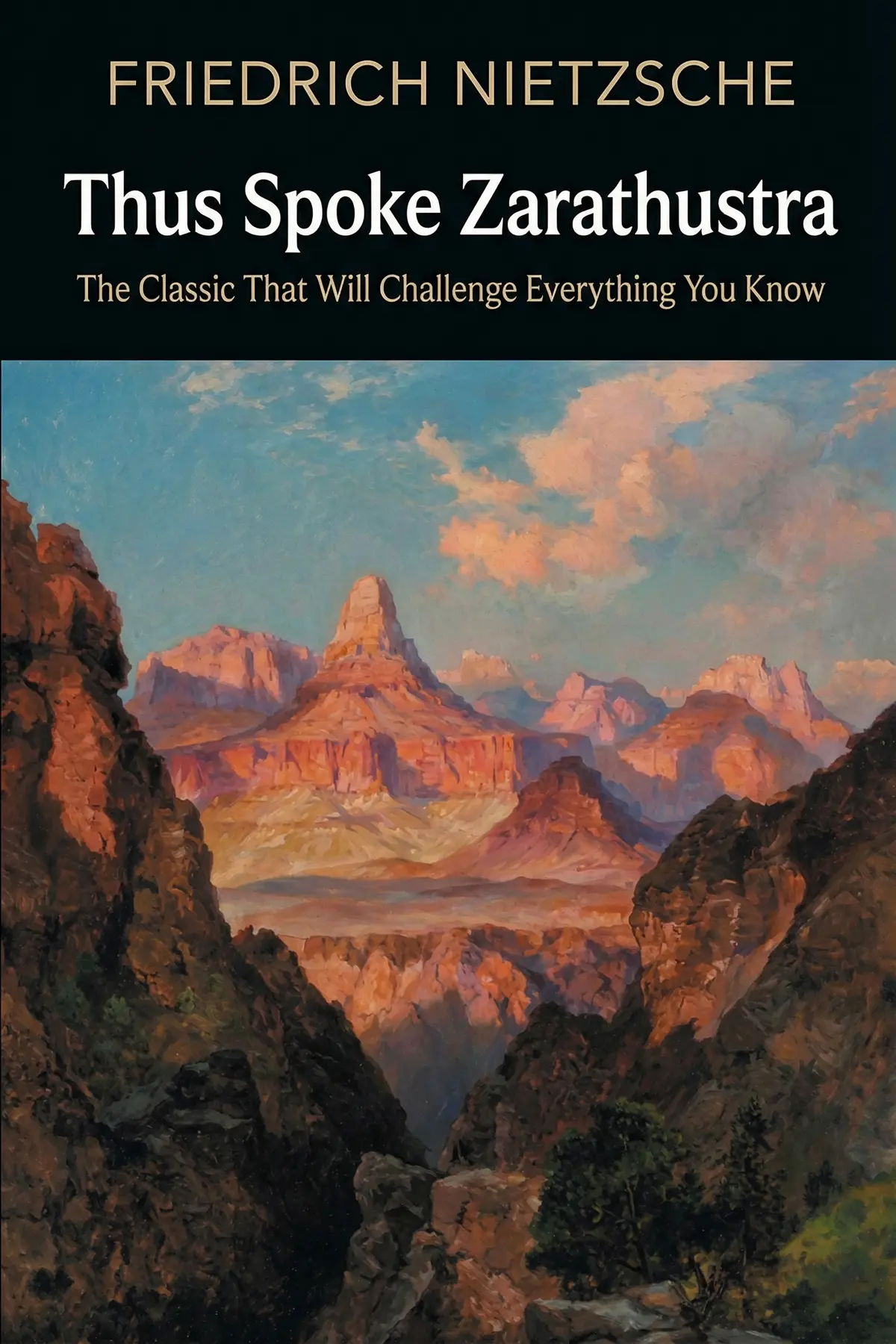
Have you ever felt that the rules and values handed down to you don’t quite fit the reality of the world? This sense of misalignment is exactly what Friedrich Nietzsche explores in his most poetic and challenging work, Thus Spoke Zarathustra. This isn’t just a book of philosophy; it’s a narrative voyage that follows a fictional prophet who returns to civilization after ten years of solitude in the mountains. Zarathustra’s mission is to wake humanity up from its spiritual slumber and offer a path forward in a world where old foundations have crumbled.
At the heart of this journey is the provocative claim that God is dead. For Nietzsche, this isn’t a celebratory statement of atheism, but a stark realization that the traditional structures of morality and meaning no longer hold their authority over us. Without those structures, we face a choice: do we sink into mediocrity and nihilism, or do we rise to create something entirely new? Zarathustra’s teachings center on the throughline of self-transcendence. He introduces us to the ideal of the Overman—a being who transcends current human weaknesses to define their own truth.
In the following minutes, we will follow Zarathustra through the town squares and back into his mountain retreats. We’ll explore the three stages of spiritual transformation, the drive of the will to power, and the staggering psychological challenge of the eternal return. Whether you find these ideas inspiring or deeply unsettling, they are designed to shake the very ground you stand on, pushing you to ask: what could I become if I were the sole architect of my own life?
2 min 23 sec
Follow the spiritual progression from a burdened beast of burden to a fierce rebel, and finally to a creative child who builds a brand-new world from scratch.
2 min 22 sec
Witness the danger of remaining stuck in mediocrity and the terrifying beauty of the human potential to reach for something higher.
2 min 30 sec
Discover why the drive for growth is the fundamental pulse of life and why conventional virtues might actually be obstacles in disguise.
2 min 16 sec
Imagine if every moment of your life repeated forever. Learn how this daunting thought experiment serves as the ultimate test of self-affirmation.
2 min 19 sec
Join Zarathustra as he gathers the disillusioned seekers of the world, teaching them to find laughter and hope in the face of a godless world.
1 min 50 sec
Friedrich Nietzsche’s Zarathustra leaves us at a threshold. The story doesn’t end with a comfortable answer or a new set of commandments. Instead, it ends with a beginning—the ‘great noonday’ where the individual stands in the full light of their own consciousness, ready to act. We have seen the spirit transform from the burdened camel to the rebellious lion and finally to the creative child. We have stood on the tightrope over the abyss, looking down at the safe, mediocre life of the Last Man and choosing instead the dangerous path of the Overman.
The throughline of this work is clear: meaning is not something we find; it is something we forge. In a world where traditional religious and moral certainties have dissolved, the responsibility for value falls entirely on our shoulders. This is both a terrifying weight and the ultimate freedom. The doctrine of the eternal recurrence serves as a final check on our choices, asking if we are living with enough passion and authenticity to repeat this life forever. Zarathustra teaches us that the will to power is not a call to cruelty, but a call to excellence and self-overcoming.
As you step away from this summary, consider what it would look like to reject the ‘spirit of gravity’ in your own life. Where are you carrying burdens that aren’t yours, like the camel? Where do you need to find the courage of the lion to say ‘no’ to social expectations? And most importantly, where can you embrace the innocence of the child to create something uniquely your own? Zarathustra’s journey is a reminder that the most heroic thing a human can do is to become who they truly are, dancing in the face of eternity and laughing in the face of struggle. Your day is beginning; arise and face your own noonday.
Friedrich Nietzsche’s most famous work is a philosophical odyssey disguised as a story. It follows the prophet Zarathustra as he descends from a decade of mountain isolation to deliver a message that would change Western thought forever. At its core, the book explores the death of traditional morality and the vacuum left behind, prompting a search for a new way to live. The narrative introduces groundbreaking concepts like the Übermensch, or Overman, which serves as a goal for human evolution beyond our current limitations. It challenges the listener to abandon the safety of the herd, reject the comfort of pity, and embrace a life of constant self-overcoming. By following Zarathustra’s interactions with various disciples and detractors, we learn what it means to possess the will to power and how to face the daunting prospect of the eternal recurrence. This is a guide to radical individualism and the artistic creation of one’s own values.
Friedrich Nietzsche (1844–1900) was a German philosopher, poet, and critic who famously challenged the foundations of Western culture and morality. He is best known for provocative concepts such as the death of God, the will to power, and the Übermensch. His influential philosophical works include Beyond Good and Evil and The Genealogy of Morals.
Friedrich Nietzsche
Friedrich Nietzsche
Friedrich Nietzsche
Friedrich Nietzsche
Friedrich Nietzsche
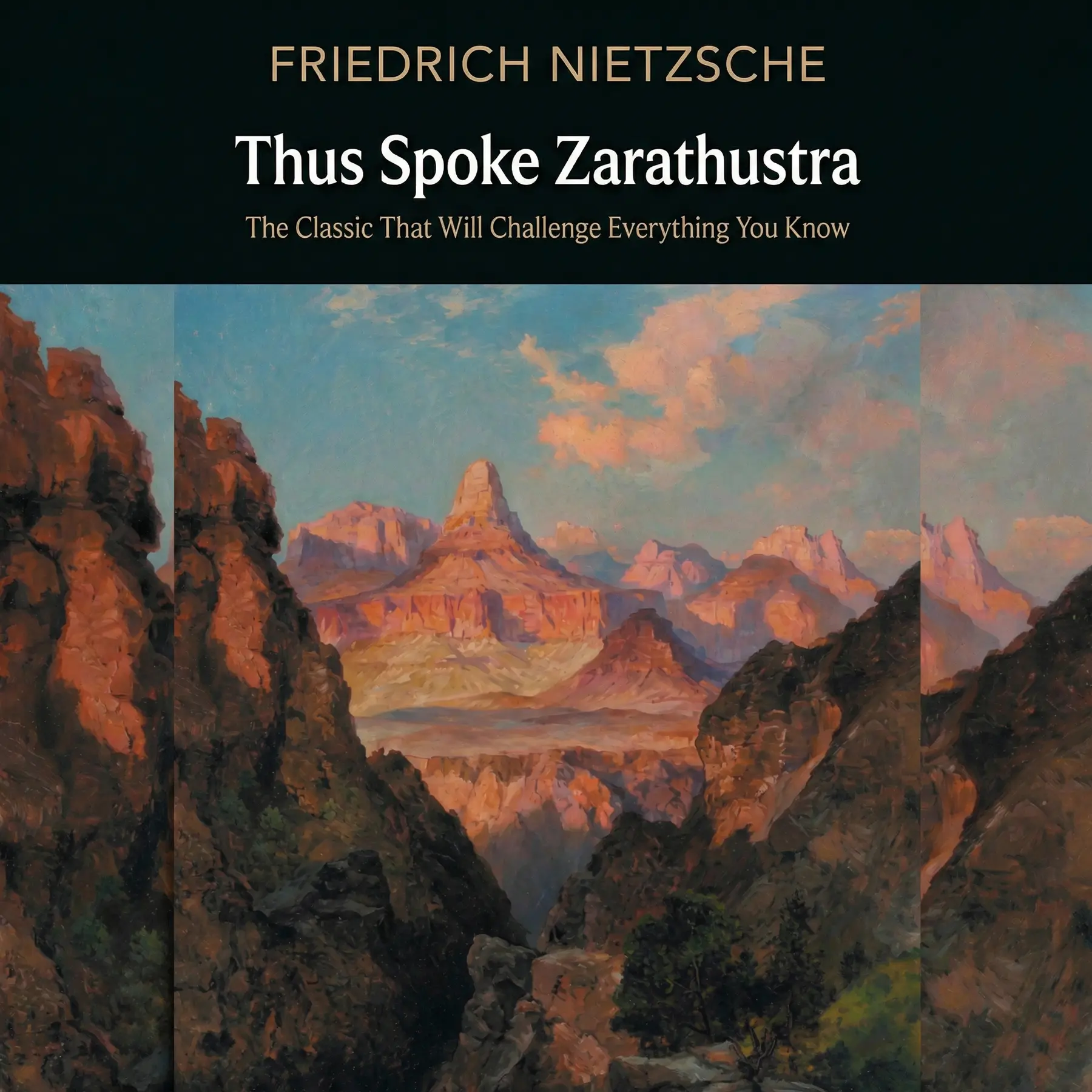
Listeners find that while perspectives differ on the text's frequently dense and cryptic language, many listeners value the book as an imaginative, sagacious, and deeply intellectual exploration of philosophy. Furthermore, they cherish the instances of genius and elegant phrasing found throughout the work, with one listener noting that the volume provides "deep insights" that make the endeavor worthwhile. Additionally, they highlight the narrative's distinct poetic organization. They also mention the demanding quality of the material, with one listener even comparing the encounter to reading James Joyce's *Ulysses*.
This book is a fever dream of philosophy that manages to be simultaneously hilarious and terrifyingly profound. Nietzsche isn't just writing a dry treatise; he’s building a whole world of symbols, from the tightrope walker to the laughing lion. While the prose can be abstruse, the core message of self-overcoming hits like a lightning bolt. It’s certainly not for everyone, as it demands your total attention and a willingness to be confused. Frankly, the sheer creativity on display here puts most modern thinkers to shame. I found myself highlighting entire pages of beautiful, rhythmic phrasing that felt more like music than text. It’s a wild, intelligent journey for anyone brave enough to climb the mountain with Zarathustra. Be prepared to feel small before you feel great.
Show moreRarely do you encounter prose that feels like it’s vibrating with its own internal energy and chaotic spirit. Nietzsche’s Zarathustra is a character for the ages, a lonely prophet shouting truths that the world isn't ready to hear. The declaration that 'God is dead' is only the beginning of a much deeper exploration into human value. I loved the way the language mimicked religious scripture while simultaneously tearing down traditional morality. It’s a wise, perceptive, and deeply creative work that defies easy categorization or summary. You might find yourself frustrated by the obscure wordplay, but the brilliance of the 'Overman' concept makes it worth the effort. This is easily one of the most intelligent and provocative books in my collection.
Show moreAfter hearing about the 'Overman' for years, reading the source material was an absolute revelation for my own philosophy. The structure is so unique—it’s part epic poem, part philosophical manifesto, and part satirical play. Nietzsche’s wordplay is incredibly clever, even in translation, and his ability to subvert biblical language is masterful. I found the animal metaphors, like the camel and the child, to be profoundly moving and easy to visualize. This isn't just a book of ideas; it’s an invitation to reinvent yourself from the ground up. Look, it’s a difficult trek, but the view from the top of Nietzsche's mountain is incomparable. I feel like a more perceptive person after finishing this journey.
Show moreThe chapter on the three metamorphoses changed how I view my own creative struggle and the nature of freedom. Nietzsche’s prose is incredibly rhythmic and beautiful, reminding me more of a symphony than a standard philosophy text. While some parts are admittedly impenetrable, the general arc of Zarathustra’s journey is surprisingly compelling. He is a teacher who doesn't want followers, which is a refreshing take on the prophet archetype. I was struck by the deep insights regarding the 'eternal recurrence' and what it means for our daily choices. It’s a book that demands to be read aloud so you can feel the weight of the words. Truly, this is one of the most intelligent and transformative things I have ever read.
Show moreFinally got around to finishing this monster and I’m still processing the sheer weight of it. Much like James Joyce’s Ulysses, this isn't a book you simply 'read'—it’s something you survive and inhabit over time. There were long chapters where I felt totally lost in a sea of obscure allusions and impenetrable metaphors. Then, suddenly, a sentence would appear that made everything click into place with startling clarity. The concept of the Übermensch is fascinating, even if the surrounding text is often a messy heap of contradictions. Truth is, Nietzsche’s tone can be quite off-putting with its constant shouting and relentless exclamation marks. Despite the difficulty, the intellectual reward of wrestling with his ideas is undeniable. It’s a beautiful, frustrating experience.
Show moreIs it possible to feel both incredibly small and vastly powerful at the same time? Reading this felt like a physical ascent, mimicking Zarathustra’s own trek up the mountain to find his solitude. The wisdom tucked between the lines of poetic prose is staggering, yet I can’t ignore how dense the second half becomes. Sometimes it feels like the author is just talking to himself in a language no one else speaks. I struggled with the blatant misogyny and the elitist dismissal of the 'rabble' throughout the text. Still, the beautiful imagery of the eagle and the serpent kept me anchored to the narrative. It’s a challenging masterpiece that requires multiple sittings to truly digest. Not for the faint of heart.
Show moreAs someone who enjoys a mental workout, Zarathustra provided the equivalent of a philosophical marathon through the high Alps. The book is wise and perceptive, but it also carries a heavy burden of spiteful blather that is hard to ignore. I appreciated the way Nietzsche challenges the reader to soar above the common herd and seek their own truth. Yet, the writing style is so arcane that it often feels like he’s trying to hide his meaning. It’s a creative and playful text, but one that demands a lot of patience and a dictionary. I suspect I will need to return to this in a few years to truly understand the allusions. It’s a flawed but undeniably brilliant piece of literature.
Show moreGotta say, the biblical parody elements really made this an entertaining, if dense, read for me. Using terms like 'Selah' and 'verily' to dismantle traditional values is a stroke of satirical genius. The book is a strange mix of profound wisdom and what can only be described as high-level intellectual trolling. I enjoyed the sections where Zarathustra wanders through the marketplace, even if the crowd's reaction is predictably depressing. It’s a long short book, as the dense phrasing makes every page feel like a mile of progress. While I didn't agree with every 'insight,' the creative energy kept me turning the pages. It’s a wild ride that I would recommend to any serious reader.
Show moreTo be fair, I think I need a degree in 19th-century German thought to fully grasp every nuance here. There are moments of absolute brilliance where Nietzsche’s insights into human nature are sharper than a razor. However, those moments are buried under what feels like a mountain of nonsensical shouting and self-serious allegories. I found myself becoming quite bewildered by the later sections involving the 'higher men' in the cave. It often felt like the plot was just a thin skeleton designed to support endless, repetitive screeds. While the writing is undeniably poetic, it can also be incredibly ungracious toward anyone Nietzsche deems 'lesser.' It’s a fascinating historical artifact, but I’m not sure I’m well-read enough to love it yet. It was simply okay.
Show moreNot what I expected from a book that is supposedly the foundation of modern individualism and thought. I found the experience largely impenetrable and, quite honestly, a bit of a slog to get through. The protagonist is constantly exclaiming at the top of his lungs, yet he rarely seems to say anything concrete. It feels like a messy heap of personal grievances wrapped in bad poetry and obscure references that mean very little today. I was particularly disappointed by the way women are treated as nothing more than cows or riddles to be solved. Perhaps it was revolutionary in 1883, but now it feels like the rambling of a very sick man. I might try his other works, but this one was a miss.
Show more
William B. Irvine
Nigel Warburton
John Rawls
Robert Nozick
Nassim Nicholas Taleb
John Milton
AUDIO SUMMARY AVAILABLE
Get the key ideas from Thus Spoke Zarathustra by Friedrich Nietzsche, plus 5,000+ more titles in English and Thai.







