

19 min 14 sec
The Consolations of Philosophy
Explore how the timeless insights of six legendary philosophers can help navigate modern challenges, from the pain of unpopularity and financial stress to the sting of heartbreak and the frustration of everyday life.
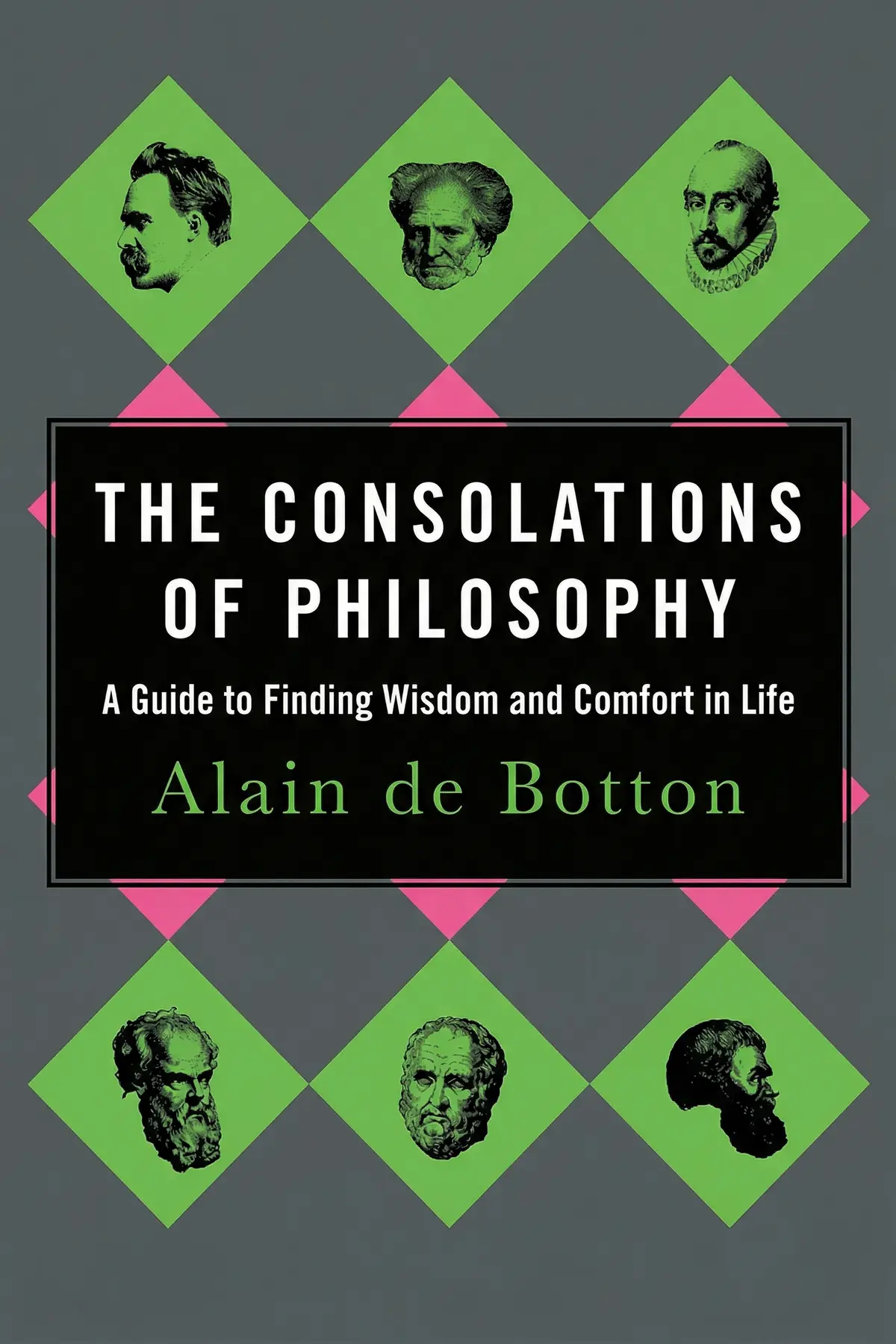
Table of Content
1. Introduction
1 min 31 sec
In the hustle of the twenty-first century, it is easy to feel that our problems are uniquely overwhelming. We grapple with the weight of social expectations, the anxiety of financial instability, the sting of romantic rejection, and the general messiness of being human. Often, we look to modern self-help or technology for answers, but Alain de Botton suggests we might find more durable comfort by looking backward.
There is a long-standing tradition of philosophy not as an abstract academic exercise, but as a practical tool for living well. This journey doesn’t require a PhD or a library of dusty tomes. Instead, it invites us to sit down with some of history’s most influential minds to see how they handled the very same obstacles we face today. From the execution of Socrates to the quiet gardens of Epicurus, the throughline is clear: human suffering can be mitigated by reason and perspective.
Over the course of this summary, we will explore five distinct ‘consolations.’ We will see how to handle the pain of being unpopular, how to redefine our relationship with money and desire, how to manage our frustrations when the world doesn’t go our way, how to accept our physical and intellectual flaws, and how to survive the inevitable wreckage of a broken heart. By the time we reach the end, you’ll see that philosophy isn’t just about asking ‘why’—it’s about learning ‘how’ to endure and even thrive amidst life’s challenges. Let’s begin by looking at a man who chose death over the comfort of a lie.
2. Standing Firm Against the Crowd
3 min 14 sec
Discover how the trial of Socrates provides a timeless blueprint for maintaining your integrity when your beliefs clash with the majority’s opinion.
3. The True Source of Contentment
3 min 16 sec
Epicurus reveals why our pursuit of luxury often misses the mark and identifies the three essential ingredients for a truly happy life.
4. Navigating the Gaps of Frustration
3 min 01 sec
Seneca’s Stoic wisdom offers a practical way to manage anger and disappointment by adjusting our expectations to match an unpredictable world.
5. The Acceptance of Our Human Nature
3 min 08 sec
Montaigne encourages us to stop striving for an impossible ideal and instead find peace in the messy, physical reality of being human.
6. Finding Meaning in the Pain of Love
3 min 17 sec
Arthur Schopenhauer offers a unique perspective on heartbreak, framing romantic suffering not as a personal failure but as a biological inevitability.
7. Conclusion
1 min 47 sec
As we reflect on the journeys of these five thinkers, a powerful picture of resilience begins to emerge. Philosophy is often portrayed as a cold and distant discipline, but as Alain de Botton demonstrates, it is actually one of the most intimate and supportive companions we can have. Whether we are facing the public shame of Socrates, the material anxieties of Epicurus, the frustrations of Seneca, the bodily embarrassments of Montaigne, or the romantic despair of Schopenhauer, we find that we are never truly alone in our struggles.
The throughline of these consolations is the power of the mind to reshape our experience of reality. We may not be able to change the fact that people will judge us, that money will be tight, or that hearts will break. However, we have absolute authority over how we interpret these events. We can choose to view a setback not as a catastrophe, but as an expected part of the human ‘cart’ we are tied to. We can choose to value our own logical conclusions over the noisy opinions of the crowd. We can choose to find joy in a simple piece of bread and the conversation of a true friend.
The most important takeaway is that wisdom is not about reaching a state of perfection where nothing hurts. It is about building a toolkit of ideas that allows us to navigate the hurt with grace and perspective. The next time you feel overwhelmed by the demands of modern life, remember that you have a council of some of the greatest minds in history waiting to offer their advice. Their voices are a reminder that while life is often difficult, it is also deeply meaningful, and that comfort is always available to those who are willing to think their way toward it. Take these consolations with you, and let them be the steady hand that guides you through the complexities of the human journey.
About this book
What is this book about?
Have you ever felt like the world was against you, or that happiness was just out of reach? This summary explores Alain de Botton’s journey through the history of thought, finding practical solutions to human suffering in the works of great thinkers. By examining the lives and theories of Socrates, Epicurus, Seneca, Montaigne, and Schopenhauer, we learn that our modern struggles are not new. The book promises a transition from seeing philosophy as a dry, academic subject to viewing it as a warm, comforting guide for the soul. Whether you are dealing with a lack of money, a broken heart, or the feeling that you don’t fit in, these philosophical consolations offer a roadmap to resilience and perspective. It is an invitation to use the wisdom of the past to build a more tranquil present.
Book Information
About the Author
Alain de Botton
Alain de Botton is a British philosopher and author known for making complex intellectual subjects accessible to a wide audience. He is the founder of The School of Life, an organization dedicated to emotional education. His literary career includes several bestselling books such as The Architecture of Happiness and Essays in Love, which explore the intersections of daily life and high culture.
How Proust Can Change Your Life
Alain de Botton
How to Think More About Sex
Alain de Botton

Status Anxiety
Alain de Botton

The Architecture of Happiness
Alain de Botton

The Art of Travel
Alain de Botton
The News: A User's Manual
Alain de Botton
The School of Life: An Emotional Education
Alain de Botton
Ratings & Reviews
Ratings at a glance
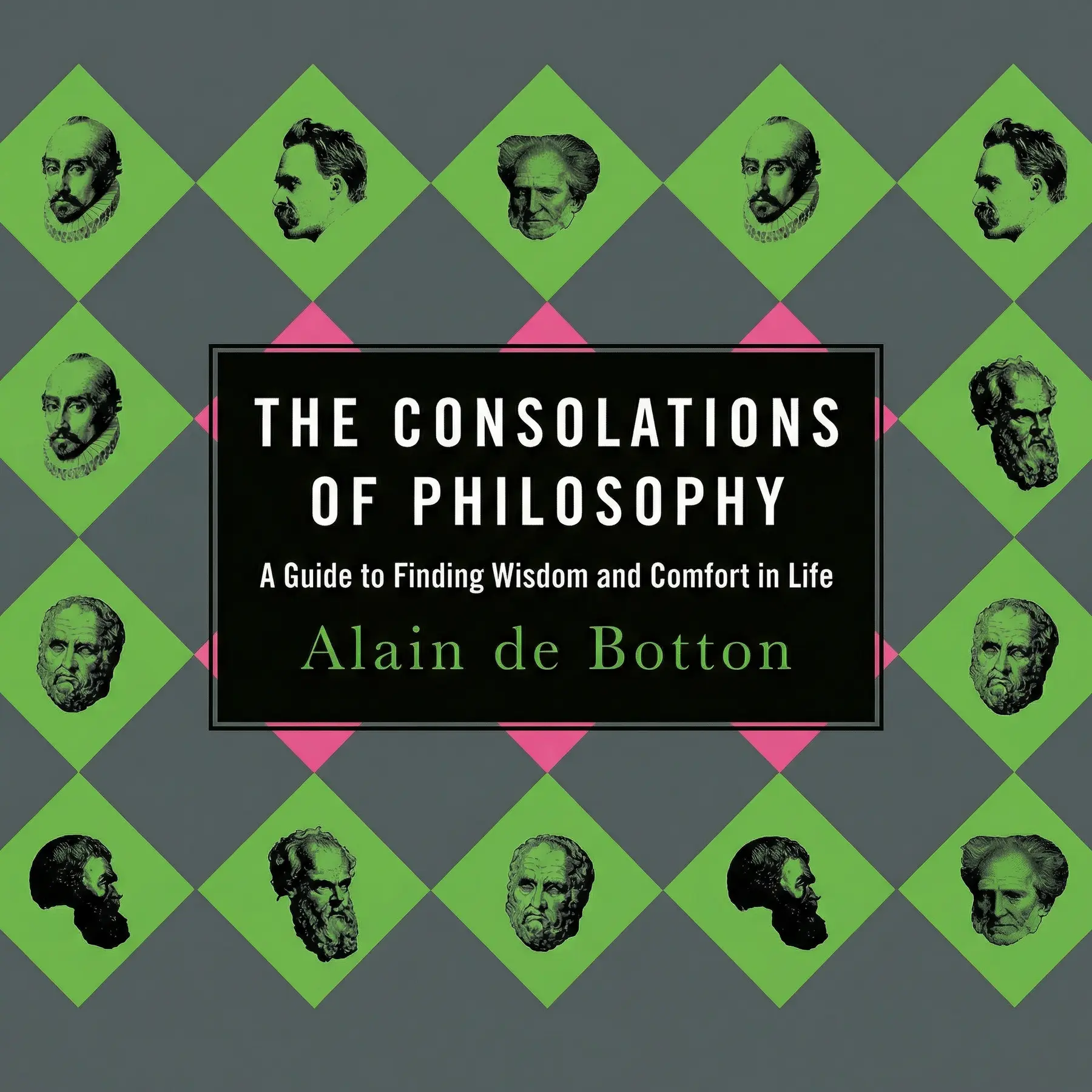
What people think
Listeners find this philosophical work both educational and captivating, serving as a superb primer for the field. Furthermore, the prose is elegant, and listeners enjoy its wit and straightforwardness. They also prize the book's stimulating material, with one listener highlighting how it presents intelligent responses to various philosophical concepts. Listeners further value its soothing quality, as one describes how it addresses areas that commonly inhibit peace of mind.
Top reviews
Adam
Picked this up during a particularly rough patch when my bank account was looking grim and my stress levels were through the roof. Frankly, I wasn't expecting a book about dead guys to actually help, but De Botton’s exploration of Seneca and the "consolation for frustration" was exactly what I needed. The writing is incredibly smooth and easy to digest, which is a relief because most philosophy books make my head spin. While some might find it a bit simplistic, the way he applies ancient wisdom to modern anxieties like lack of money is genuinely brilliant. It’s more of a warm hug than a lecture, and sometimes that is exactly what a modern reader needs. I also really loved the quirky illustrations included throughout the text.
Show morePruet
Wow, I did not expect to actually feel a sense of relief after reading a chapter on Schopenhauer and broken hearts. Most people view philosophy as this "out of reach" subject for the elite, but this book completely dismantles that elitism. De Botton’s prose is beautiful and effortless, making it possible to read a few pages on a noisy train without losing the thread of the argument. Not gonna lie, I was worried it would be another dry history lesson, but it is actually a very practical manual for staying sane. It manages to be comforting without being cloying, which is a rare balance to strike in any book. Truly an eye-opening joy for anyone dealing with the miasma of modern life.
Show moreAroon
The chapter on Nietzsche was an absolute revelation for me and changed how I view my own personal difficulties. De Botton argues that we should not shy away from hardship, but rather see it as a necessary step toward something greater. The book is filled with these kinds of intelligent responses to life’s most persistent problems, from financial lack to unrequited love. I loved the way the author uses concrete examples and historical anecdotes to bring the philosophy to life. It is an incredibly comforting read that does not feel like it is pandering to the reader at all. Even if you have never picked up a philosophy book before, you will find something of immense value here.
Show moreDarius
De Botton has a rare gift for making the "untouchable" giants of intellectual history feel like empathetic, wise friends who understand our modern woes. This book is not just a collection of facts; it is a beautiful, humorous, and deeply human guide to finding peace in a chaotic world. I was struck by how relevant the struggles of Socrates or Montaigne remain in the twenty-first century. The simplicity of the prose is its greatest strength, allowing the profound truths to shine through without being obscured by jargon. It is a work that encourages you to pause and think about your place in the universe with a renewed sense of calm. This is easily one of the most helpful books I have ever owned.
Show moreMats
This book acts as a fantastic bridge between dense intellectual theory and the messy reality of everyday life. I especially appreciated how the author structured the chapters around specific human struggles like inadequacy and unpopularity. Using Socrates to explain why we should not fear being disliked was a masterstroke that actually changed my perspective on social anxiety. The humor sprinkled throughout keeps the tone from feeling too heavy or pretentious, which is a common pitfall in this genre. My only minor gripe is that some sections felt a little repetitive, but the overall experience was deeply rewarding. It is an accessible, thought-provoking read that I have already recommended to several friends who feel stuck.
Show moreWanida
Ever wonder why we get so worked up over the smallest frustrations or the fear of being misunderstood by our peers? This book tackles those exact anxieties by looking through the lenses of men like Seneca and Montaigne. I found the chapter on inadequacy particularly enlightening, as it makes these "great" thinkers feel surprisingly human and relatable. The style is clear and approachable, steering far away from the tedious and boring vibe of a standard college textbook. To be fair, the author does simplify some of the more complex theories to make them fit a moral lesson. However, for a layperson just looking for a bit of mental peace, that is a small price to pay for such an engaging read.
Show moreWoramet
Finally got around to reading this after stumbling upon the author’s old television series on the same topic. Just like the show, the book is absorbing and fast-paced, managing to deconstruct big ideas into their essential, usable parts. I read most of it while commuting, and the clear structure made it easy to pick up and put down amid the chaos of the city. While it is definitely a popular text rather than a scholarly one, that is exactly what makes it so useful for the average person. Some of the sections on Schopenhauer were a bit grim, but the humor elsewhere helps balance the mood. It is a manageable, light reading that provides genuine intellectual enlightenment without the usual headache.
Show moreWit
As someone who spent four years in university wrestling with Kant and Hegel, I went into this with a healthy dose of skepticism. To be fair, De Botton does a decent job of distilling complex ideas into bite-sized pieces, but he definitely strips away the nuance. It feels more like a collection of life lessons than a rigorous academic study of the six thinkers involved. The chapter on Montaigne was charming, yet I couldn't help but feel that Nietzsche’s darker edges were sanded down for the sake of palatability. It is a great entry point for a beginner, but if you are looking for deep analysis, you will find it thin. It works as a self-help tool, even if the philosophy is a bit watered-down.
Show moreHassan
Personally, I found the tone of this work to be a little bit too whimsical for the subject matter at hand. While I appreciate the attempt to make philosophy accessible, at times it felt like the author was trying too hard to be clever. That being said, the book does serve as an excellent introduction for those who find traditional philosophy classes to be a total drag. The connection between Epicurus and our modern obsession with consumerism was particularly thought-provoking and made me rethink my own spending habits. It is a decent enough read, but I wish it had delved just a little bit deeper into the actual arguments. It is good for a quick mental reset, but do not expect a masterclass.
Show moreAom
Look, if you are looking for a rigorous, heavyweight examination of philosophical thought, this is definitely not the text for you. It reads remarkably like a self-help book that happened to find a few relevant quotes from Epicurus to justify its existence. The truth is, it feels a bit like "airport philosophy" designed for quick consumption and immediate forgetting once you land. De Botton’s tone can be somewhat precious, and he often ignores the more complex, contradictory parts of these thinkers’ lives to fit his narrative. It is not that it is poorly written, because it is actually quite elegant, but it just lacks the intellectual depth I was craving. It is philosophy-lite for the masses, which is fine, but it did not land for me.
Show moreReaders also enjoyed
A Guide to the Good Life: The Ancient Art of Stoic Joy
William B. Irvine
A Little History of Philosophy
Nigel Warburton
A Theory of Justice
John Rawls

Anarchy, State, and Utopia
Robert Nozick

Antifragile: Things That Gain from Disorder
Nassim Nicholas Taleb
Areopagitica: Philosophy)
John Milton
AUDIO SUMMARY AVAILABLE
Listen to The Consolations of Philosophy in 15 minutes
Get the key ideas from The Consolations of Philosophy by Alain de Botton, plus 5,000+ more titles in English and Thai.
- 5,000+ titles
- Listen as much as you want
- 7-day free trial
- Cancel anytime







