
How Proust Can Change Your Life
Alain de Botton
Great Thinkers offers a curated journey through the most transformative ideas in human history, demonstrating how ancient philosophy, economic theory, and psychological insights can solve contemporary emotional and social challenges.
2 min 17 sec
In our modern era, we often congratulate ourselves on how far we’ve come. We live in an age of staggering technological breakthroughs, where we can map the human genome, split the atom, and communicate across the globe in a heartbeat. It’s easy to fall into the trap of thinking that because we have more data and better tools than our ancestors, we must also be wiser. We assume that the thinkers of the ancient world or the medieval period are mere curiosities—intellectual relics that have been superseded by the cold, hard facts of contemporary science and economics. But if we pause for a moment, we realize that for all our gadgets and advanced physics, we are still plagued by the very same problems that kept people awake at night two thousand years ago. We still struggle with the paralyzing grip of anxiety. We still wonder how to find work that actually feels meaningful. We still grapple with the messiness of love, the sting of rejection, and the search for a sense of belonging in our communities. These are not technical problems; they are human problems.
This is where Great Thinkers enters the conversation. Instead of looking forward to the next software update, it invites us to look backward to the intellectual giants who spent their lives dissecting the human condition. This isn’t a dry history lesson. Rather, it’s a toolkit for the modern soul. It suggests that by engaging with the ideas of the past, we can gain the emotional intelligence we so desperately need today. In the following segments, we’re going to explore a vast landscape of thought. We’ll see how Roman Stoics can calm our modern panic, how an 18th-century economist can help us understand why our jobs feel hollow, and how a 20th-century anthropologist can change our perspective on identity and desire. We’ll learn why going with the flow is more than just a cliché and how the structure of our cities dictates the depth of our relationships. By the end of this journey, the throughline will be clear: wisdom isn’t about knowing more facts; it’s about knowing how to live well. Let’s begin by looking at how some of history’s most resilient minds taught us to handle the inevitable storms of life.
3 min 07 sec
What if your greatest fears held the key to your peace of mind? Discover how ancient Roman wisdom teaches us to confront catastrophe to find calm.
2 min 41 sec
Explore the medieval insights that allowed science and faith to live in harmony, offering a surprising lesson in intellectual humility for our secular age.
3 min 01 sec
Adam Smith is often called the father of capitalism, but his true vision included a deep concern for the human soul and social well-being.
3 min 03 sec
Discover why the ancient Chinese philosophy of Taoism suggests that our obsession with productivity is actually getting in the way of a sweet life.
2 min 50 sec
Explore how Margaret Mead’s groundbreaking study of remote tribes challenged everything the West believed about gender, sex, and teenage rebellion.
2 min 55 sec
Sigmund Freud’s theories of childhood and the ‘pleasure principle’ reveal why we often repeat the same self-sabotaging patterns in adulthood.
2 min 54 sec
Jane Jacobs fought for the ‘soul’ of our neighborhoods, arguing that the best cities aren’t built for cars or skyscrapers, but for human connection.
2 min 47 sec
Jane Austen’s novels are more than just period romances; they are moral guides that teach us why the best partners are the ones who help us grow.
2 min 04 sec
As we reflect on the vast array of wisdom we’ve explored, a single, powerful theme emerges: the tools for a better life have been with us all along. We’ve seen that the ancient Stoics offer a roadmap for navigating modern anxiety by teaching us to face our fears and accept the whims of fate. We’ve learned from Thomas Aquinas that an open, curious mind can bridge the gap between our scientific world and our deepest human mysteries. We’ve discovered that even the father of capitalism, Adam Smith, was deeply concerned with the human need for meaning and social support. From the quiet gardens of Lao Tzu to the bustling streets of Jane Jacobs, and from the psychological insights of Sigmund Freud to the moral classrooms of Jane Austen’s drawing rooms, the message is consistent: our happiness depends on our emotional intelligence and our willingness to learn from the past.
These great thinkers remind us that we are part of a long, ongoing conversation about what it means to be human. When we feel lost, overwhelmed, or alienated, we don’t have to reinvent the wheel. We can reach back across the centuries and find a companion who has felt what we feel and thought what we think. The ultimate ‘actionable advice’ from this journey is to cultivate a sense of intellectual humility. When you feel small or your problems feel insurmountable, follow the Stoic practice: go outside and look at the stars. Remember that you are a tiny part of a vast, ancient universe, and that your current struggle is just one chapter in a much larger story. Take the time to be still, like the Taoists suggest, and listen to the wisdom that only comes when the noise of the world fades away. By integrating these time-tested ideas into our modern lives, we don’t just become smarter; we become more resilient, more compassionate, and ultimately, more fulfilled. The past is not behind us; it is beneath us, providing the solid ground upon which we can build a truly great life.
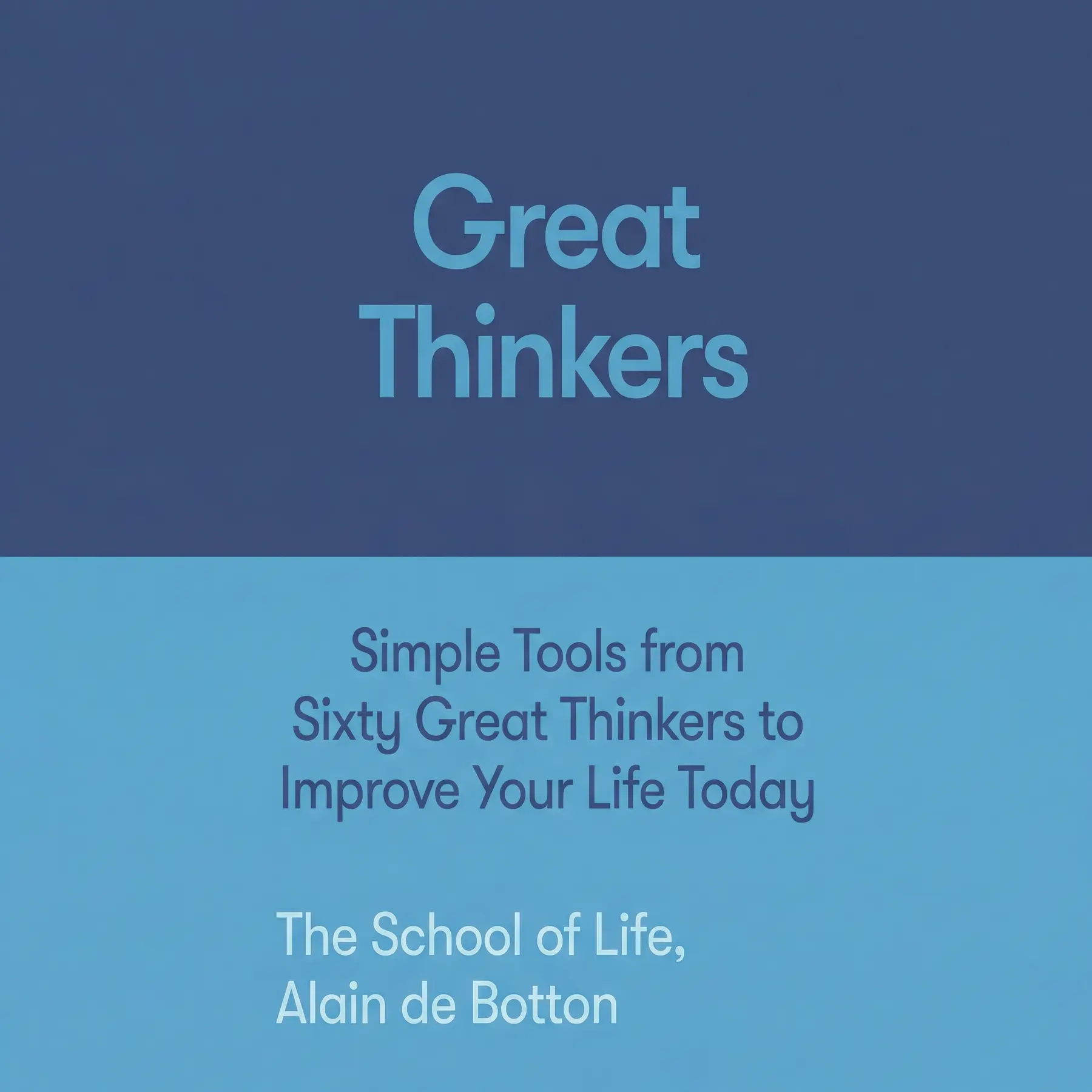
Great Thinkers serves as a bridge between the profound wisdom of the past and the complexities of modern existence. Produced by The School of Life, this guide distills the work of sixty monumental figures—from Stoic philosophers to modern urbanists—to provide practical tools for living a more fulfilled and emotionally intelligent life. The book promises that the humanities are not merely academic relics but essential resources for self-improvement. It explores how we can navigate anxiety, find meaning in our work, build better communities, and understand the deep-seated roots of our own behaviors by listening to the voices that shaped civilization.
The School of Life is a global organization dedicated to fostering emotional intelligence and cultural wisdom. With hubs in major cities like London, Amsterdam, and Seoul, they offer classes, films, and therapy to help people navigate the challenges of daily life. Alain de Botton is a renowned author whose works, including The Architecture of Happiness and How Proust Can Change Your Life, focus on applying philosophical and intellectual curiosity to the pursuit of a better way of living.
Alain de Botton
Sara Maitland
Alain de Botton

Alain de Botton
Alain de Botton
Alain de Botton
Alain de Botton
Alain de Botton
Alain de Botton
Listeners find the text educational and approachable, with one review noting how it quickly exposes readers to new ways of thinking. Furthermore, the prose is skillfully composed, and listeners appreciate the book's entertainment value. They also value the information provided; one listener highlights the wonderful selection of historical figures who changed the world, while another mentions how it inspires deeper life reflection.
Finally got around to finishing this massive collection, and it’s genuinely changed how I view my morning commute. The School of Life has a knack for taking these heavy, dusty concepts and making them feel like practical tools for modern sanity. I appreciated how it didn't just stick to the standard philosophers but branched out into artists and architects who shaped our world. While some might find the lack of academic citations frustrating, I found the conversational tone quite refreshing for a change. It’s an educational buffet that encourages you to reflect on your own life choices through the lens of history’s greatest minds. You don't need a PhD to grasp the core insights here, which is exactly why it works so well. Personally, I think every household should have a copy of this on the shelf for those days when life feels a bit too chaotic.
Show moreThis book acts as a perfect gateway drug for anyone intimidated by the 'Greats' or those who don't want to slog through Hegel. I’ve always wanted to understand the big ideas that moved humanity, but original texts can be dense and frankly impenetrable to the casual reader. Alain de Botton and his team have distilled these complex theories into bite-sized, entertaining chapters that prioritize emotional intelligence over dry, academic logic. The writing is incredibly well-crafted, making even the more nihilistic sections feel strangely comforting rather than depressing. It’s the kind of book you can dip into for ten minutes and walk away with a completely new perspective on your relationships or career. Every entry feels like a quick conversation with a very wise, albeit slightly patronizing, friend who just wants you to be happy.
Show moreAs someone who struggled with philosophy in college, this was a breath of fresh air that I didn't know I needed. Instead of focusing on abstract epistemology, the authors focus on how these thinkers can help us live better, more fulfilled lives today. The selection of figures is impressive, spanning centuries and disciplines to provide a holistic view of human wisdom. Truth is, I spent more time reflecting on my own character while reading this than I have in years of expensive therapy. It’s highly educational but maintains an entertainment value that keeps you turning the pages late into the night. Some might argue the language is a bit watered down, but for the average reader, it’s a masterclass in clarity. This is the manual for adulthood I wish I had been given a decade ago.
Show moreWow, what a comprehensive yet accessible journey through the history of human thought! I was worried that sixty different profiles would feel rushed, but each one is carefully distilled to its most potent essence. The writing is exceptionally well-crafted, managing to be both intellectual and deeply relatable at the same time. It’s rare to find a book that functions as both a reference guide and an inspirational companion for daily life. Look, you might not agree with every 'great thinker' included, but the exposure to such a variety of worldviews is invaluable. It’s an educational powerhouse that doesn’t feel like work, making it perfect for casual readers and history buffs alike. I found myself highlighting passages on almost every page because the insights were just that sharp and applicable.
Show morePicked this up on a whim and ended up finishing it in three sittings because I couldn't put it down. Not gonna lie, I expected it to be a bit dry, but the entertainment value is surprisingly high for a book about dead philosophers. It’s educational in a way that feels like a series of 'aha!' moments rather than a lecture from a podium. The book quickly exposes readers to new ways of thinking about mundane problems like work, love, and social status. It’s an essential addition to any library if you’re looking for a broad canon of ideas to draw from. While it glosses over the more technical aspects of logic and metaphysics, it succeeds wildly at its core mission. This is exactly the kind of writing we need to make high-level thought more inclusive and useful for everyone.
Show moreThe chapter on Epicurus alone made the entire purchase worthwhile for me. I love how the book bridges the gap between ancient wisdom and contemporary struggles like consumerism and anxiety. To be fair, the collection is heavily skewed toward male thinkers, which feels like a missed opportunity given the rich history of female intellect. However, the quality of the prose and the way it exposes you to radical new ways of thinking is undeniable. It's a beautifully designed volume that looks great on a coffee table and even better in your hands. I did find the lack of sources a bit annoying when I wanted to dig deeper into a specific quote. Still, it’s a solid introduction that serves its purpose of enhancing emotional intelligence without being too academic or boring.
Show moreEver wonder why certain ideas stick around for centuries while others fade away? This book explores that question by focusing on the 'therapeutic' value of philosophy, which is a hallmark of The School of Life's approach. In my experience, most introductory texts are either so dense that they become impenetrable to the layperson or so shallow that they lose the core of the message, but this hits a comfortable middle ground. The language is definitely more colloquial than your average textbook, which helps demystify figures like Nietzsche or Stendhal for the modern reader. I will say that the normative undertone can be a bit thick at times, as if the authors are projecting their own values onto the subjects. Despite that, the selection of historical figures who changed the world is quite wonderful and thought-provoking.
Show moreAfter hearing so much about Alain de Botton, I finally decided to dive into this collection of historical figures. It’s a wonderful selection that spans from the Stoics to modern architects, showing how ideas manifest in all areas of culture. The book is designed to inspire deeper life reflection, and it certainly achieved that for me during several late-night reading sessions. Gotta say, the way they summarize complex worldviews into a few pages is a feat of editorial skill. My only real gripe is that it can feel a bit repetitive if you read too many chapters at once. However, as a daily devotional for the mind, it’s hard to beat the clarity and wisdom found here. It truly exposes you to new ways of thinking about your own place in the grand scheme of things without requiring a degree.
Show moreHonestly, I wish I had discovered this book years ago when I was first starting to question things about life and purpose. It’s a brilliantly well-crafted guide that makes the most profound thoughts in history feel accessible and, more importantly, useful for navigating the complexities of modern work, love, and our own inner anxieties. The School of Life has created something that is both educational and fun, which is a rare combination in the world of non-fiction. Each chapter is short enough to read over coffee, but the ideas stay with you long after you’ve closed the cover. I appreciated the humanistic values throughout, even if the tone occasionally felt a little paternalistic or overly simplistic. It’s a great starting point for anyone looking to broaden their intellectual horizons without getting bogged down in academic jargon.
Show moreNot what I expected from a book titled 'Great Thinkers' in the 21st century, frankly. While the writing itself is well-crafted and easy to read, the selection feels incredibly dated and lacks the diversity I was hoping for. Out of sixty thinkers, the vast majority are men from the Western canon, which ignores so many crucial voices from other backgrounds. I also felt that the book was a bit too enamored with nihilism and the inherent meaninglessness of existence. It’s educational to a point, but the 'watered down' language occasionally strips the original ideas of their actual power and nuance. If you want a very basic, casual introduction, this might suffice, but serious students of philosophy will find it patronizing. It’s a mixed bag that prioritizes a specific brand of emotional intelligence over rigorous intellectual history.
Show more
Nigel Warburton
John Rawls
Richard Wiseman
AUDIO SUMMARY AVAILABLE
Get the key ideas from Great Thinkers by The School of Life, plus 5,000+ more titles in English and Thai.







