
15 min 49 sec
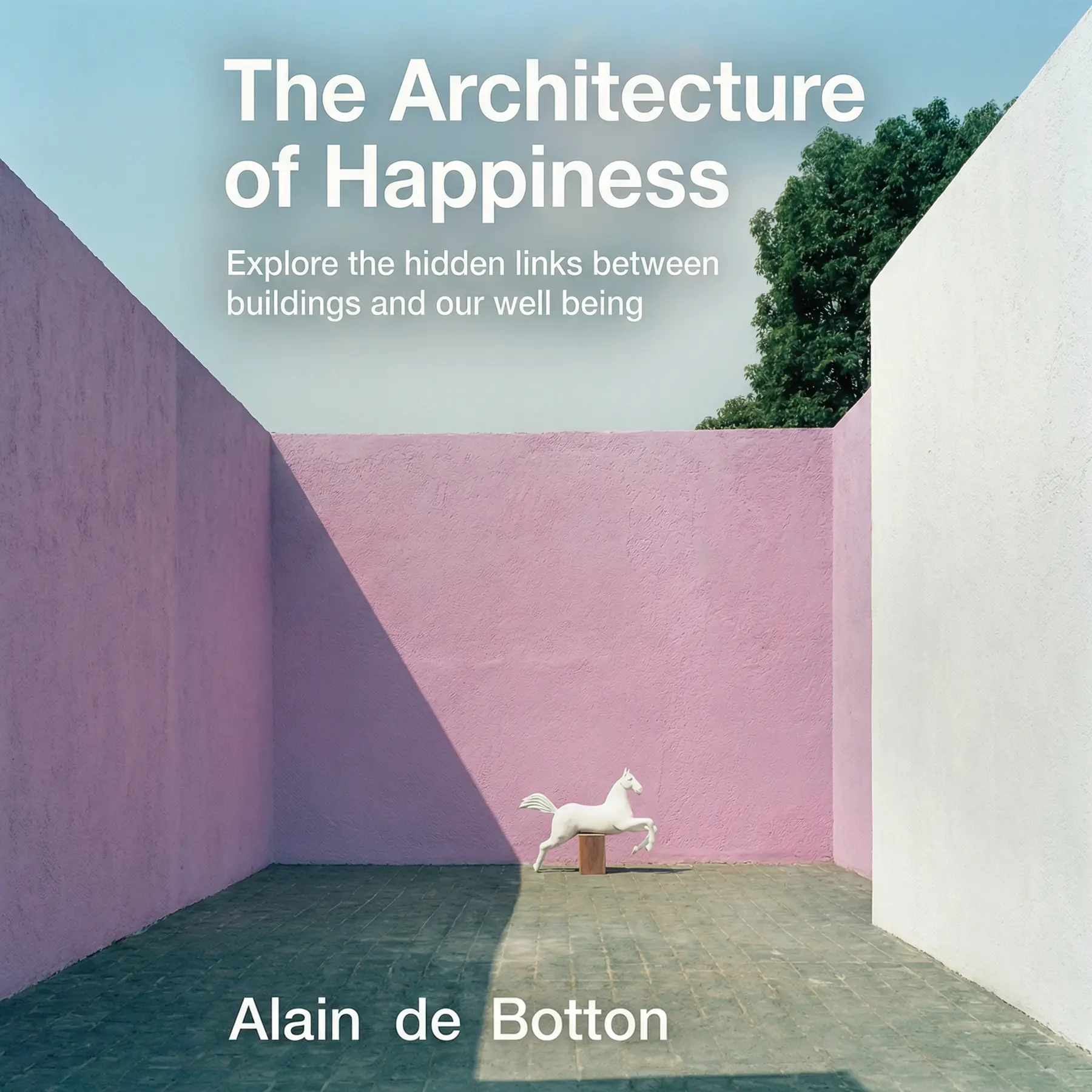
The Architecture of Happiness
Explore how the physical structures around us shape our inner emotional landscape. This summary reveals the profound connection between architectural design, human psychology, and our collective search for happiness and well-being.
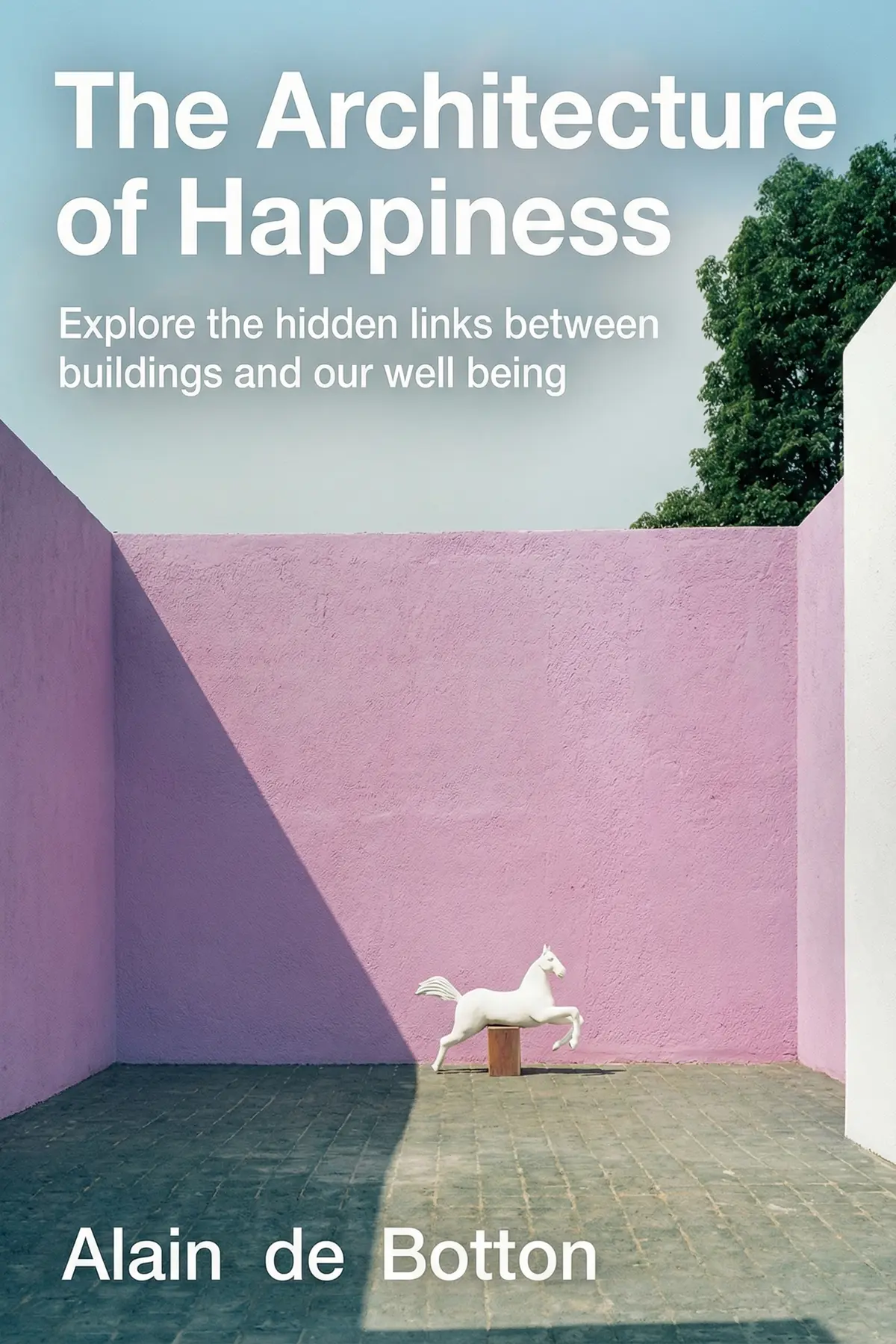
Table of Content
1. Introduction
1 min 27 sec
Have you ever walked into a room and felt an immediate, inexplicable sense of calm? Or perhaps you’ve stepped into a vast, cold building and felt a sudden wave of insignificance or unease. We often think of architecture as the background noise of our lives—the walls that keep us dry and the floors that keep us level. But there is a much deeper story happening in the spaces we occupy. In truth, we are place-dependent creatures. Our internal moods are constantly being negotiated by the external structures surrounding us.
In this exploration of our built environment, we are looking at the profound idea that beauty in architecture is not just a matter of taste, but a matter of well-being. Since the very first monuments were raised in ancient Egypt or the legendary structures of Babylon, humans have treated building as an art form. But why does that art matter so much? Why do we care if a column is Corinthian or if a window is Gothic?
The throughline of this journey is the understanding that buildings speak. They communicate values, they remind us of our history, and they even try to coax us into becoming better versions of ourselves. We aren’t just looking at blueprints; we are looking at a mirror of the human soul. By the end of this, you will see your home, your office, and your city through a completely different lens—one that recognizes the silent power of design to shape your happiness.
2. The Changing Definition of Architectural Beauty
2 min 00 sec
Why did we stop building like the Greeks? Explore how the rules of beauty have shifted from classical symmetry to the raw efficiency of the industrial age.
3. How Buildings Speak to Our Values
1 min 50 sec
Every object in your home is telling a story. Discover how the furniture and structures we choose reflect our deepest psychological and moral beliefs.
4. The Power of Human Association and Memory
1 min 28 sec
Architecture isn’t just about stone and steel; it’s about the people and moments they evoke. Learn why your past dictates your taste in buildings.
5. Architecture as a Catalyst for Personality
1 min 29 sec
Can a room actually change who you are? Explore how the right environment can unlock hidden parts of your character and mood.
6. Designing to Correct Our Internal Flaws
1 min 37 sec
We don’t always build what we are; we build what we lack. Discover how our surroundings can act as a corrective for our psychological imbalances.
7. The Essential Balance of Order and Complexity
1 min 32 sec
Too much order is boring, but too much chaos is frightening. Learn how the best architecture finds the ‘sweet spot’ between the two.
8. The Elegance of Effortless Design
1 min 37 sec
What makes a skyscraper or a bridge look ‘elegant’? It’s all about making the impossible look easy and the complex look coherent.
9. Respecting the Quirks of Human Nature
1 min 28 sec
Pure logic doesn’t always lead to happiness. Discover why the most ‘rational’ cities can sometimes be the most miserable to live in.
10. Conclusion
1 min 21 sec
As we’ve seen, the buildings we inhabit are much more than piles of brick and mortar. They are the physical guardians of our moods and the silent narrators of our values. From the ancient temples of the classical era to the sleek, functional machines of the modern world, architecture has always been our way of trying to pin down what we mean by ‘the good life.’
We’ve learned that our taste in beauty is deeply personal, rooted in our memories and our psychological needs. We look to buildings to compensate for our flaws and to remind us of who we want to be. When we find a space that balances order with complexity and elegance with human sensitivity, we don’t just feel comfortable—we feel a sense of happiness.
The final message is a call to pay attention. Look around your own home or your neighborhood. What are your walls saying to you? Do they reflect the person you are, or the person you hope to become? We should dare to care about our surroundings and move away from the dull, repetitive designs that often dominate our modern landscape. By creating and demanding architecture that is both beautiful and intelligent, we aren’t just improving our streets; we are improving our lives. Remember, your environment is the stage upon which your life unfolds—make sure it’s a stage worthy of the story you want to tell.
About this book
What is this book about?
The Architecture of Happiness examines the silent yet powerful conversation between the buildings we inhabit and the emotions we feel. Rather than viewing architecture as a mere matter of utility or historical record, this exploration treats it as a reflection of our deepest values and aspirations. It asks why we find certain structures beautiful and others repulsive, suggesting that our aesthetic preferences are closely tied to the psychological qualities we lack or admire. The book promises a new way of seeing the world around you. By understanding the language of design—from the curve of a window frame to the height of a ceiling—you can begin to create environments that nurture your best self. It moves through the history of styles, the psychology of memory, and the importance of balance, ultimately arguing that beautiful architecture is not a luxury, but a vital component of a fulfilled life.
Book Information
About the Author
Alain de Botton
Alain de Botton is a Swiss-born author and television presenter currently based in London. He achieved literary success at the young age of 23 with his first book, Essays in Love. Beyond his writing, de Botton is deeply committed to emotional education; in 2008, he co-founded the School of Life, an organization that focuses on helping people navigate the complexities of work and relationships.
How Proust Can Change Your Life
Alain de Botton
How to Think More About Sex
Alain de Botton

Status Anxiety
Alain de Botton

The Art of Travel
Alain de Botton
The Consolations of Philosophy
Alain de Botton
The News: A User's Manual
Alain de Botton
The School of Life: An Emotional Education
Alain de Botton
Ratings & Reviews
Ratings at a glance
What people think
Listeners find this work charming and elegantly composed, emphasizing its particular worth for those in the design and architecture professions. Furthermore, they value the way it examines building design from an external viewpoint, with one listener noting that it has changed their perception of the structures around them. The text is also intellectually stimulating; one review specifically points out the deep dive into the principles of Japanese aesthetics, while listeners appreciate the perfectly balanced historical background. They additionally commend its stunning visual layout and regard it as essential material for anyone in the architectural field.
Top reviews
Joy
This book should be required reading for every aspiring architect and designer working today. It moves beyond the 'how' of building and dives deep into the 'why,' specifically the philosophy that beauty is a promise of happiness. I was particularly captivated by the chapter on Japanese aesthetics and the discussion of how we find order in the midst of nature’s inevitable chaos. The physical presentation of the book is also stunning, with photos that perfectly illustrate his points about elegance and restraint. De Botton has a gift for taking complex architectural theories and making them feel like common sense. In my experience, very few books manage to be this intellectually stimulating while remaining so genuinely enjoyable to read on a Sunday afternoon. It makes you realize that the walls around us are constantly speaking; we just need to learn how to listen.
Show moreGame
In my experience, it is rare to find a writer who can bridge the gap between high philosophy and everyday life as seamlessly as Alain de Botton. I’ve been looking at buildings differently for weeks now, noticing the 'honesty' of materials and the 'arrogance' of certain facades. The book functions as a brilliant architecture primer for the layperson, providing just the right amount of historical context without becoming a textbook. I loved the section discussing how our homes are meant to be 'receptacles' for our identities, holding onto the people we want to be even when we forget. The prose is almost musical, with long, flowing sentences that perfectly mirror the grace of the structures he admires. It is a work of great sensitivity and intelligence. Truly, it's a masterpiece for anyone who believes that our physical surroundings have a direct impact on our souls.
Show moreIce
Passing a building on the way to work used to be a mundane act, but after this book, it’s an exercise in observation and empathy. De Botton argues that architecture is an art that mediates between the body and the earth, and he does so with such poetic conviction that it's hard not to be swept away. I loved the discussion on how 'ugliness' is often just a symptom of a lack of care or a misunderstanding of human needs. The historical context provided is just enough to be informative without being overwhelming for a non-architect. Look, this isn't a manual on how to build a house, but it is a manual on how to live in one. It’s thought-provoking, beautifully written, and ultimately very hopeful about the human capacity to create something lasting and meaningful. A must-read for anyone who cares about the intersection of art and daily life.
Show moreAraya
Picked this up after seeing it on a friend's coffee table, and I must say it has fundamentally changed how I walk through my own neighborhood. Alain de Botton explores the psychological connection between our environment and our inner state with such grace that you almost forget you’re reading a philosophy book. He posits that architecture is not just about shelter, but a physical manifestation of our aspirations and virtues. While his tone can occasionally lean into a specific type of upper-class pessimism, his insights into how a simple window placement can act as a 'guardian of a mood' are truly profound. The prose is elegant and rhythmic, making even the most technical discussions about neoclassical symmetry feel accessible. It’s a delightful read for anyone who has ever felt a strange, inexplicable joy while standing in a specific room.
Show moreNit
To be fair, I went into this expecting a dry history of columns and arches, but I was pleasantly surprised by the emotional depth of the text. De Botton argues that we seek in our buildings the qualities we lack in our own lives, which is a hauntingly beautiful idea. If we are chaotic, we crave the rigid geometry of a Parisian street; if we are repressed, we might long for the whimsical curves of the Baroque. The way he references Stendhal’s views on beauty adds a rich layer of literary context that you don't usually find in design books. My only real gripe is the occasional streak of elitism that colors his descriptions of 'ugly' modern suburbs. However, his ability to articulate the sadness of a poorly designed space is unmatched. It’s a thought-provoking journey that will make you look at your own office’s cinderblock walls with a mix of new understanding and slight despair.
Show moreAroon
The way the author explores the 'psychology' of a chair or a lamp is honestly fascinating. It’s not just about what looks good; it’s about what a piece of furniture says about human character and our desire for stability. I found the section on the 'logic' of beauty particularly helpful in understanding why I’m drawn to certain minimalist designs over others. De Botton writes with a gentle, conversational tone that makes the reader feel like they are walking through a gallery with a very smart friend. Some of the historical detours felt a bit long-winded, and his dismissal of modern creativity as 'perverse' was a bit much for me. Still, the core message—that we are different people in different places—is a powerful one that resonates deeply. It’s a wise book that manages to be both light-hearted and profoundly serious at the same time.
Show moreOmar
Frankly, I think people who listen to the audio version of this are missing out on half the experience. The images are essential to the argument; seeing the contrast between a rigid cathedral and a sprawling modern villa makes his points about 'order' and 'freedom' click instantly. I appreciated how he stepped outside the traditional bounds of the field to talk about how buildings represent our hopes. The book is a beautiful object in itself, and the layout is very well-considered. While I don't agree with his take on nature as a destructive force that we must 'master,' I found his analysis of the 'sacrifices' demanded by great architecture to be deeply moving. It’s a book that invites you to slow down and really look at the world. Highly recommended for anyone who feels that their environment is currently lacking a sense of purpose.
Show moreRoo
Ever wonder why certain spaces make you feel small while others make you feel at peace? De Botton tries to answer this, but I found his constant use of the collective 'we' a bit presumptuous and occasionally irritating. He speaks as if his specific European aesthetic preferences are universal human truths, which ignores a massive range of cultural perspectives. For instance, his critique of Le Corbusier felt a bit one-sided, focusing heavily on the failures of modernism without fully acknowledging its original noble intentions. Frankly, the book feels more like a series of poetic meditations on interior design than a rigorous architectural study. The writing is undeniably beautiful, and I enjoyed the historical context, but I often felt like the author was trying to lull me into agreeing with shaky generalizations through sheer charm. It is worth reading for the perspective shift, but keep your critical thinking cap on.
Show moreVimolwan
I’ve read this book twice now—once because I saw it in a movie and once for a design class—and my feelings remain complicated. On one hand, de Botton is a master of the essay form; his sentences are crisp, evocative, and frequently brilliant. On the other hand, the book never quite stops apologizing for its own subject matter, repeatedly suggesting that caring about architecture is a sign of 'moral frailty.' It’s a weirdly backhanded way to defend beauty. He also spends a lot of time blaming Le Corbusier for everything wrong with the modern world, which feels like a tired trope at this point. Truth is, the book is great for sparking conversation, but it lacks the depth required for a serious study of urban planning. It’s a lovely 'starter' book for people who want to feel more connected to their cities, but don't expect it to solve any real architectural problems.
Show moreBua
Not what I expected from a book that claims to be about happiness. While the writing is polished, the underlying philosophy felt remarkably corrosive and rooted in a strange, colonialist disdain for nature. De Botton describes the natural world as something that 'claws' and 'chews' at our buildings, viewing architecture as a violent victory over a malevolent environment. This adversarial stance is exhausting and feels incredibly dated in an era where we are trying to build in harmony with the earth. Furthermore, his brief sojourn into Japanese architecture felt superficial, almost as if he was checking a box rather than engaging with the culture. The book is preoccupied with 'rightness' and 'order' in a way that feels suffocating and narrow-minded. If you enjoy being told that your taste is probably wrong by a very polite British man, this is the book for you.
Show moreReaders also enjoyed
A Guide to the Good Life: The Ancient Art of Stoic Joy
William B. Irvine
A Little History of Philosophy
Nigel Warburton
A Theory of Justice
John Rawls

Being and Time
Martin Heidegger
Beyond Good and Evil
Friedrich Nietzsche
AUDIO SUMMARY AVAILABLE
Listen to The Architecture of Happiness in 15 minutes
Get the key ideas from The Architecture of Happiness by Alain de Botton, plus 5,000+ more titles in English and Thai.
- 5,000+ titles
- Listen as much as you want
- 7-day free trial
- Cancel anytime







