

15 min 16 sec
Blueprint for Revolution: How to Use Rice Pudding, Lego Men, and Other Non-Violent Techniques to Galvanize Communities, Overthrow Dictators or Simply Change the World
This guide explores how nonviolent movements use strategic planning, humor, and community organizing to challenge oppressive systems and create lasting democratic change without ever picking up a weapon.
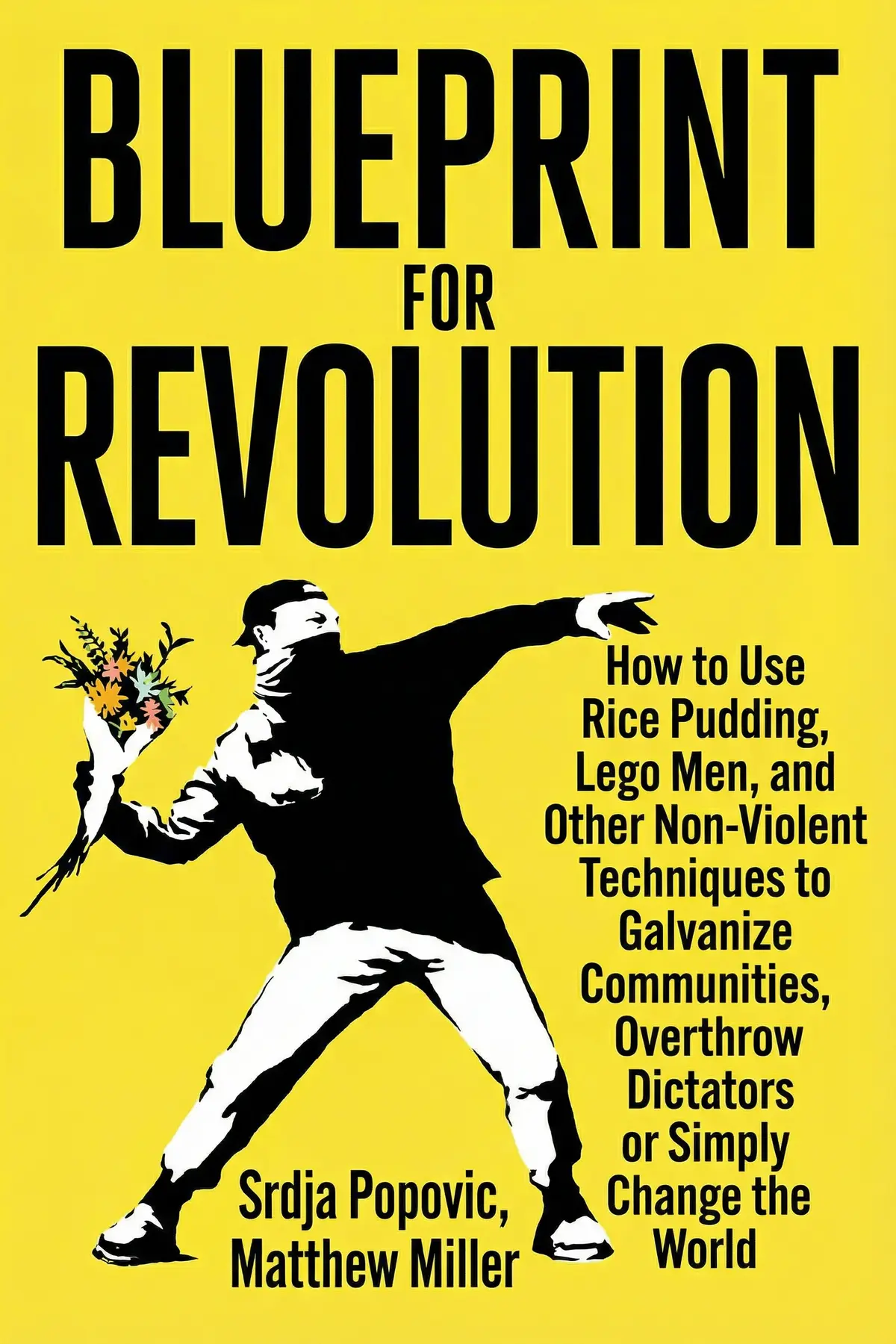
Table of Content
1. Introduction
1 min 24 sec
When we hear the word revolution, our minds often jump to scenes of violent clashes, smoke-filled streets, and armed soldiers. We tend to think of massive shifts in power as events born from blood and steel. However, history tells a different and much more hopeful story. From the legendary efforts of Gandhi in India to the collapse of the Milošević regime in Serbia, some of the most significant transformations in human history haven’t come from the barrel of a gun, but from the power of nonviolent strategy.
This isn’t just about being peaceful or taking the moral high ground. It is about being smarter than the opponent. It is about understanding the mechanics of power and knowing exactly where to apply pressure so that the entire system begins to crack. In this exploration, we are going to dive into the toolkit used by activists who have successfully stared down dictators and won.
We will look at how seemingly insignificant battles can lead to massive momentum, how humor can be a weapon more terrifying to a tyrant than an army, and why the most effective revolutions are the ones that invite everyone—from children to grandparents—to participate. This is a throughline of strategic planning, where the goal isn’t just to fight against something, but to build a compelling vision for what comes next. Whether you are looking to change your local community or challenge a national injustice, these proven techniques offer a blueprint for making the impossible happen.
2. The Power of Starting Small
2 min 16 sec
Big changes rarely start with grand gestures. Discover how picking minor, winnable battles can build the momentum necessary to eventually take down a giant.
3. Creating an Irresistible Future
1 min 59 sec
A movement needs more than just a list of grievances. Explore why a positive, inclusive vision of the future is the ultimate catalyst for long-term social change.
4. Dismantling the Pillars of Power
1 min 54 sec
Every regime depends on specific supports to stay standing. Learn how to identify and neutralize these ‘pillars’ to make a system collapse from within.
5. Laughter as a Revolutionary Weapon
2 min 08 sec
Humor is the one thing a dictator cannot control. See how pranks and satire can shatter the aura of fear that keeps oppressive regimes in place.
6. The Strategic Use of the Backfire Effect
2 min 07 sec
When a regime uses violence, it often expects to crush dissent. Instead, discover how brutality can actually accelerate the downfall of the oppressor.
7. Why Peace Beats War Every Time
1 min 58 sec
Data shows that nonviolent revolutions are significantly more successful than armed struggles. Uncover the reasons why peace is the most effective strategy.
8. Conclusion
1 min 30 sec
In the end, the message of this blueprint is one of immense empowerment. Revolution is not an unpredictable storm that simply happens to people; it is a craft that can be learned, practiced, and mastered. We have seen that the most powerful tools in the world aren’t weapons of destruction, but the tools of human connection and clever strategy. By starting with small, winnable goals, activists can build the confidence and momentum needed for larger victories. By holding onto a positive, inclusive vision, they can inspire a nation.
We have explored how humor can strip away the power of fear and how understanding the pillars that support a regime allows us to dismantle it from the bottom up. Most importantly, we have seen that nonviolence is not a sign of weakness, but the ultimate expression of strength. It is a more inclusive, more effective, and more sustainable way to create lasting change.
What this means for you is that you don’t need permission to start making a difference. You don’t need a massive budget or a military background. You just need a clear vision, a bit of creativity, and the willingness to stand together with your community. Whether you are fighting for a cleaner park, better healthcare, or a more just government, the principles of nonviolent struggle remain the same. Start small, stay creative, and remember that when ordinary people organize, they become an unstoppable force. The blueprint is in your hands; now it is time to build.
About this book
What is this book about?
Have you ever wondered how a group of students or ordinary citizens can topple a powerful dictator without using any violence? This summary breaks down the tactical brilliance behind successful nonviolent movements. It moves beyond the idealistic notion of peaceful protest and gets into the gritty, strategic reality of how change actually happens. The promise of this work is that anyone, anywhere, can learn the mechanics of revolution. By shifting the focus from brute force to clever psychological and social strategies, the text illustrates how tiny acts—like sharing a bowl of rice pudding or placing a painted barrel in the street—can be more effective than a thousand guns. It provides a roadmap for identifying the structural weaknesses of an opponent and building a movement that is too large and too creative to be suppressed.
Book Information
About the Author
Srdja Popovic
Srdja Popovic is a prominent Serbian activist who rose to international recognition as a leader in the Otpor! movement. This student-led organization was instrumental in the nonviolent struggle that eventually toppled the Serbian dictator, Slobodan Milošević.
Ratings & Reviews
Ratings at a glance
What people think
Listeners consider this work an excellent manual for enacting meaningful transformation via nonviolent means, while one listener emphasizes its battle-tested techniques. Furthermore, the prose is delivered with sharp wit, and listeners characterize it as both an entertaining and thought-provoking experience. They also value its uplifting message, as one listener points out its potential to help improve and impact the lives of millions of people. The humor throughout is highly regarded; one listener mentions how it weaves comedy into activism, and another calls it a hilarious handbook for effectively engaging large adversaries.
Top reviews
Audrey
Picked this up after seeing a documentary on Otpor!, and it is just as engaging as the history itself. Popovic turns the daunting task of toppling a dictator into something that feels manageable, almost like a marketing campaign for freedom. The way he describes using humor—what he calls 'laughtivism'—to make the police look ridiculous is pure genius. It’s not just theory; these are battle-tested tactics from Serbia to the Maldives. The writing is incredibly punchy and avoids the dry, academic tone you usually find in political science books. I loved the emphasis on 'small wins' to build momentum. It makes the idea of change feel accessible to anyone, not just hardened activists. If you want to understand how David can actually beat Goliath in the modern world, this is your handbook.
Show moreKevin
Finally got around to reading this, and it’s easily one of the most stimulating books on my shelf. It takes the heavy subject of revolution and injects it with a much-needed dose of optimism and humor. Popovic proves that you don’t need a weapon to change the world; you just need a better plan and a sense of irony. The stories about the 'toy revolution' in Russia or the cottage cheese protests in Israel were eye-opening. It’s essentially a field guide for making an impact without losing your humanity in the process. The prose is light and conversational, making it a very quick read. The strategic insights here are applicable to more than just politics—they’re about leadership and organization in general. A must-read for anyone tired of feeling powerless.
Show morePaiboon
Wow, this was such an inspirational and surprisingly hilarious handbook for anyone looking to make a difference. Popovic has this incredible ability to make you feel like you’re sitting in a café with him, plotting ways to make a dictator’s life miserable through pranks. The focus on 'laughtivism' is a game-changer because it takes the fear out of the equation. When you can laugh at your oppressor, they lose their power over you. The book is filled with these little 'aha!' moments that shift your perspective on what activism looks like. It’s not just about shouting; it’s about being smarter than the adversary. This isn't just a political book; it’s a manual for creative problem-solving and community building. I finished it feeling empowered and ready to tackle the issues in my own neighborhood.
Show moreSomsak
Truth is, this book completely changed how I view political engagement. I used to think that real change required massive, dramatic gestures, but Popovic shows that it’s the small, humorous, and consistent actions that actually win the day. His 'blueprint' is a masterpiece of psychological warfare that prioritizes the safety of the activists while maximizing the embarrassment of the regime. The stories of Pussy Riot and the Syrian activists were particularly moving. This is a handbook for effectively engaging large adversaries without becoming the very thing you're fighting against. The humor throughout makes it feel like a call to action rather than a lecture. It’s rare to find a book that is both this practical and this enjoyable to read. Highly recommended for any modern-day 'hobbit' looking to take down Sauron.
Show moreIsabella
After hearing about Srđa Popović’s work with CANVAS, I had high expectations for this book, and it did not disappoint. It’s a brilliant mix of memoir and strategy that highlights how ordinary people can accomplish extraordinary things. The writing is sharp, funny, and deeply human. One of my favorite takeaways was the idea that you don't need to be a hero to participate; you just need to care enough to show up. The strategies are proven and practical, focusing on how to maintain nonviolent discipline even under pressure. It’s an essential read for anyone who wants to improve the lives of others but doesn't know where to start. This book is a ray of light that proves that hope is a more effective weapon than anger.
Show moreSam
Ever wonder why some protests result in massive change while others just fizzle out? This book offers a compelling explanation by treating nonviolent resistance as a strategic discipline rather than just a moral stance. Popovic and Miller write with a sharp, witty edge that keeps the pages turning, though some might find the pop culture references a bit frequent. The core idea—that you have to make revolution fun to get people involved—is transformative. He breaks down the pillars of support that keep regimes alive and shows exactly how to chip away at them. While I think he oversimplifies some complex geopolitical factors, the practical advice on branding and unity is gold. It’s a refreshing take that moves away from the 'angry protester' trope toward something much more clever and effective.
Show moreIce
As someone who grew up studying Gandhi and King, I found Popovic’s modern update to those philosophies incredibly relevant for the social media age. He strips away the saintly aura of nonviolence and treats it as a tactical advantage. He argues that violence is exactly what the 'big man' wants, so you have to deny him that and fight on your own terms. The book is packed with proven strategies that emphasize the importance of unity and discipline. I did find the dismissal of certain historical nuances a bit frustrating, but the energy of the book is infectious. It’s a fun, quick read that reminds us that ordinary people hold the real power if they know how to organize. Even if you don't plan on starting a revolution, the sections on communication and 'branding' a movement are incredibly insightful.
Show moreCha
Look, I’ll be direct: I didn't think a book about revolution could be this much fun. The authors managed to take a subject that is usually depressing and turn it into something witty and hopeful. The way they explain how to identify 'pillars of support' is genuinely brilliant and makes so much sense. It turns out that change isn't just about passion; it's about cold, hard strategy. I appreciated the various examples from different countries, though some felt a bit more fleshed out than others. The writing is accessible and avoids jargon, which I really appreciated. It’s a stimulating read that challenges the idea that violence is the only way to get things done. A few parts felt a bit oversimplified, but the overall message is powerful.
Show moreAiden
Not what I expected, to be perfectly frank. While the anecdotes about the Otpor! movement are fascinating and the emphasis on nonviolence is noble, the book feels a bit like a 'Revolution for Dummies' manual that skips over the messy parts. Popovic tends to ignore the massive role of external factors and complex international relations that helped his cause. He frames everything as if a few clever jokes and stickers can take down a regime, which feels a little naive when looking at more brutal dictatorships. Also, the writing style tries a bit too hard to be 'cool' and 'funny,' sometimes bordering on condescending. It’s a great memoir of a specific time and place, but as a universal blueprint? I have my doubts. It’s worth reading for the tactics, but take the success stories with a grain of salt.
Show moreRatchada
The chapter on 'laughtivism' was definitely the highlight for me, but the rest of the book was a bit of a mixed bag. On one hand, the tactical advice is very practical and grounded in real-world experience. On the other, the tone can be quite repetitive, and the author’s ego definitely shines through in a way that’s a bit off-putting. He presents his methods as a universal 'blueprint,' yet many of the examples feel very specific to certain cultural contexts. I also felt that the gender dynamics and the role of women in these movements were largely glossed over, which is a major oversight. It’s a decent introductory guide for those new to activism, but it lacks the depth of a serious political analysis. Good for a plane ride, but don't expect a deep dive.
Show moreReaders also enjoyed
A Warning
Miles Taylor
Abolish Rent: How Tenants Can End the Housing Crisis
Tracy Rosenthal
Abortion: Our Bodies, Their Lies, and the Truths We Use to
Jessica Valenti

Adults in The Room: My Battle With Europe’s Deep Establishment
Yanis Varoufakis
21 Lessons for the 21st Century
Yuval Noah Harari
A Different Kind of Power: A Memoir
Jacinda Ardern
AUDIO SUMMARY AVAILABLE
Listen to Blueprint for Revolution in 15 minutes
Get the key ideas from Blueprint for Revolution by Srdja Popovic, plus 5,000+ more titles in English and Thai.
- 5,000+ titles
- Listen as much as you want
- 7-day free trial
- Cancel anytime







