
19 min 28 sec
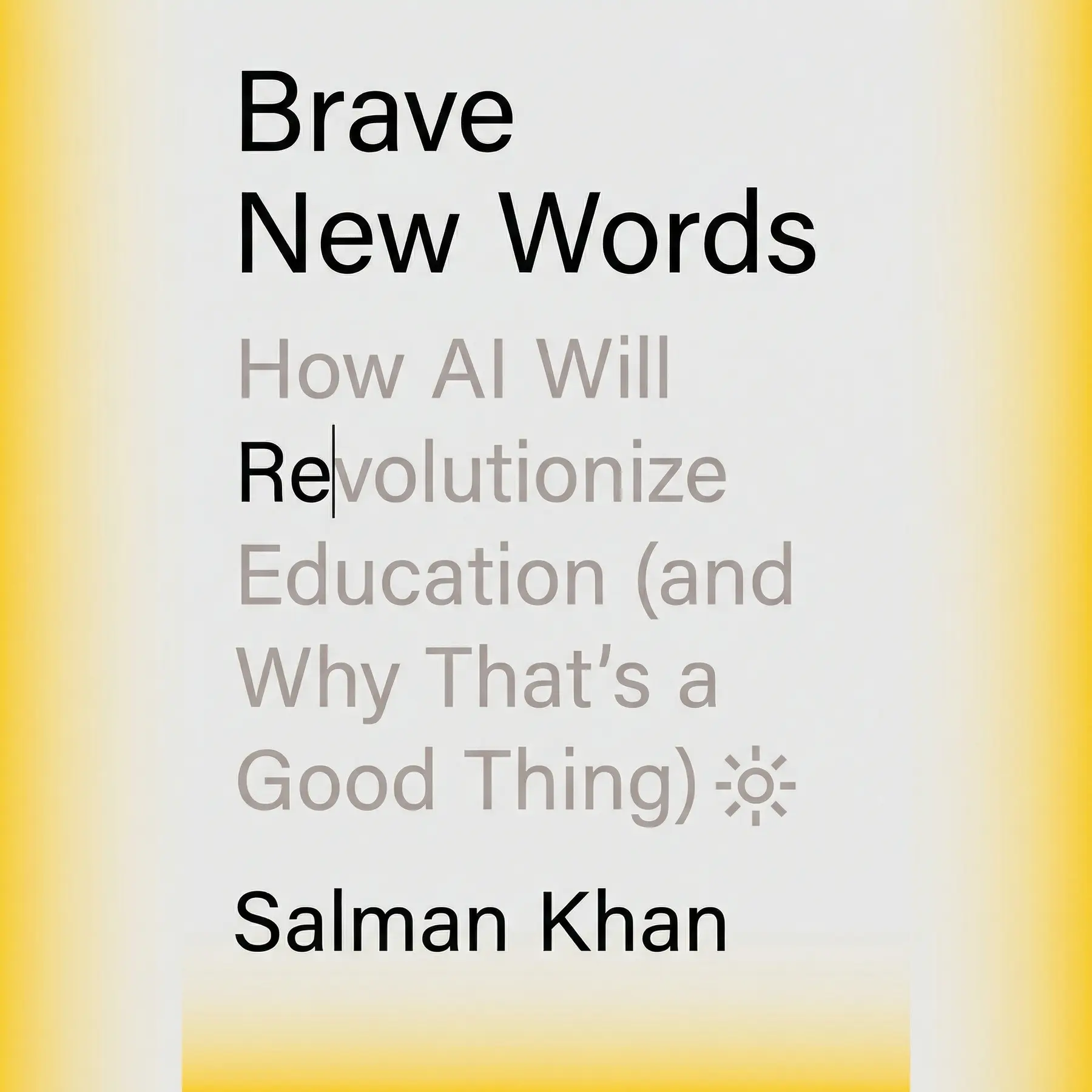
Brave New Words: How AI Will Revolutionize Education (and Why That's a Good Thing)
By Salman Khan
Explore the transformative power of artificial intelligence in education and beyond. Salman Khan offers a hopeful vision of how AI can personalize learning, empower workers, and accelerate scientific breakthroughs for everyone.
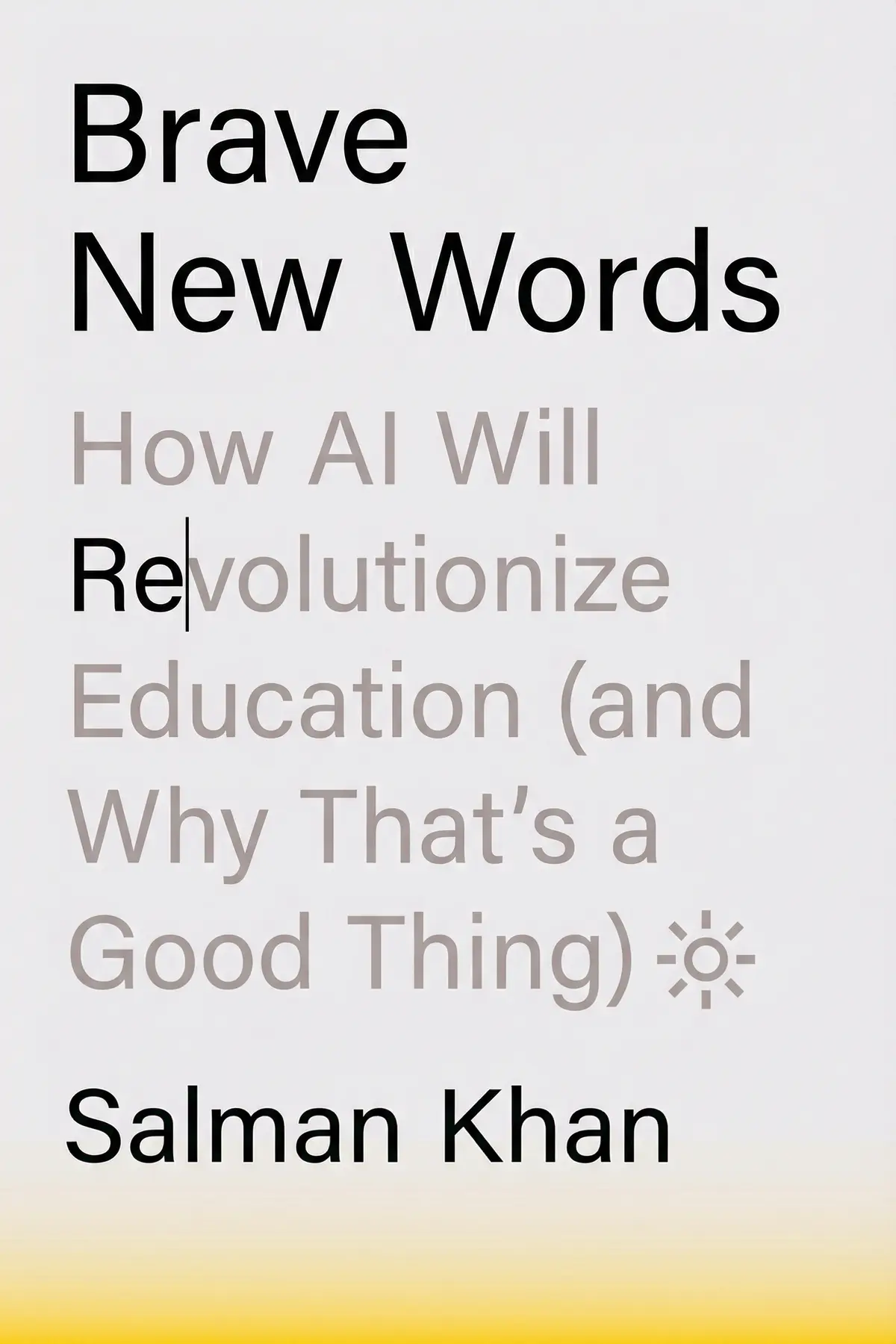
Table of Content
1. Introduction
2 min 04 sec
Think for a moment about the stories we usually tell regarding artificial intelligence. In many of them, the narrative is one of displacement or loss—machines taking over our roles, or perhaps even our lives. However, there is a much more hopeful perspective that suggests we are on the verge of a new era of human potential. In this exploration of the future, education pioneer Salman Khan invites us to look past the sensational headlines and see AI for what it truly can be: a tool that enhances our intelligence, broadens our access to knowledge, and solves some of the most persistent problems in society.
At the heart of this vision is the idea that the digital revolution doesn’t have to be a cold, mechanical process. Instead, it can be the very thing that makes our interactions more personal and our learning more human. For years, we have struggled with a one-size-fits-all model in schools and workplaces. We have accepted that individual attention is a luxury and that deep scientific breakthroughs take decades of painstaking labor. AI is changing those assumptions.
Through this summary, we will walk through the milestones of AI’s development and examine how it is ready to fundamentally rewire the classroom experience. We will see how it acts not as a replacement for human guidance, but as a supportive framework that lets students and teachers thrive. We will also look at the broader implications for the economy, healthcare, and global research. The throughline here is one of empowerment. It is about how we can use these ‘brave new words’ to write a better story for humanity, ensuring that the technology of tomorrow is used to lift up every individual, regardless of their starting point in life. Let’s begin by looking at how this technology grew from simple logic into the complex, conversational partner it is today.
2. The Decades-Long Evolution of Artificial Intelligence
2 min 25 sec
Artificial intelligence didn’t emerge overnight; discover the long history of neural networks and early triumphs that paved the way for today’s revolution.
3. Personalized Learning for Every Student
2 min 03 sec
Imagine a world where every child has access to a private, world-class tutor; see how AI is making this once-impossible dream a reality.
4. Redefining the Role of the Human Educator
1 min 51 sec
AI isn’t coming for the teacher’s job; it’s coming to free them from paperwork and provide the data they need to be better mentors.
5. Thriving in a New Economic Landscape
2 min 00 sec
As machines take over routine tasks, the most valuable skills in the workforce will be the ones that are most uniquely human.
6. The Transformation of Medicine and Healthcare
1 min 49 sec
From catching cancer earlier to creating custom drug treatments, AI is poised to usher in a new era of precision medicine.
7. Solving Global Challenges Through High-Speed Discovery
1 min 48 sec
Discover how AI is being used to tackle massive problems like climate change and the search for new sustainable materials.
8. Addressing the Ethical Frontier
1 min 53 sec
Technological progress is only half the battle; learn why we must proactively design AI to be fair, private, and unbiased.
9. The Path Forward: Proactive Engagement
1 min 47 sec
Don’t just watch the future happen; explore why active participation and lifelong learning are the keys to a successful AI-driven era.
10. Conclusion
1 min 48 sec
As we look back at the journey we’ve taken through Salman Khan’s vision, one thing becomes clear: the arrival of artificial intelligence is not an end, but a beginning. It represents a fundamental shift in how we approach the most basic elements of human life—how we learn, how we work, and how we care for one another. We have seen how AI can finally break the mold of standardized education, giving every child the personalized attention they need to succeed. We have explored how it can liberate us from the repetitive tasks of the workplace, allowing us to focus on the empathy and creativity that define our species. And we have glimpsed a future where scientific and medical breakthroughs happen at a speed that was once unimaginable.
However, the promise of this ‘Brave New World’ comes with a responsibility. We must be the architects of this change, ensuring that ethics, fairness, and privacy are not afterthoughts but the very foundation of the systems we build. This transition requires us to be active participants rather than passive consumers. It demands that we stay curious and that we continue to invest in our own growth, even as our tools become more capable.
The throughline of this summary is hope. AI has the potential to be the ultimate equalizer, providing world-class resources to the underserved and tackling global crises that have long seemed insurmountable. By embracing these tools with a critical eye and a compassionate heart, we can ensure that the technology of the future doesn’t diminish our humanity—it amplifies it. The tools are in our hands; now, it is up to us to use them to build a world where everyone has the opportunity to thrive.
About this book
What is this book about?
This summary explores the central arguments of Salman Khan’s vision for an AI-enhanced world. It moves past the typical fears of a machine-led future to showcase how technology can actually make us more human. The core promise is a radical shift in education, where every student has a world-class tutor, and every teacher is empowered with deep insights into their students' needs. Beyond the classroom, the book details the way AI is already reshaping professional life, healthcare, and scientific research. It emphasizes that while machines will handle routine tasks, human qualities like empathy, creativity, and ethical reasoning will become our most valuable assets. It serves as both a roadmap for the coming technological revolution and a guide on how to prepare for the unique challenges and opportunities it brings.
Book Information
About the Author
Salman Khan
Salman Khan is an educator, entrepreneur, and the founder of Khan Academy, a free online learning platform. He’s been recognized as one of TIME's 100 Most Influential People and is also the author of The One World Schoolhouse: Education Reimagined.
Ratings & Reviews
Ratings at a glance
What people think
Listeners consider the book an essential guide for teachers navigating the era of AI, with one listener pointing out its special capacity for connecting disparate ideas. Furthermore, the text is accessible and functional; one listener even characterizes it as an influential Socratic tool. Listeners also value the work's hopeful tone, with one noting that it provides a bright alternative to typical grim forecasts about artificial intelligence. The caliber of the writing is highly regarded, with one listener depicting the author as a superb storyteller.
Top reviews
Pop
Ever wonder how AI could actually help students instead of just helping them cheat? Salman Khan provides a refreshing, deeply optimistic roadmap that feels like a necessary antidote to all the doom-scrolling we’ve been doing lately. He paints a picture of a world where every child has a personal Socratic tutor, making elite-level education accessible to the masses. Truth is, his storytelling is masterful, turning complex technical concepts into something that feels both practical and profoundly human. While some might see it as an advertisement for his own platform, I found the specific experiments with Khanmigo to be the most enlightening parts of the text. It’s not just theory; it’s a peek into a future that’s already being built. If you’re an educator feeling overwhelmed by the rise of GPT, this book will give you the language and the hope to navigate the coming years.
Show moreSiriphen
Picked this up because I’ve always admired Khan Academy, and I wasn't disappointed by the vision presented here. This isn't just a book about technology; it’s a book about how we can leverage that technology to unlock human potential. Sal Khan addresses the fear of plagiarism head-on and shows how AI can actually be used to foster deeper critical thinking. Truth is, his optimism is infectious, and we need more voices like his in a room full of doomsday prophets. The specific examples of transcripts between the AI and students are brilliant, showcasing the Socratic method in action. It’s a powerful, easy-to-read guide that makes the complex world of generative AI feel manageable. Highly recommended for anyone who wants to see how we can use these new tools for good.
Show moreGoy
Frankly, we need more books that focus on the 'best-case' scenarios instead of just scaring everyone about the robot uprising. Salman Khan has written a manifesto for the AI age that is both grounded in his experience with Khan Academy and soaring with ambition. He doesn't just tell us AI is good; he shows us how it can act as a personal tutor, a creative partner, and a guide for lifelong learning. The writing is top-notch, clearly the work of someone who knows how to explain difficult concepts to a wide audience. I was particularly moved by the idea of AI helping to facilitate family conversations and bridge educational gaps for underprivileged kids. While it is certainly pro-AI, the arguments are well-constructed and feel like a direct response to the pessimism of our times. It’s an essential, light-filled read.
Show moreLena
As someone who has taught in public schools for a decade, I found the chapters on the Socratic method particularly compelling. Sal Khan argues that generative AI doesn't have to replace the teacher; rather, it acts as a tireless assistant that can handle the rote tasks. Personally, I think his vision of 'mastery for all' is beautiful, even if it feels a bit utopian at times. The writing is incredibly accessible, moving quickly through various use cases from therapy to job applications. There are moments where the optimism feels slightly forced, especially regarding how AI might handle bias in hiring, but the core message remains powerful. It’s a bridge between the tech world and the classroom that we desperately need right now. Even if you don't use Khan Academy, the philosophical questions he raises about the purpose of learning are worth the price of admission.
Show moreVilaiporn
Finally got around to finishing this, and I’m actually feeling quite energized about the future of pedagogy. Salman Khan has a unique ability to bridge the gap between technical jargon and practical classroom application. He describes AI as a tool for human potential, rather than a replacement for human intellect, which is a breath of fresh air. I particularly enjoyed the section on how AI can help parents monitor progress without it feeling like a burden or an interrogation. Gotta say, his storytelling makes the prospect of a 'Star Trek' utopia feel almost within reach. My only real gripe is that he glosses over the potential for AI to further widen the inequality gap if access isn't truly democratized. Still, it’s a masterful piece of writing that every forward-thinking administrator should have on their shelf.
Show moreOak
The chapter on the future of work alone makes this book a mandatory read for college students and recent grads. Sal Khan does a great job of explaining why AI literacy will be the defining skill of the next generation. Personally, I liked the way he refutes common counterarguments by comparing the potential risks of AI with the very real flaws of our current status quo. It’s a clever technique that forces you to think more comprehensively about the issues. My main concern remains the 'dopamine-infused allure' of social media—AI can be a great tutor, but it still has to compete for a teenager's attention. Even so, the book provides a valuable perspective that is often missing from the mainstream headlines. It’s a hopeful, practical, and highly engaging look at the road ahead.
Show moreAudrey
After hearing so much buzz about Sal Khan’s latest, I walked away feeling conflicted but ultimately glad I read it. The book is structured into short, digestible chapters that make it a very quick read, even if you’re in a bit of a reading slump. I appreciated the transparency regarding the OpenAI partnership, though it does make the whole narrative feel incredibly biased toward a specific corporate vision. He makes a valid point that if 'good' people don't engage with AI, then the 'bad' folks will surely win. However, I kept waiting for a deeper dive into the environmental costs or the long-term impact on human-to-human communication. To be fair, it’s a great conversation starter for school boards, but it shouldn’t be the only book you read on the subject. It’s a solid 3-star effort that succeeds as a manifesto but falters as an objective study.
Show moreBam
Not what I expected, but still quite useful for getting a handle on where the industry is heading. The book is essentially an optimistic 'how-to' guide for embracing GPT-4 in educational settings. While it’s definitely 'jualan' (selling) his own platform, Khan’s perspective as a major stakeholder is undeniably important. He explains how AI can provide the kind of personalized tutoring once reserved only for the wealthy. To be fair, I found the arguments about AI being less biased than human HR recruiters to be fascinating, even if I’m not entirely convinced yet. The prose is clean and direct, though it does get repetitive when he brings up Khanmigo for the hundredth time. It’s a practical tool for anyone looking to imagine the best-case scenarios for our future. Just take the corporate enthusiasm with a grain of salt.
Show moreMind
This book felt more like a 250-page brochure for Khanmigo than a serious exploration of artificial intelligence. Look, I have immense respect for what Sal Khan has done for global education, but the level of corporate 'deslumbramiento' here is almost blinding. He brushes off legitimate concerns about screen time, social media dopamine loops, and the digital divide with a wave of his hand. It’s frustrating because the arguments often feel like Swiss cheese—full of holes and based on the best-case scenarios rather than the messy reality of a modern classroom. I was expecting a nuanced debate about the ethics of AI, but instead, I got a declaration of faith supported by Silicon Valley giants. Frankly, it lacks the critical distance needed to be truly useful for skeptical parents or policymakers.
Show moreGame
Wow. I haven’t been this disappointed by a book in a very long time. It’s basically a long-form advertisement that even an AI would find derivative and uninspired. Khan ignores the very real dystopian elements of AI that are already affecting us today, like the 'black-box' algorithms used in hiring. Not gonna lie, reading this felt like being trapped in a sales pitch for a product that hasn’t even solved the basic problem of student engagement. Will kids actually talk to a bot for hours to learn math when TikTok is one swipe away? He doesn’t have a real answer for that. It’s a shallow, one-sided take on a technology that deserves a much more rigorous and critical analysis than what’s provided here.
Show moreReaders also enjoyed
AUDIO SUMMARY AVAILABLE
Listen to Brave New Words in 15 minutes
Get the key ideas from Brave New Words by Salman Khan, plus 5,000+ more titles in English and Thai.
- 5,000+ titles
- Listen as much as you want
- 7-day free trial
- Cancel anytime







